- Animals
- ›Chordates
- ›Vertebrates
- ›Mammals
- ›Therians
- ›Placental Mammals
- ›Ungulates, Carnivorans, and Allies
- ›Bats
- ›Yinpterochiroptera
- ›Pteropodoidea
- ›Old World Fruit Bats
- ›Flying-foxes, Monkey-faced Bats and allies
- ›Flying-foxes and allies
- ›Pteropus
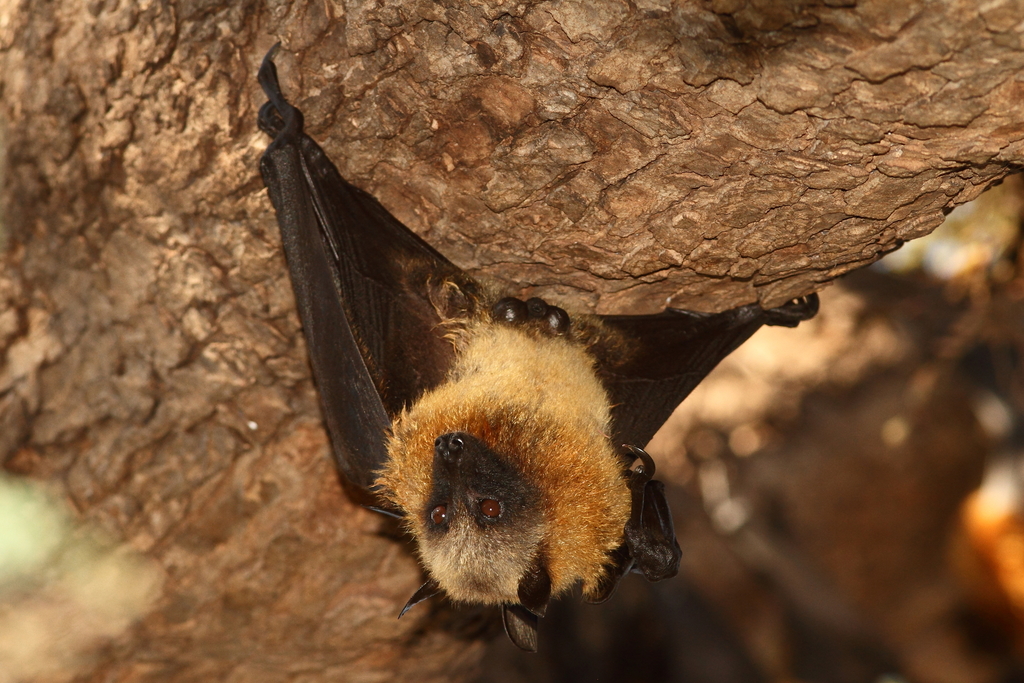
Madagascan Flying-fox
Pteropus rufus
The Madagascan flying fox, Madagascar flying-fox, or Madagascar fruit bat (Pteropus rufus) is a species of megabat in the genus Pteropus. It is endemic to Madagascar. Its natural habitats are diverse, and include moist lowland forests, dry forests, succulent woodlands, and spiny thickets, and mangroves. It eats figs and other fruits, flowers, and leaves. It is threatened by habitat loss.
From the article Madagascan flying fox on Wikipedia (CC BY-SA), quoted section by section
Description
This is the largest bat in Madagascar, with a body length of 23.5–27 cm (9.3–10.6 in), a wingspan of 100–125 cm (39.5–49 in), and a body weight of 500–750 g (1.10–1.65 lb). Madagascan flying fox species have a brown color and the area on their chest and shoulders have a golden to slightly dark brown color. Its wings have a grey to black color, and both male and female Madagascan flying foxes look alike in appearance, but it is noted that the male has a slightly larger head than the females.
Range & habitat
The Madagascan flying fox is one of the most common bat species on Madagascar and is found in all parts of the island except the central highland region, ranging from sea level to 1,200 meters elevation.
Wikipedia: “Distribution”
What it does
The Madagascan flying fox roosts during the day in large trees in colonies of up to 1000 individuals although 400 is a more normal number. The bats are noisy and easily disturbed, and if roused, the whole colony may move off to an alternative roost site. Most roosts are in isolated trees in degraded areas. The diet mainly consists of fruit juice which is squeezed from the fruit in the mouth. In the process many seeds are swallowed and dispersed to other areas as they pass through the animal's gut. Other tree products are also eaten, including leaves, flowers and nectar. It has been observed to visit the flowers of the kapok tree Ceiba pentandra and it is believed to pollinate this tree.
Wikipedia: “Ecology”
Listen
Looking for field recordings…
Where it lives
Recorded sightings
—
geo-referenced records in GBIF, from museums, herbaria and field observers.
Drag the globe to turn it. Dots are where records exist, not a range map; darker means more records.
In the stacks
Searching the stacks…
Every page naming Pteropus rufus in the Biodiversity Heritage Library →
This page is assembled live from iNaturalist, GBIF, Wikipedia, the Source Library and the Internet Archive. It is not yet part of the hand-edited codex. iNaturalist taxon 40874.