- Animals
- ›Chordates
- ›Vertebrates
- ›Mammals
- ›Therians
- ›Placental Mammals
- ›Ungulates, Carnivorans, and Allies
- ›Bats
- ›Yinpterochiroptera
- ›Pteropodoidea
- ›Old World Fruit Bats
- ›Flying-foxes, Monkey-faced Bats and allies
- ›Flying-foxes and allies
- ›Pteropus
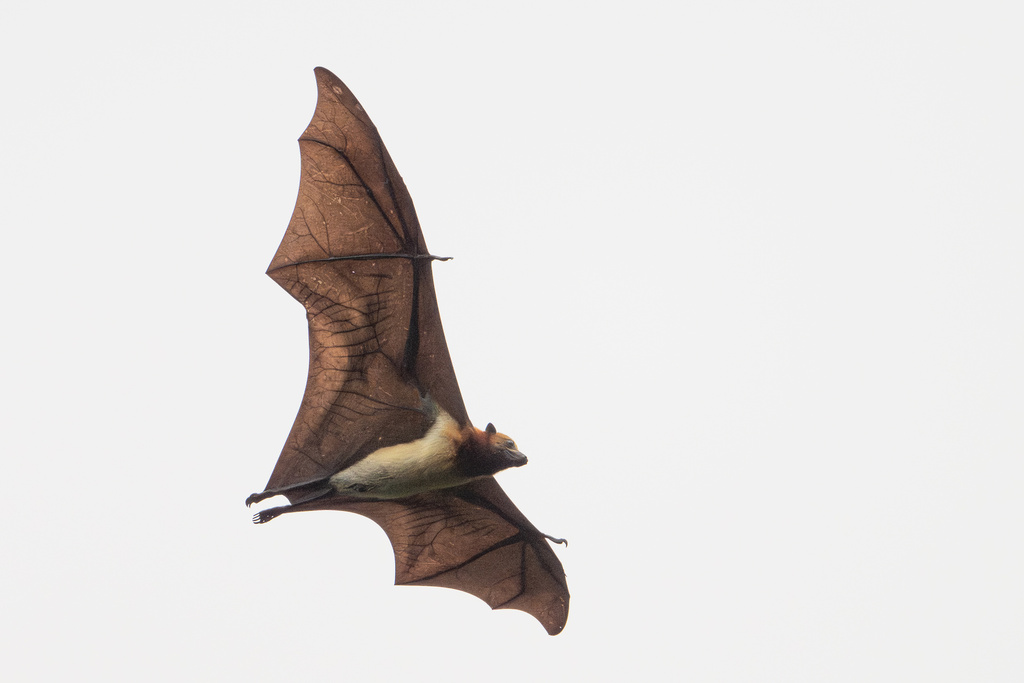
Black-bearded Flying-fox
Pteropus melanopogon
The black-bearded flying fox (Pteropus melanopogon) is an endangered species of megabat in the Pteropus genus. It is endemic to Indonesia, found on the islands of Ambon, Buru, Seram, Banda, and Yamdena. Currently considered monotypic, it formerly included the Aru flying fox and Kei flying fox as subspecies.
From the article Black-bearded flying fox on Wikipedia (CC BY-SA), quoted section by section
Description
Adults weigh approximately 510–900 g (1.12–1.98 lb). It is one of the heavier species of its family, based on the few individuals that have been weighed. The fur is dark red on its brow, face, between the eyes, and under the jaw. On its head, neck, shoulders, and ventral side, it is bright reddish brown. Individual hairs are bicolored, with the base of the hair pale and yellowish while the tip is darker. Its dorsal surface is dark brown, with bright yellow hairs sparsely throughout. The uropatagium is covered with long, dark brown fur. Its forearm is approximately 175–193 mm (6.9–7.6 in) long. Its ears are shorter than its muzzle. While in many species of bats the wings attach to the sides of the body, in this species, the wings attach closer to the spine. The legs and forearms lack fur. The baculum is 9.45 mm (0.372 in) long. It has a robust skull compared to other members of its genus.
Range & habitat
It is endemic to the Maluku Islands, which are a part of Indonesia. The only known remaining colony roosts in mangrove forests on Seram Island. In the past, its range included Ambon Island, Buru, Banda Islands, and Yamdena, though there are no recent observations on any of these islands.
Wikipedia: “Range and habitat”
In human culture
It was described in 1867 by German naturalist Wilhelm Peters based on an individual in the collection of Hermann Schlegel. Its species name comes from the Neo-Latin melanin, which is derived from Ancient Greek "mélas", meaning "black", and Ancient Greek pṓgōn, meaning "beard". As the genus Pteropus is speciose, it is divided into closely related species groups. The black-bearded flying fox is identifier of the melanopogon species group, which also includes the following species:
Aru flying fox (Pteropus aruensis) Kei flying fox (Pteropus keyensis)
Wikipedia: “Taxonomy and etymology”
Listen
Looking for field recordings…
Where it lives
Recorded sightings
—
geo-referenced records in GBIF, from museums, herbaria and field observers.
Drag the globe to turn it. Dots are where records exist, not a range map; darker means more records.
In the stacks
Searching the stacks…
Every page naming Pteropus melanopogon in the Biodiversity Heritage Library →
This page is assembled live from iNaturalist, GBIF, Wikipedia, the Source Library and the Internet Archive. It is not yet part of the hand-edited codex. iNaturalist taxon 40897.