- Animals
- ›Chordates
- ›Vertebrates
- ›Mammals
- ›Therians
- ›Placental Mammals
- ›Ungulates, Carnivorans, and Allies
- ›Bats
- ›Yangochiroptera
- ›Noctilionoid Bats
- ›New World Leaf-nosed Bats
- ›Stenodermatine Bats
- ›Stenodermatini
- ›Artibeus
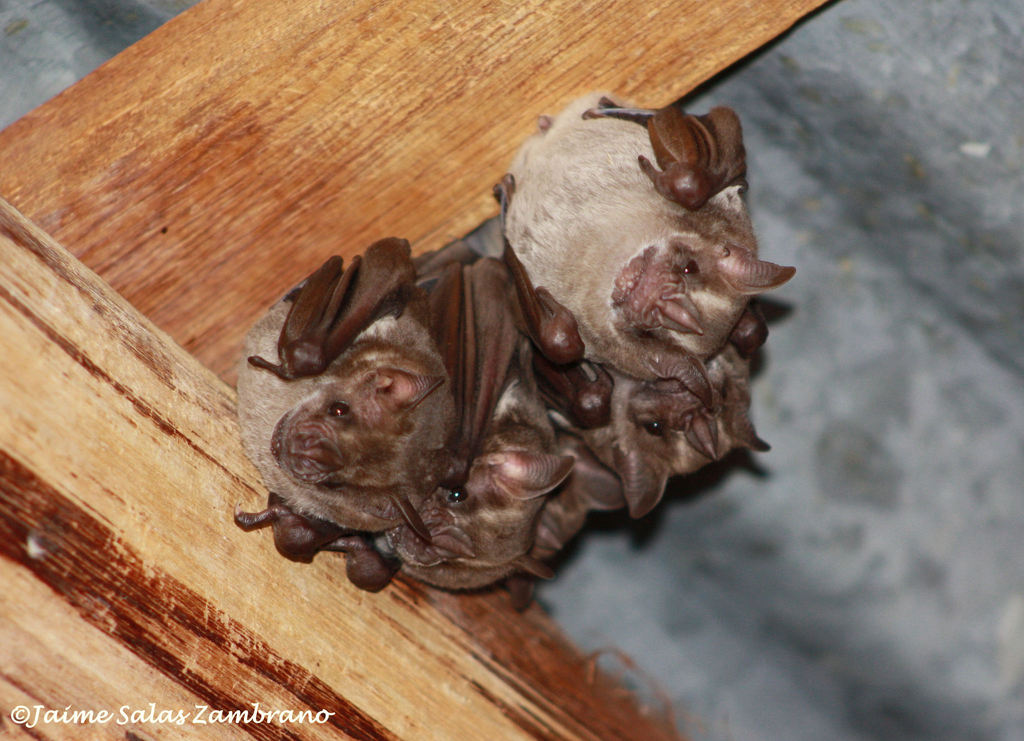
Fraternal Fruit-eating Bat
Artibeus fraterculus
The fraternal fruit-eating bat (Artibeus fraterculus) is a species of bat in the family Phyllostomidae that is found in drier habitats in Ecuador and Peru. It was formerly considered to be a subspecies of the Jamaican fruit bat, but was raised to species level in 1978. The smallest species in the group of large Artibeus (a group that also includes the Jamaican fruit bat, flat-faced fruit-eating bat, and great fruit-eating bat), it has a forearm length of 52–59 mm (2.0–2.3 in), a total length of 64–76 mm (2.5–3.0 in), and a weight of 30–55 g (1.1–1.9 oz).
It is a generalist frugivore, feeding on a variety of fruit and supplementing its diet with insects. It breeds in both the wet and dry season, with parturition (birth of young) peaking in February and May. The only known predator is the barn owl, although it may also be hunted by other birds of prey and the spectral bat. It is parasitized by species of streblid bat flies, mites, and protozoans.
From the article Fraternal fruit-eating bat on Wikipedia (CC BY-SA), quoted section by section
Description
The fraternal fruit-eating bat is the smallest species of large Artibeus (a group that also includes the Jamaican fruit bat, flat-faced fruit-eating bat, and great fruit-eating bat), with a forearm length of 52–59 mm (2.0–2.3 in) and total length of 64–76 mm (2.5–3.0 in). Adults weigh 30–55 g (1.1–1.9 oz). It is the palest South American Artibeus, and is similar in appearance to Anderson's fruit-eating bat, but smaller. It occurs in both grayish-brown and yellowish-brown color morphs. It has soft velvety fur, which is short on the back. The dorsal fur is dark gray to dark brown. The fur on the underside is pale and appears frosted due to the silvery-gray tip of each hair. The head is large with a relatively big snout and a large, well-developed, and elliptical noseleaf with a free horseshoe. The ears and noseleaf, along with the skin membrane on the forearm, tibia, metacarpals, and phalanges are pale brown, contrasting with the dark blackish patagium (wing membrane). The tragus (a projection in front of the ear) is gray to dark gray, while the feet and uropatagium (tail membrane) are dark brown. The propatagium extends to the first thumb phalanx, while the wing membrane extends to the base of the thumbs. The tail membrane has a slightly hairy central notch and the tail is absent. …
Range & habitat
The fraternal fruit-eating bat is found in Peru and Ecuador. In Peru, it is found west of the Andes in the Tumbes, Piura, Lambayeque, and Ica departments and in arid parts of the Amazon Basin in the Cajamarca and Amazonas departments. In Ecuador, it is found in the central and southern coastal areas, and in the southwestern foothills of the Andes. It inhabits forests, disturbed habitats, and agricultural and urban areas. It is most frequently found in mangrove forests, arid scrubland, and deciduous and semideciduous forests. It is also uncommonly found in wetter habitats. It has been recorded in humid montane scrub in Loja, Ecuador. It occurs at elevations between 0–2,145 m (0–7,037 ft). Throughout most of its range, the fraternal fruit-eating bat is sympatric with Anderson's fruit-eating bat and the great fruit-eating bat. It also co-occurs with many other species of bats, including endemics in the Tumbesian Center of Endemism, a region of the Andes with a proportion of endemic species. It roosts in hollow trees, shrubs, caves, termite mounds, bridges, churches, houses, gardens, and mines. The number of individuals roosting together can range from nine to hundreds of bats.
Wikipedia: “Distribution and habitat”
What it does
The fraternal fruit-eating bat is mainly a frugivore, feeding on a wide variety of fruit such as Ficus figs, mangoes, loquats, Brosimum alicastrum, Muntingia calabura, Psidium guajava, Syzygium jambos, Iochroma arborescens, Solanum crinitipes, Styrax subargentea, Cecropia obtusifolia, and Cecropia polystachya. It also supplements its diet with insects.
Wikipedia: “Diet”
Listen
Looking for field recordings…
Where it lives
Recorded sightings
—
geo-referenced records in GBIF, from museums, herbaria and field observers.
Drag the globe to turn it. Dots are where records exist, not a range map; darker means more records.
In the stacks
Searching the stacks…
Every page naming Artibeus fraterculus in the Biodiversity Heritage Library →
This page is assembled live from iNaturalist, GBIF, Wikipedia, the Source Library and the Internet Archive. It is not yet part of the hand-edited codex. iNaturalist taxon 40998.