- Animals
- ›Chordates
- ›Vertebrates
- ›Mammals
- ›Therians
- ›Placental Mammals
- ›Ungulates, Carnivorans, and Allies
- ›Bats
- ›Yangochiroptera
- ›Noctilionoid Bats
- ›New World Leaf-nosed Bats
- ›Stenodermatine Bats
- ›Stenodermatini
- ›Pygoderma
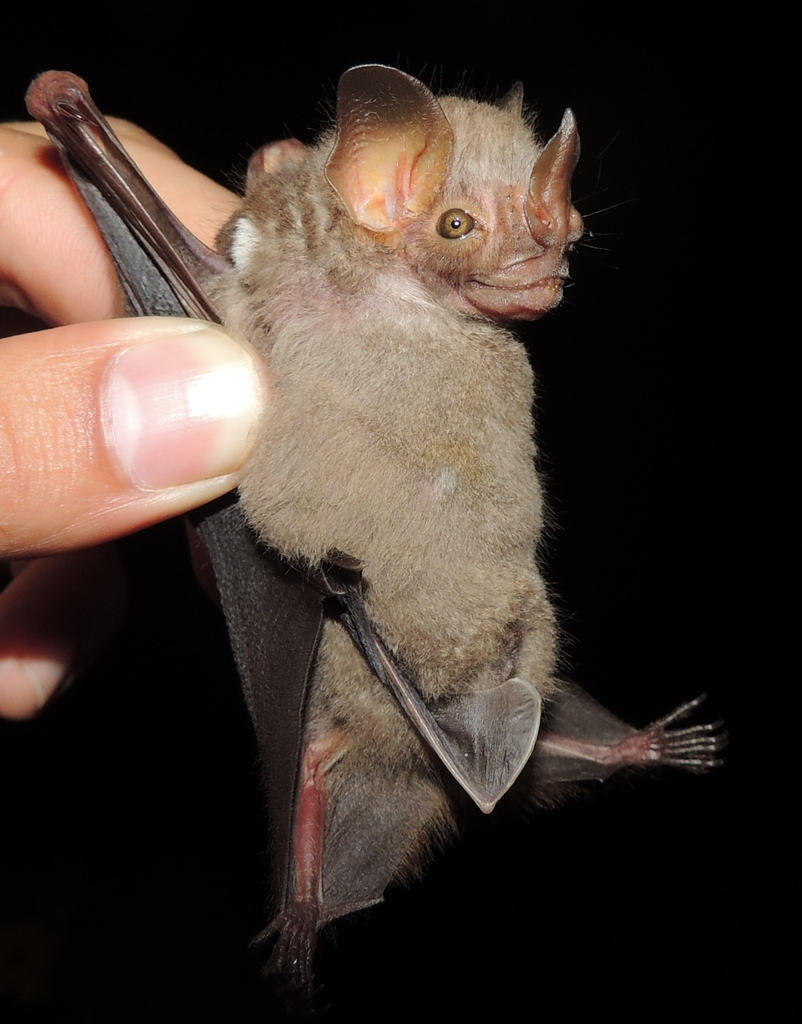
Ipanema bat
Pygoderma bilabiatum
The Ipanema bat (Pygoderma bilabiatum), is a bat species of order Chiroptera and family Phyllostomidae. It is found in South America, specifically in northern Argentina, Bolivia, southeastern Brazil and Paraguay. It is monotypic within its genus.
From the article Ipanema bat on Wikipedia (CC BY-SA), quoted section by section
Description
The Ipanema bat is a medium-sized bat which is brown-furred overall, with the exception of its white-furred shoulders. The fur of its back is a darker shade of brown than that of its chest. It has less fur on its shoulders and upper chest than on the rest of its body, particularly in males. Its rostrum is shorter and more square-shaped than other species of its subfamily, Stenodermatinae It has a large nose and no tail, with roundish ears having a small, 4–5 mm (0.16–0.20 in) tragus. Size varies based on sex and geographical location. Females tend to be larger than males. The skulls of Ipanema bats from Argentina and Bolivia are bigger than those of their counterparts in Paraguay and Brazil. P. bilabiatum typically has two molars. However, some females have a third molar (usually in the mandibular jaw) not seen in males. This may be correlated with the larger jaw size of females. While both males and females have glands below the jaw and surrounding the eyes, the glands in males are generally larger. Males also have forelimb swellings, which are not seen in females. The size and presence of such swellings varies geographically. Additionally, forelimb swellings appear to be correlated with development of the males' eye glands. Due to the dimorphism of forelimb swellings, It is thought that they could be correlated with mating behaviors.
Range & habitat
The Ipanema bat resides in northern Argentina, southeastern Brazil, Paraguay, and Bolivia. Their preferred habitats are tropical forests, subtropical forests, and secondary forests. Although atypical, they are sometimes found in the coastal shrublands of Brazil. This suggests that perhaps P. bilabiatum can expand its habitat into dryer, more sparsely vegetated areas.
Wikipedia: “Range and habitat”
What it does
Migration patterns may be influenced by rainfall amount and/or temperature. P. biliabatum appears to prefer regions with a minimum annual rainfall of 1,500 mm (59 in) and moderate temperatures of 16–23 °C (61–73 °F) Food availability and foraging capabilities seem to be an important factor in the timing and distance traveled during migration Females and males migrate differently. Males tend to linger in lower elevations, while females reside at intermediate and high elevations.
== References ==
Wikipedia: “Behavior”
Listen
Looking for field recordings…
Where it lives
Recorded sightings
—
geo-referenced records in GBIF, from museums, herbaria and field observers.
Drag the globe to turn it. Dots are where records exist, not a range map; darker means more records.
In the stacks
Searching the stacks…
Every page naming Pygoderma bilabiatum in the Biodiversity Heritage Library →
This page is assembled live from iNaturalist, GBIF, Wikipedia, the Source Library and the Internet Archive. It is not yet part of the hand-edited codex. iNaturalist taxon 41053.