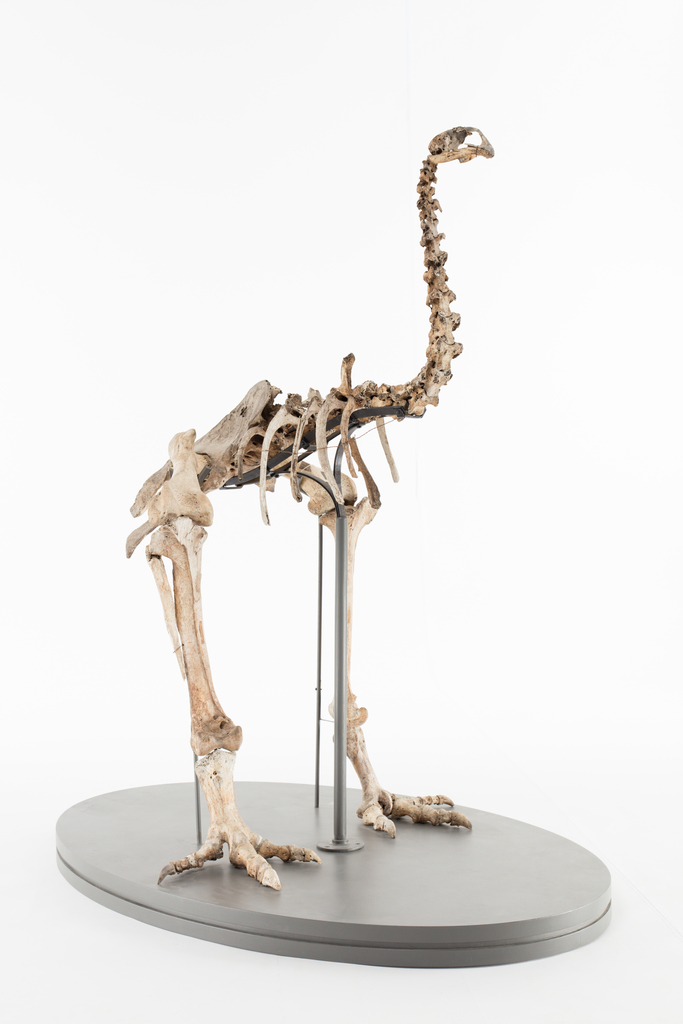
Heavy-footed Moa
Pachyornis elephantopus
The heavy-footed moa (Pachyornis elephantopus), or Moa waewae taumaha (Māori), is an extinct species of moa from the lesser moa family. The heavy-footed moa was widespread across the South Island of New Zealand, and inhabited lowland environments like shrublands, dunelands, grasslands, and forests. Moa are ratites, flightless birds with a sternum without a keel. They also have a distinctive palate.
The heavy-footed moa was about 1.8 m (5 ft 11 in) tall, and weighed as much as 145 kg (320 lb). Three complete or partially complete moa eggs in museum collections are considered eggs of the heavy-footed moa, all sourced from Otago. These eggs have an average length of 226 mm (8.9 in) and a width of 158 mm (6.2 in), making these the second-largest moa eggs, behind the single South Island giant moa egg specimen.
From the article Heavy-footed moa on Wikipedia (CC BY-SA), quoted section by section
Range & habitat
The heavy-footed moa was found only on the South Island of New Zealand. Their range covered much of the eastern side of the island, with a northern and southern variant of the species. P. elephantopus primarily inhabited lowland environments, preferring dry and open habitats such as grasslands, shrublands and dry forests. They were absent from sub-alpine and mountain habitats, where they were replaced by the crested moa (Pachyornis australis). During the Pleistocene-Holocene warming event, the retreat of glacial ice meant that the heavy-footed moa's preferred habitat increased in size, allowing their distribution across the island to increase as well.
Wikipedia: “Distribution and habitat”
What it does
Due to its relative isolation before the arrival of Polynesian settlers, New Zealand has a unique plant and animal community and, historically, had no native terrestrial mammals. Moa filled the ecological niche of large herbivores, filled by mammals elsewhere, until the arrival of the Polynesian settlers and the associated mammalian invasion in the 13th Century. The heavy-footed moa is thought to have been less common than other moa species, which is backed up by its less frequent occurrence in the fossil record. Until recently it was unknown what the diet of the heavy-footed moa consisted of, although the fact that it had a differently shaped head and beak when compared to related and contemporary moa species suggested that it had a different diet. It had been hypothesized that this was an adaptation for dealing with tougher vegetation, which would have been more abundant in its preferred dry and shrubby habitat. Specialising in different foods would have also allowed it to avoid competition with other moa species which may have shared part of its range. In 2007, Jamie Wood described the gizzard contents of a heavy-footed moa for the first time. Wood found evidence of 21 plant taxa which included Hebe leaves, various seeds and mosses as well as a large amount of twigs and wood, with some of the recovered fragments being of considerable size. …
Wikipedia: “Ecology and diet”
Listen
Looking for field recordings…
Where it lives
Recorded sightings
—
geo-referenced records in GBIF, from museums, herbaria and field observers.
Drag the globe to turn it. Dots are where records exist, not a range map; darker means more records.
In the stacks
Searching the stacks…
Every page naming Pachyornis elephantopus in the Biodiversity Heritage Library →
This page is assembled live from iNaturalist, GBIF, Wikipedia, the Source Library and the Internet Archive. It is not yet part of the hand-edited codex. iNaturalist taxon 410549.