- Animals
- ›Chordates
- ›Vertebrates
- ›Mammals
- ›Therians
- ›Placental Mammals
- ›Ungulates, Carnivorans, and Allies
- ›Bats
- ›Yangochiroptera
- ›Noctilionoid Bats
- ›New World Leaf-nosed Bats
- ›Stenodermatine Bats
- ›Stenodermatini
Ectophylla
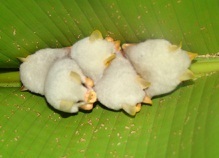
The Honduran white bat (Ectophylla alba), also called the Caribbean white tent-making bat, is a species of bat in the family Phyllostomidae. It is the only member of the genus Ectophylla. The genus and the species were both scientifically described for the first time in 1892. It has distinctive, entirely white fur, which is only found in six of the roughly 1,300 known species of bat. It constructs "tents" out of understory plant leaves by strategically cutting the leaf ribs with its teeth; it roosts in these tents during the day. It is a specialist frugivore, consuming almost exclusively the fruits of one species of fig. Females can likely become pregnant twice per year, giving birth to one offspring at a time.
It is found in Honduras, Nicaragua, Costa Rica and western Panama at elevations from sea level to 700 m (2,300 ft). Due to habitat loss, it is evaluated as near-threatened by the IUCN. Its bright yellow ears, nose-leaf, and lips are a result of carotenoid deposition; the mechanism of this deposition is being researched as a way to understand and combat macular degeneration in humans.
1 branches of this genus, most-observed first · about 1 known species
See this branch on the Wheel of Life →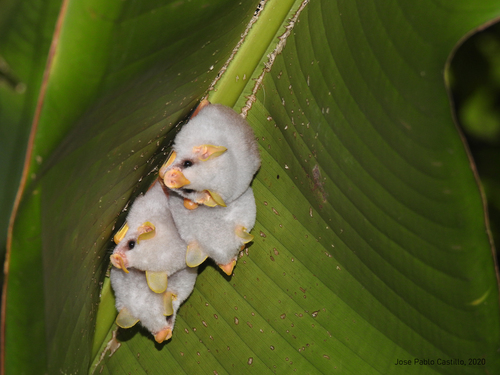
Where it lives
Recorded sightings
—
geo-referenced records in GBIF, from museums, herbaria and field observers.
Drag the globe to turn it. Dots are where records exist, not a range map; darker means more records.
In the stacks
Searching the stacks…
Every page naming Ectophylla in the Biodiversity Heritage Library →
This page is assembled live from iNaturalist, GBIF, Wikipedia, the Source Library and the Internet Archive. It is not yet part of the hand-edited codex. iNaturalist taxon 41056.