- Animals
- ›Chordates
- ›Vertebrates
- ›Mammals
- ›Therians
- ›Placental Mammals
- ›Primates, Rodents, and Allies
- ›Primates
- ›Monkeys, Apes, and Tarsiers
- ›Monkeys and Apes
- ›New World Monkeys
- ›Cebid Monkeys
- ›Capuchins
- ›Sapajus
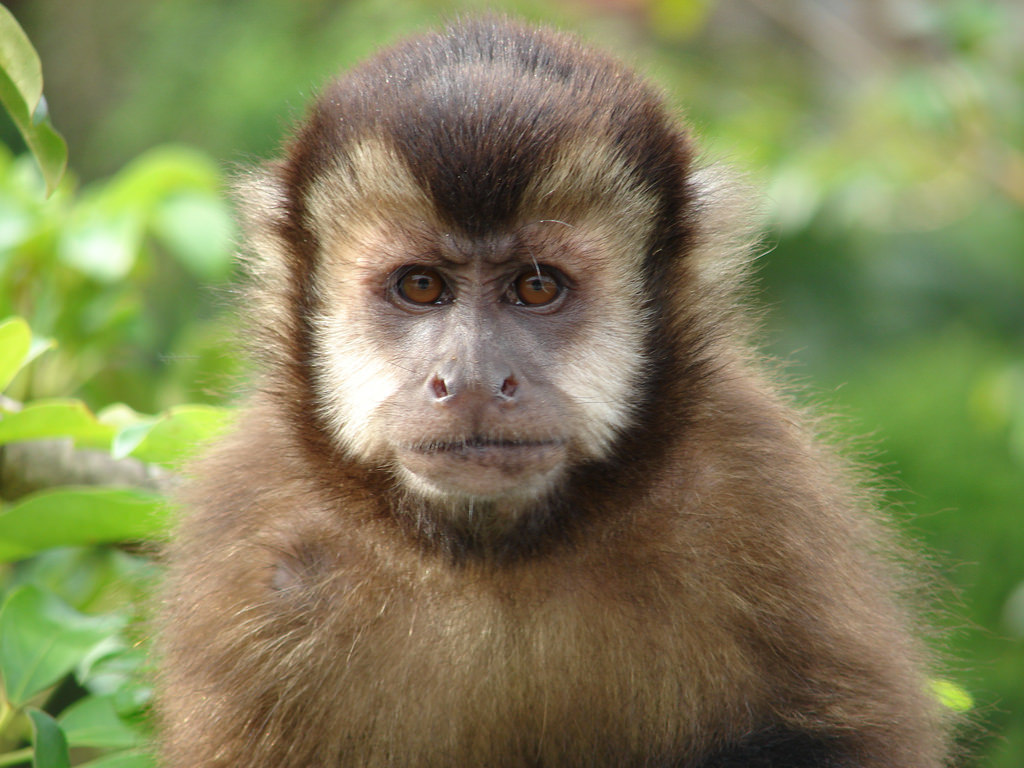
Black capuchin
Sapajus nigritus
The black capuchin, (Sapajus nigritus), also known as the black-horned capuchin, is a capuchin monkey from the Atlantic Forest in south-eastern Brazil and far north-eastern Argentina. Historically, it was included as a subspecies of the tufted capuchin.
From the article Black capuchin on Wikipedia (CC BY-SA), quoted section by section
Range & habitat
The black capuchin is found in the Atlantic region of North-eastern Argentina and South-eastern Brazil, with its habitat overlapping with other capuchin species. They are considered arboreal, mainly dwelling in the tree canopy; however, they will also drop to the forest floor to forage, where insects and nuts are most abundant.
Wikipedia: “Habitat”
What it does
Females strongly favor the alpha male in choosing a sexual partner; one study found that he is the target mate in three-quarters of female sexual advances and failed to find any coercion on his part which might force this outcome. To initiate mating, females possess a wide variety of signals, both auditory and ocular, which they employ at different stages of the process. There is some evidence that these are used to encourage coitus to occur at the time most opportune for procreation, including the increasing frequency with which visual signals occur as ovulation approaches. At least seven distinct calls exist for this purpose alone, although no evidence has been found that call type indicates anything to do with the stage of ovulation or fertility, although they do change pre and post-copulation. Those vocalized after mating may function to assure the chosen mate of his paternity by making the whole affair public knowledge, thereby encouraging him to guard both the female and her resulting offspring from competing mates and infanticide. In this context, the purpose of male postcoital courtship is perhaps revealed to be mate protection. For the same ends, the potentially impregnated female might use visual signals to assure the alpha of his status as her mate, while using vocalizations to confuse the other males as to who the father truly is, thereby discouraging aggression.
Wikipedia: “Reproduction”
Listen
Looking for field recordings…
Where it lives
Recorded sightings
—
geo-referenced records in GBIF, from museums, herbaria and field observers.
Drag the globe to turn it. Dots are where records exist, not a range map; darker means more records.
In the stacks
Searching the stacks…
Every page naming Sapajus nigritus in the Biodiversity Heritage Library →
This page is assembled live from iNaturalist, GBIF, Wikipedia, the Source Library and the Internet Archive. It is not yet part of the hand-edited codex. iNaturalist taxon 410834.