- Animals
- ›Chordates
- ›Vertebrates
- ›Mammals
- ›Therians
- ›Placental Mammals
- ›Ungulates, Carnivorans, and Allies
- ›Bats
- ›Yangochiroptera
- ›Noctilionoid Bats
- ›New World Leaf-nosed Bats
- ›Stenodermatine Bats
- ›Stenodermatini
- ›Uroderma
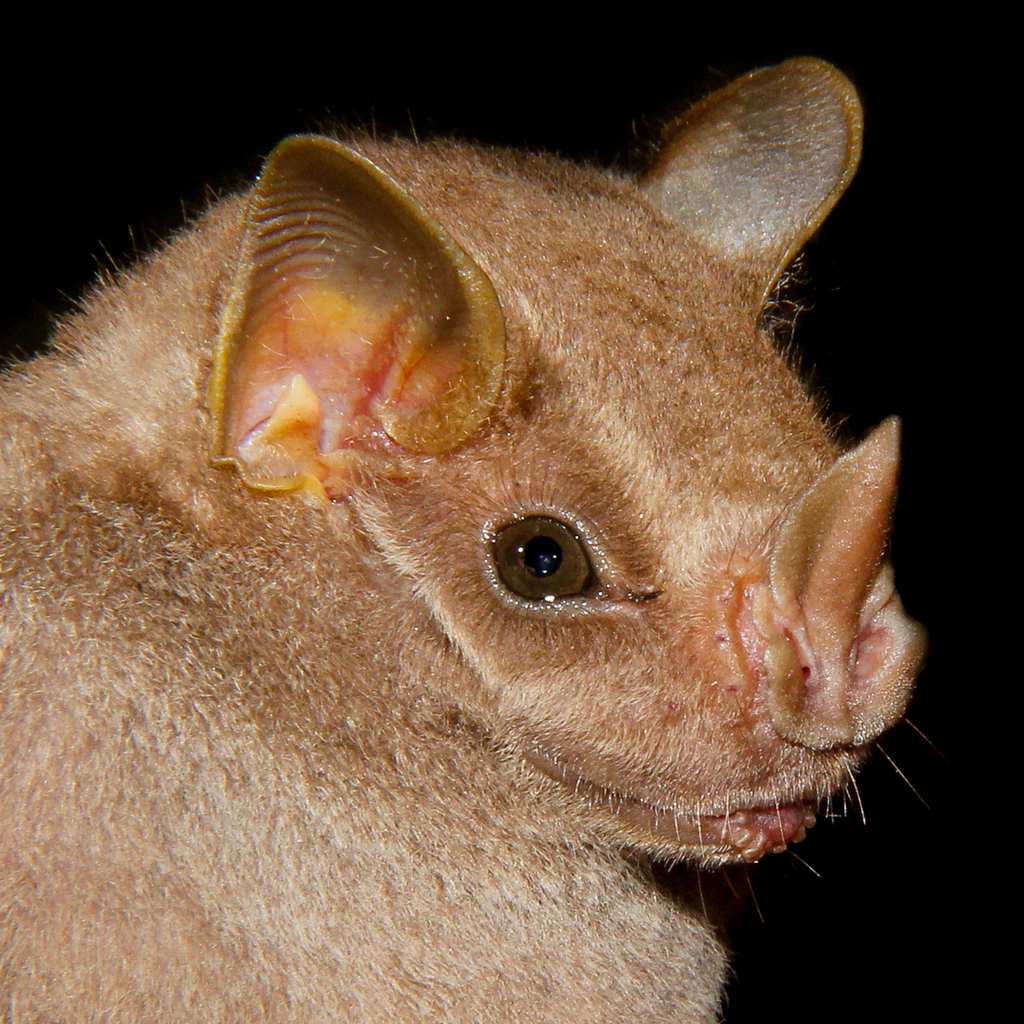
brown tent-making bat
Uroderma magnirostrum
The brown tent-making bat (Uroderma magnirostrum) is a species of bat found in South and Central America.
From the article Brown tent-making bat on Wikipedia (CC BY-SA), quoted section by section
Description
Members of this species are 54 to 70 mm (2.1 to 2.8 in) long, have no tails and weigh between 12 and 21 g (0.42 and 0.74 oz). Their forearms reach lengths between 41 and 45 mm (1.6 and 1.8 in), the hindfeet are 9 to 12 mm (0.35 to 0.47 in) long, and the length of the ears is between 13 and 17 mm (0.51 and 0.67 in). A faint white dorsal stripe is visible on the top of the head. The bottom half of the head is covered by taupe fur, while the bottom of the nose-leaf and the ears may be brighter. A white strip is visible above the eyes, and an additional faint white stripe is sometimes visible below the eyes. In flight, the uropatagium is U-shaped.
Range & habitat
The range of the brown tent-making bat includes a broad strip of the Pacific coast of North America, ranging from the Mexican state of Michoacán in the west to Nicaragua in the east. A second population occupies a region between central Panama and Rio de Janeiro, whose western border reaches the Andes in Ecuador, Peru and Bolivia. The brown tent-making bat lives in flatlands and in heights of up to 1000 meters. Habitats include evergreen forests, drier tropical forests and plantations.
Wikipedia: “Geographic distribution”
What it does
The species is named after its behavior of biting into the midribs or veins of large leaves such as banana leaves so that they fold to create tent-like nests. Since individuals have been found dusted in pollen, it is presumed that their diet includes nectar or flower parts. The species is also known to feed on fruits and insects.
Wikipedia: “Behavior”
Listen
Looking for field recordings…
Where it lives
Recorded sightings
—
geo-referenced records in GBIF, from museums, herbaria and field observers.
Drag the globe to turn it. Dots are where records exist, not a range map; darker means more records.
In the stacks
Searching the stacks…
Every page naming Uroderma magnirostrum in the Biodiversity Heritage Library →
This page is assembled live from iNaturalist, GBIF, Wikipedia, the Source Library and the Internet Archive. It is not yet part of the hand-edited codex. iNaturalist taxon 41154.