- Animals
- ›Chordates
- ›Vertebrates
- ›Mammals
- ›Therians
- ›Placental Mammals
- ›Ungulates, Carnivorans, and Allies
- ›Bats
- ›Yangochiroptera
- ›Noctilionoid Bats
- ›Bulldog Bats
- ›Noctilio
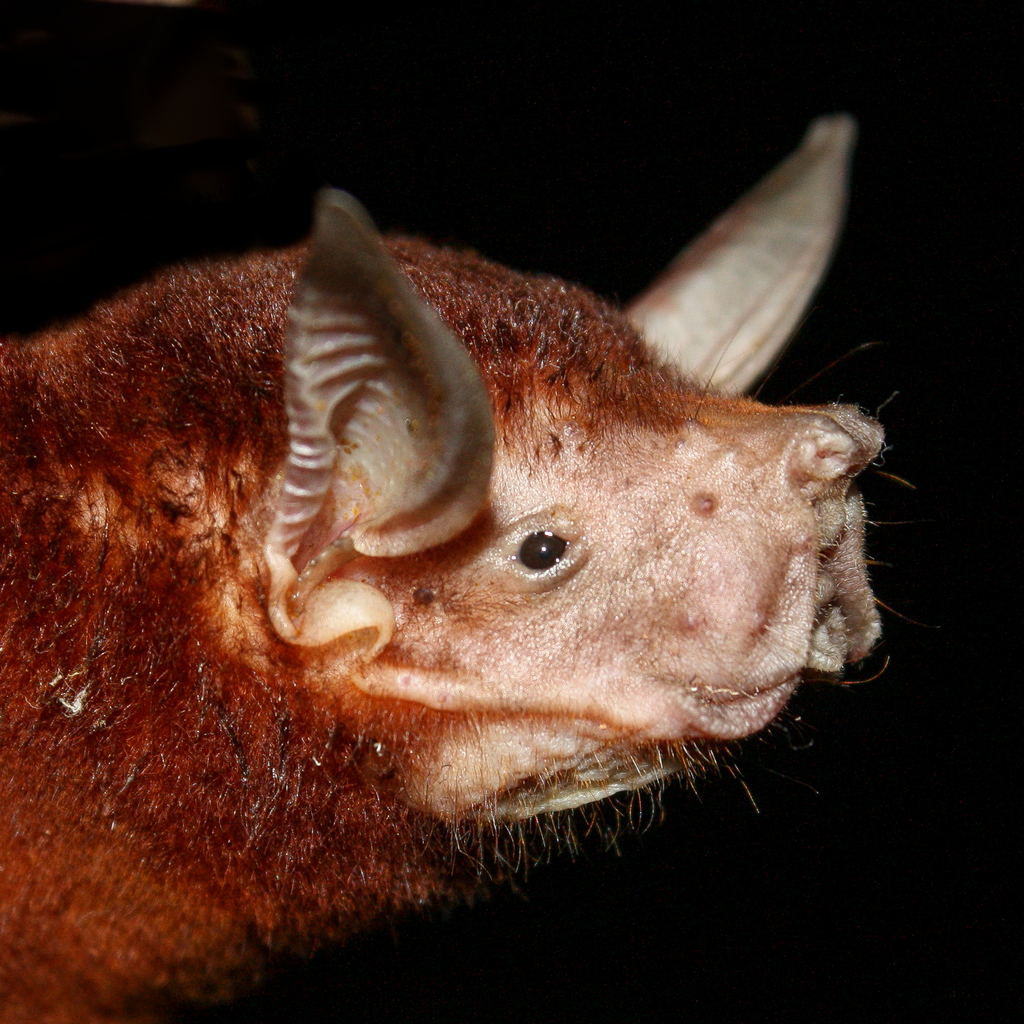
Greater Bulldog Bat
Noctilio leporinus
The greater bulldog bat or fisherman bat (Noctilio leporinus) is a species of fishing bat native to Latin America (Spanish: murciélago pescador; Portuguese: morcego-pescador). The bat uses echolocation to detect water ripples made by the fish upon which it preys, then uses the pouch between its legs to scoop the fish up and its sharp claws to catch and cling to it. It is not to be confused with the lesser bulldog bat, which, though belonging to the same genus, merely catches water insects, such as water striders and water beetles.
It emits echolocation sounds through the mouth like Myotis daubentoni, but the sounds are quite different, containing a long constant frequency part around 55 kHz, which is an unusually high frequency for a bat this large.
From the article Greater bulldog bat on Wikipedia (CC BY-SA), quoted section by section
Range & habitat
The greater bulldog bat's range stretches from Mexico to Northern Argentina and also includes most Caribbean islands. While vast, its range is also patchy as the bat is limited to mostly well-watered lowland and coastal areas as well as river basins. There is geographical variation in the species and are classified as subspecies. Bats around the Caribbean Basin are large and usually have the pale mid-dorsal stripe, despite varying in pelage. These bats are known as N. l. mastivus. In Guianas and the Amazon Basin, the bats are small and dark and often lack the pale mid-dorsal stripe. These bats are known as N. l. leporinus. In eastern Bolivia, southern Brazil and northern Argentina bats tend to be large and pale, more so than the other subspecies. They are known as N. l. rufenscenes.
Wikipedia: “Distribution and variation”
What it does
The greater bulldog bat lives primarily in tropical lowlands. The bats are commonly found over ponds and streams as well as estuaries and coastal lagoons. They live in colonies that number in the hundreds. In Trinidad, bulldog bats rest in hollow trees like silk-cotton, red mangrove and balatá. The bats live in hollow tree roosts in other areas as well. They also roost in deep sea caves. Like most bats, bulldog bats are nocturnal. Female bulldog bats stay together in groups while roosting and tend to be accompanied by a resident male. Females associate with the same individuals in the same location for several years unaffected by changes in resident males and movements of the group to different roosts. A male may stay with a female group for two or more reproductive seasons. Bachelor males are segregated from the females and may roost alone or together in small groups. Female bats forage either alone or with their roost mates, with stable female groups continue to forage in the same areas in the long term. Males forage alone and use areas that are larger and separate from those used by the females.
Food and hunting. The greater bulldog bat is one of the few bat species that has adapted to eating fish. Nevertheless, the bats eat both fish and insects. During the wet season, the bats feed primarily on insects like moths and beetles. …
Wikipedia: “Ecology and behavior”
Listen
Looking for field recordings…
Where it lives
Recorded sightings
—
geo-referenced records in GBIF, from museums, herbaria and field observers.
Drag the globe to turn it. Dots are where records exist, not a range map; darker means more records.
In the stacks
Searching the stacks…
Every page naming Noctilio leporinus in the Biodiversity Heritage Library →
This page is assembled live from iNaturalist, GBIF, Wikipedia, the Source Library and the Internet Archive. It is not yet part of the hand-edited codex. iNaturalist taxon 41200.