- Animals
- ›Chordates
- ›Vertebrates
- ›Mammals
- ›Therians
- ›Placental Mammals
- ›Ungulates, Carnivorans, and Allies
- ›Bats
- ›Yangochiroptera
- ›Vespertilionoid Bats
- ›Free-tailed Bats
- ›Molossinae
- ›Otomops
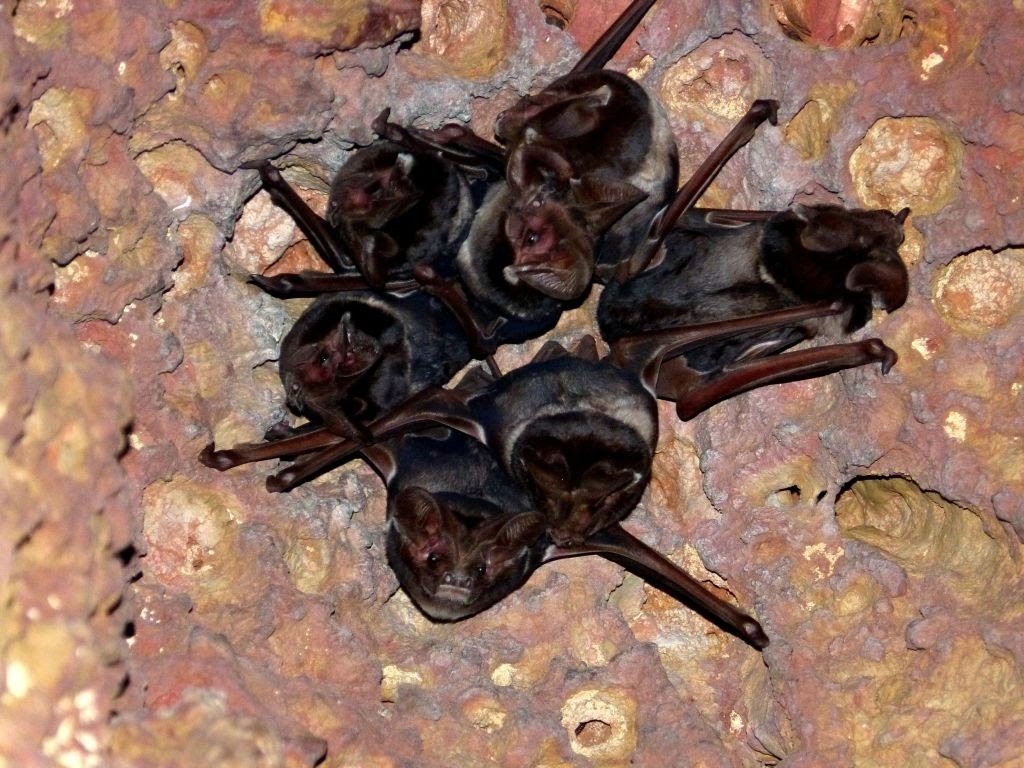
Wroughton's free-tailed bat
Otomops wroughtoni
Wroughton's free-tailed bat (Otomops wroughtoni) is a free-tailed bat formerly considered to be confined to the Western Ghats area of India, though it has also recently been discovered in northeast India and in a remote part of Cambodia. It is classified as a Data Deficient species as little is known about their habitat, ecology, or foraging range.
From the article Wroughton's free-tailed bat on Wikipedia (CC BY-SA), quoted section by section
Description
Wroughton's free-tailed bat has a forearm length of 63 to 67 millimetres (2.5 to 2.6 in). Males weigh approximately 36 grams (1.3 oz) and females 27 grams (0.95 oz). This species has large forward-pointing ears connected to each other by a membrane over the forehead. The face is naked and the nostril pad is large and prominent. The hair is short and velvety. It is a rich dark brown colour on the crown of the head, back and rump. There is a thin white border on each flank, extending from the armpit to the groin, and on the membranes of the forearms. The shoulders and the nape of the neck are a pale greyish white. The ventral surface is a dull brown, but with a contrasting grey collar, which extends onto the chin and upper chest. A small throat sac is present in both sexes. The tail projects far beyond the free edge of the narrow tail membrane, hence the common name "free-tailed bats" for this family.
Range & habitat
In India, the species is found in two locations in the southern Indian state of Karnataka and in Meghalaya in northeast India. In Karnataka, it is found in the Barapede Caves, located between Krishnapur and Talewadi, in Belgaum district, adjacent to the Bhimgad Wildlife Sanctuary near the state of Goa and was the only known location of this species for years. From 2012 – 2015, the average number of individuals in Barapede cave was 82. In 2000 it was reported from Cambodia. In Meghalaya, it was recently discovered in 2001 in Siju cave near Nongrai village, Shella confederacy approximately midway between the previous two locality records. There is a foraging record of a single specimen from Meghalaya collected in 2001. Since then, there is no record of sighting and/or collection of this species from that locality in Meghalaya in northeastern India. Therefore, J.R.B. Alfred states in 2006 that the distribution record of this species from Meghalaya needs confirmation and authentication. On the other hand, the sighting of the colony/collection records of this species were reported at different times by Topal and Ramkrishna (1980), Bates (1992), Mistry and Parab (2001), and Ramakrina and Pradhan (2003). …
Wikipedia: “Distribution”
Listen
Looking for field recordings…
Where it lives
Recorded sightings
—
geo-referenced records in GBIF, from museums, herbaria and field observers.
Drag the globe to turn it. Dots are where records exist, not a range map; darker means more records.
In the stacks
Searching the stacks…
Every page naming Otomops wroughtoni in the Biodiversity Heritage Library →
This page is assembled live from iNaturalist, GBIF, Wikipedia, the Source Library and the Internet Archive. It is not yet part of the hand-edited codex. iNaturalist taxon 41308.