- Animals
- ›Chordates
- ›Vertebrates
- ›Mammals
- ›Therians
- ›Placental Mammals
- ›Ungulates, Carnivorans, and Allies
- ›Bats
- ›Yinpterochiroptera
- ›Rhinolophoid Bats
- ›False Vampire Bats
- ›Cardioderma
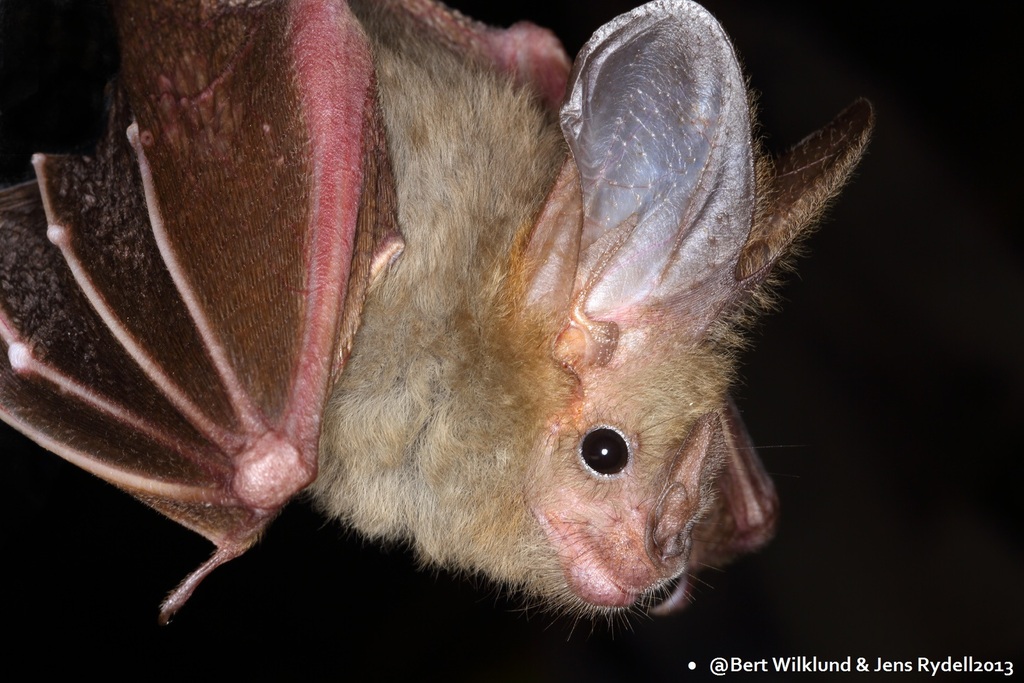
Heart-nosed bat
Cardioderma cor
The heart-nosed bat (Cardioderma cor) is a species of bat in the family Megadermatidae. It is the only species within the genus Cardioderma. It is found in eastern Sudan, north Tanzania, and south Zambia. In an experiment conducted in 2017, it was concluded that heart-nosed bats emit vocalizations or "sing" as a way to establish their foraging areas and actively defend these territories from other bats of the same species.
From the article Heart-nosed bat on Wikipedia (CC BY-SA), quoted section by section
Description
Heart-nosed bats weigh 21–35 g (0.74–1.23 oz) and are 70–77 mm (2.8–3.0 in) in length. Heart-nosed bats have blueish/grayish fur. Their fur also hangs off of their body and is considered to be long and loose. These bats have no tails, unlike most other species of bats. Some of the most recognizable features of this species is its teeth and skull, as well as its heart-shaped nose.
Wikipedia: “Appearance”
Range & habitat
The heart-nosed bat typically occupies areas that are in dry lowlands, coastal strips, and river valleys. Places of interest that the bats tend to gather in the daylight hours are abandoned buildings, dry caves, or baobab trees. They are also found living no higher than 940 meters or 3094 feet in elevation. Heart-nosed bats live in large colonies together, but they are very territorial and do not mingle with other bat species.
Wikipedia: “Habitat”
What it does
Heart-nosed bats are monogamous. If possible, mates will stay together during multiple mating seasons. Breeding sites are extremely territorial and are typically protected by the males. These sites are set up during the breeding season itself and afterwards it will be taken down. A new breeding site will be found for the next mating season. The female period of gestation is three months. Baby bats are referred to as pups. Heart-nosed bats can only have one pup at a time. Females, like all mammals, feed their young via lactation. Females will carry their newborns until two months of age. After the third month, the pup is weaned from its mother and will then follow the mother around. The pup learns from its mother about foraging and territories that will allow them to be successful later in their life. The father's parental behavior is mostly unknown, but it is thought that the songs and territorial protection is protection of the mother and their young. The prime reproduction months happen between March and June and then again between October and December. These months are in the rainy season months and make the best mating months for heart-nosed bats.
Wikipedia: “Reproduction”
Listen
Looking for field recordings…
Where it lives
Recorded sightings
—
geo-referenced records in GBIF, from museums, herbaria and field observers.
Drag the globe to turn it. Dots are where records exist, not a range map; darker means more records.
In the stacks
Searching the stacks…
Every page naming Cardioderma cor in the Biodiversity Heritage Library →
This page is assembled live from iNaturalist, GBIF, Wikipedia, the Source Library and the Internet Archive. It is not yet part of the hand-edited codex. iNaturalist taxon 41324.