On eBird ↗
Parkinson's Petrel
Live sightings near you, the range map, bar charts of when it is seen, and Macaulay Library photos and recordings.
Black Petrel
Procellaria parkinsoni
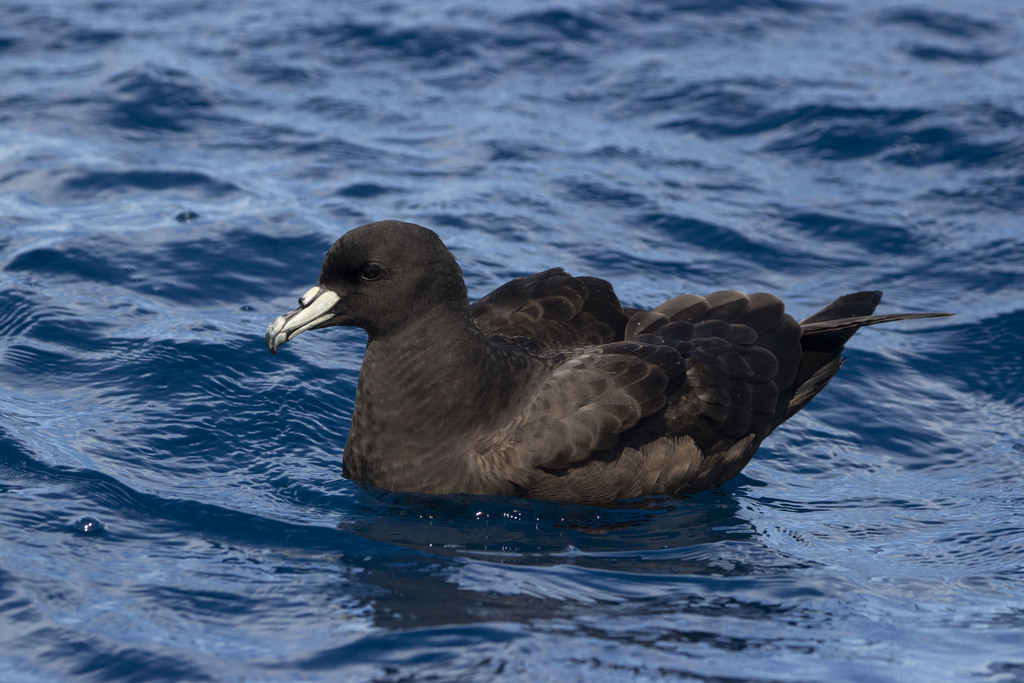
The black petrel (Procellaria parkinsoni), (Māori: tāiko, or tākoketai) also called Parkinson's petrel, is a medium-sized, black-plumaged petrel, the smallest of the Procellaria. The species is an endemic breeder of New Zealand, breeding only on Great Barrier Island and Little Barrier Island, off the North Island. At sea it disperses as far as Australia and Ecuador.
From the article Black petrel on Wikipedia (CC BY-SA), quoted section by section
Description
The plumage of the black petrel is all black, as are its legs and bill except for pale sections on the bill. It is a medium-sized petrel: males average about 720 g (25 oz), females around 680 g (24 oz). It has an overall length of 46 cm (18 in) and a wingspan averaging 115 cm (45 in).
Range & habitat
It is endemic to New Zealand. It was previously found throughout the North Island and Northwest Nelson in the South Island, but predators (feral cats, pigs) caused their extinction on the mainland from about the 1950s. It is often seen in the outer Hauraki Gulf from October to May. Breeding is now restricted to the main colony on Great Barrier Island (c. 5000 birds over summer, including approximately 1300 breeding pairs and 1000 "pre-breeders" seeking mates) and a small colony of c. 250 birds on Little Barrier Island. In addition to breeding birds, there are likely to be a further 6000 juveniles, pre-breeders and non-breeding birds at sea. Black petrels may range from the east coast of Australia all the way to the coast of South America between Mexico and Peru and the Galapagos islands. Females and males forage separately and in different places – it is not known why. Birds forage much closer to the Hauraki Gulf over the summer and autumn while incubating an egg and raising a chick – mainly in the Tasman Sea and to the north-east of New Zealand.
Wikipedia: “Distribution”
What it does
They may feed at night or during the day (unlike albatrosses which do not feed at night). Birds will aggressively follow fishing boats and longline hooks and may dive up to 20m below the surface after baits. Black petrels can cover amazing distances – the longest recorded foraging trip for a bird from Great Barrier Island is 39 days. Mapping of foraging patterns against fishing activity in New Zealand waters is underway.
Wikipedia: “Feeding”
Listen
Looking for field recordings…
Where it lives
Recorded sightings
—
geo-referenced records in GBIF, from museums, herbaria and field observers.
Drag the globe to turn it. Dots are where records exist, not a range map; darker means more records.
In the stacks
Searching the stacks…
Every page naming Procellaria parkinsoni in the Biodiversity Heritage Library →
This page is assembled live from iNaturalist, GBIF, Wikipedia, the Source Library and the Internet Archive. It is not yet part of the hand-edited codex. iNaturalist taxon 4137.