- Animals
- ›Chordates
- ›Vertebrates
- ›Mammals
- ›Therians
- ›Placental Mammals
- ›Ungulates, Carnivorans, and Allies
- ›Bats
- ›Yangochiroptera
- ›Sheath-tailed and Slit-faced Bats
- ›Sheath-tailed Bats
- ›Typical Sheath-winged Bats
- ›Diclidurini
- ›Rhynchonycteris
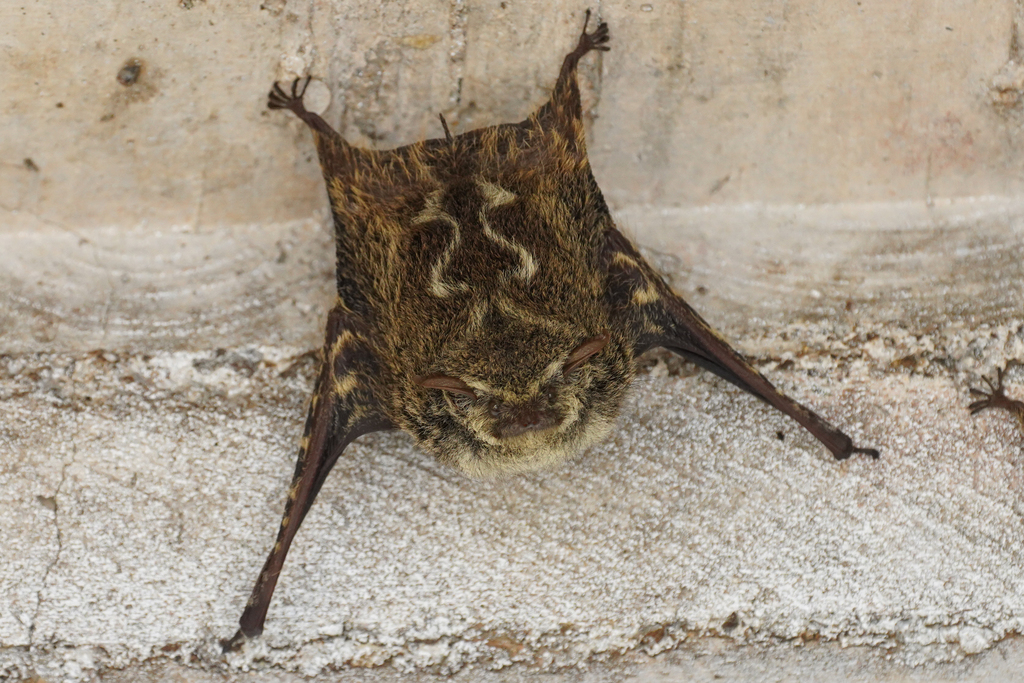
Proboscis Bat
Rhynchonycteris naso
The proboscis bat (Rhynchonycteris naso) is a species of bat found in South America and Central America. Other common names include long-nosed proboscis bat, sharp-nosed bat, Brazilian long-nosed bat, and river bat. It is the only species in the genus Rhynchonycteris.
This species is in the family Emballonuridae, the sac-winged or sheath-tailed bats. Like most bats, it is nocturnal. It is found from southern Mexico to Belize, Peru, Venezuela, Bolivia and Brazil, as well as in Trinidad.
From the article Proboscis bat on Wikipedia (CC BY-SA), quoted section by section
Description
This is a small bat, with a head-and-body length of 37–43 mm (1.5–1.7 in), a tail length of around 12 mm (0.47 in), and a forearm length of 35–41 mm (1.4–1.6 in). A sample of males and females from Trinidad found weights ranging between 2.1–4.3 g (0.074–0.152 oz). Males in northern South America were found to average 56 millimetres (2.2 in) long, females 59 millimetres (2.3 in). The tail is about 16 millimetres (0.63 in) long. Pregnant females can weigh up to 6 grams (0.21 oz).
Wikipedia: “Characteristics”
Range & habitat
This species is found in the lowlands of the northern half of South America, throughout Central America, and into southeastern Mexico. From Ecuador south, it is limited to east of the Andes; its range extends south to the northern half of Bolivia and much of Brazil. It seldom occurs above 300 meters (980 feet) in elevation. Its habitats include forests, caves and non-aquatic underground habitats. It usually lives around wetlands and is frequently found in riparian forests, pastures swamps, and all near water.
Wikipedia: “Habitat”
Listen
Looking for field recordings…
Where it lives
Recorded sightings
—
geo-referenced records in GBIF, from museums, herbaria and field observers.
Drag the globe to turn it. Dots are where records exist, not a range map; darker means more records.
In the stacks
Searching the stacks…
Every page naming Rhynchonycteris naso in the Biodiversity Heritage Library →
This page is assembled live from iNaturalist, GBIF, Wikipedia, the Source Library and the Internet Archive. It is not yet part of the hand-edited codex. iNaturalist taxon 41396.