- Animals
- ›Chordates
- ›Vertebrates
- ›Mammals
- ›Therians
- ›Placental Mammals
- ›Ungulates, Carnivorans, and Allies
- ›Even-toed Ungulates and Cetaceans
- ›Cetaceans and Hippopotamuses
- ›Cetaceans
- ›Toothed Whales
- ›Beaked Whales
- ›Beaked Whales
- ›Berardius
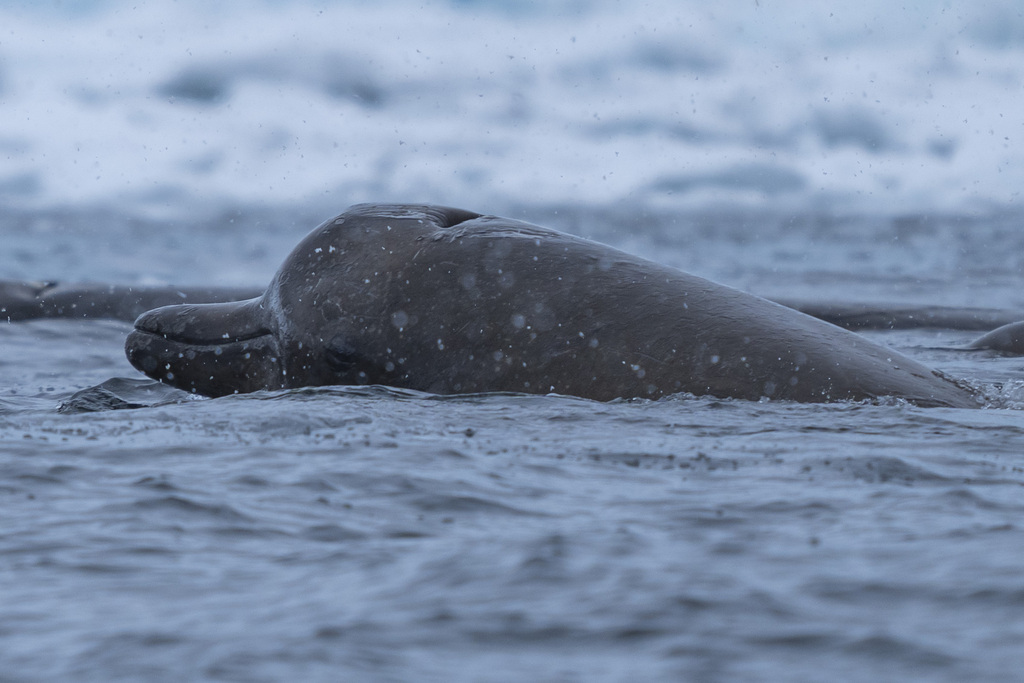
Arnoux's Beaked Whale
Berardius arnuxii
Arnoux's beaked whale (Berardius arnuxii), also called the southern four-toothed whale, southern beaked whale, New Zealand beaked whale, southern giant bottlenose whale and southern porpoise whale is one of the species of Berardius. Arnoux's and Baird's beaked whales are so similar that researchers debated whether or not they are simply two populations of the same species, until genetic evidence and their wide geographical separation led them to be classified as separate. Little is known about their behavior due to infrequent encounters with live individuals.
From the article Arnoux's beaked whale on Wikipedia (CC BY-SA), quoted section by section
Description
Arnoux's and Baird's beaked whales, have very similar features and would be indistinguishable at sea if they did not exist in disjoint locations. Both whales reach similar sizes, have bulbous melons, and long prominent beaks. Their lower jaw is longer than the upper, and once sexual maturity is reached the front teeth are visible even when the mouth is fully closed. The Baird's and Arnoux's beaked whales are the only whales in the Ziphiidae family where both sexes have erupted teeth. The teeth in the Ziphiidae are presumed to be used by males for fighting and competition for females. Ziphiidae have the most prevalent and pronounced markings caused by teeth scarring among the cetaceans. Front-facing teeth may be covered in barnacles after many years.
Baird's and Arnoux's beaked whales have similarly shaped small flippers with rounded tips, and small dorsal fins that sit far back on their bodies. These traits are similar in both sexes, as there is little sexual dimorphism in either species. Among the observed differences in the sexes is their size: female Baird's and Arnoux giant beaked whales are slightly larger than the males.This species has a thick, lipid-rich blubber layer to provide thermal insulation in its frigid habitat.
Range & habitat
Arnoux's beaked whales inhabit great tracts of the Southern Ocean. Beachings in New Zealand and Argentina indicate the whale may be relatively common in the Southern Ocean between those countries and Antarctica; sporadic sightings have been recorded in polar waters, such as in McMurdo Sound. It has also been spotted close to South Georgia and South Africa, indicating a likely circumpolar distribution. The northernmost stranding was at 34 degrees south, indicating the whales inhabit cool and temperate, as well as polar, waters. There is no stock report for the Arnoux's beaked whale to date by NOAA. An April 2022 sighting in the Weddell Sea prompted a review of 108 prior sightings of 1125 individuals, dating to 1986-1998. This review corroborated their presumed range in the Southern Ocean, and found that Arnoux's beaked whales prefer the coasts of icy landmasses. In temperate regions above 60 degrees South, they can also be found near continents, even in fjords far inland.
Wikipedia: “Population and distribution”
What it does
This species has been recorded taking dives of 15–25 minutes to an hour. They tend to spend 5-15 at the surface between dives. They routinely dive greater than 500 m, and possibly as deep as 3000 m.
Wikipedia: “Diving behavior”
At the table
Arnoux's beaked whales are deep-diving, echolocating suction-feeders. Like other beaked whales, this species possess a pair of V-shaped throat grooves that are thought to facilitate suction feeding by creating negative pressure within the mouth as the tongue retracts and the throat grooves expand, powerfully drawing prey inward like a biological vacuum. Prey taxa include Batoteuthis skolops, Moroteuthopsis longimana, Galiteuthis glacialis and Taonius sp. and some fish.
Wikipedia: “Food and foraging”
In human culture
Named Berardius arnuxii in 1851 for the French surgeon, M. Arnoux, who presented the skull to the Paris Museum of Natural History in 1846.
Wikipedia: “Etymology”
Listen
Looking for field recordings…
Where it lives
Recorded sightings
—
geo-referenced records in GBIF, from museums, herbaria and field observers.
Drag the globe to turn it. Dots are where records exist, not a range map; darker means more records.
In the stacks
Searching the stacks…
Every page naming Berardius arnuxii in the Biodiversity Heritage Library →
This page is assembled live from iNaturalist, GBIF, Wikipedia, the Source Library and the Internet Archive. It is not yet part of the hand-edited codex. iNaturalist taxon 41425.