- Animals
- ›Chordates
- ›Vertebrates
- ›Mammals
- ›Therians
- ›Placental Mammals
- ›Ungulates, Carnivorans, and Allies
- ›Even-toed Ungulates and Cetaceans
- ›Cetaceans and Hippopotamuses
- ›Cetaceans
- ›Toothed Whales
- ›Beaked Whales
- ›Beaked Whales
- ›Berardius
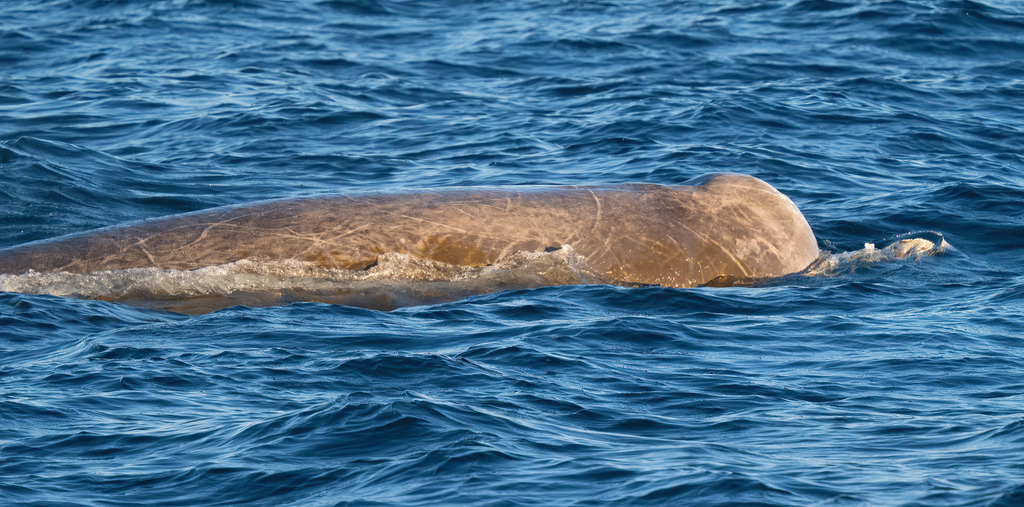
Baird's Beaked Whale
Berardius bairdii
Baird's beaked whale (Berardius bairdii), also known commonly as the northern giant bottlenose whale, North Pacific bottlenose whale, giant four-toothed whale, northern four-toothed whale and North Pacific four-toothed whale, is a species of whale in the genus Berardius of the family Ziphiidae. Baird's beaked whale and Arnoux's beaked whale are so similar that researchers have debated whether or not they are simply two populations of the same species. However, genetic evidence and their wide geographical separation has led them to be classified as separate. Baird's beaked whale is the largest beaked whale and the second largest living species of toothed whale after the sperm whale.
From the article Baird's beaked whale on Wikipedia (CC BY-SA), quoted section by section
Description
The species Berardius bairdii reaches lengths of about 11.9 metres (39 ft) for males and 12.8 metres (42 ft) for females. The longest confirmed specimen was 13 m (43 ft) in length and the heaviest was 14 tonnes (15 short tons). The snout, called a beak, is elongated and lacks all teeth except for one or two sets in the lower mandible, which are called "battle teeth" for their use in intra-species conflict. Individuals often bear scars from such confrontations. The age of sexual maturity is thought to be 10–15 years for females and 6–11 years for males. Young Baird's beaked whales remain with their mothers until they are 6–9 years old. The testes continue to grow until the whales are 30–40 years old, and only these older males are likely to participate in reproduction. The oldest in a study of Baird's beaked whales were 54 years for females and 84 years for males, respectively.
Range & habitat
Berardius bairdii occurs primarily in the North Pacific Ocean, where it is a deep-water cetacean, often frequenting depths between 1,000 and 3,000 m (3,280 and 9,840 ft) in its search for prey. In the northwestern part of its range, sightings have been documented off of Hokkaido, Japan, Sakhalin and Kamchatka, as well as in the Sea of Okhotsk, the Bering Sea and the Aleutian Islands. In the more eastern and southern reaches of their distribution, they have been seen from southern Alaska and down the U.S. West Coast to San Diego and northern Baja California.
Wikipedia: “Distribution”
What it does
Similar to other beaked whales, Baird's beaked whale feeds primarily on deep-water fishes and cephalopods. Analyses of stomach contents from individuals taken in Japanese waters have shown that the species consumes a wide range of deep-sea prey, including benthic fishes such as Moridae and grenadiers, as well as numerous species of squid. Diet composition varies regionally. Populations off the Pacific coast of Honshu feed predominantly on deep-water fishes, while those in the southern Sea of Okhotsk consume mostly cephalopods, including members of the families Gonatidae and Cranchiidae. The longfin codling (Laemonema longipes) has been identified as an important prey species in both regions. These differences are thought to reflect variation in prey availability rather than strict dietary specialization. Other recorded prey taxa include pollock, mackerel, sardines, Pacific saury, skates, scorpionfish, Coryphaenoides sp., Onychoteuthis sp. and Onykia sp.
Wikipedia: “Diet”
Listen
Looking for field recordings…
Where it lives
Recorded sightings
—
geo-referenced records in GBIF, from museums, herbaria and field observers.
Drag the globe to turn it. Dots are where records exist, not a range map; darker means more records.
In the stacks
Searching the stacks…
Every page naming Berardius bairdii in the Biodiversity Heritage Library →
This page is assembled live from iNaturalist, GBIF, Wikipedia, the Source Library and the Internet Archive. It is not yet part of the hand-edited codex. iNaturalist taxon 41426.