On eBird ↗
Waved Albatross
Live sightings near you, the range map, bar charts of when it is seen, and Macaulay Library photos and recordings.
Waved Albatross
Phoebastria irrorata
The waved albatross (Phoebastria irrorata), also known as Galapagos albatross, is one of three species of the family Diomedeidae that occur in the tropics. When they forage, they follow a straight path to a single site off the coast of Peru, about 1,000 km (620 mi) to the east. During the non-breeding season, these birds reside primarily on the Ecuadorian and Peruvian coasts.
From the article Waved albatross on Wikipedia (CC BY-SA), quoted section by section
Description
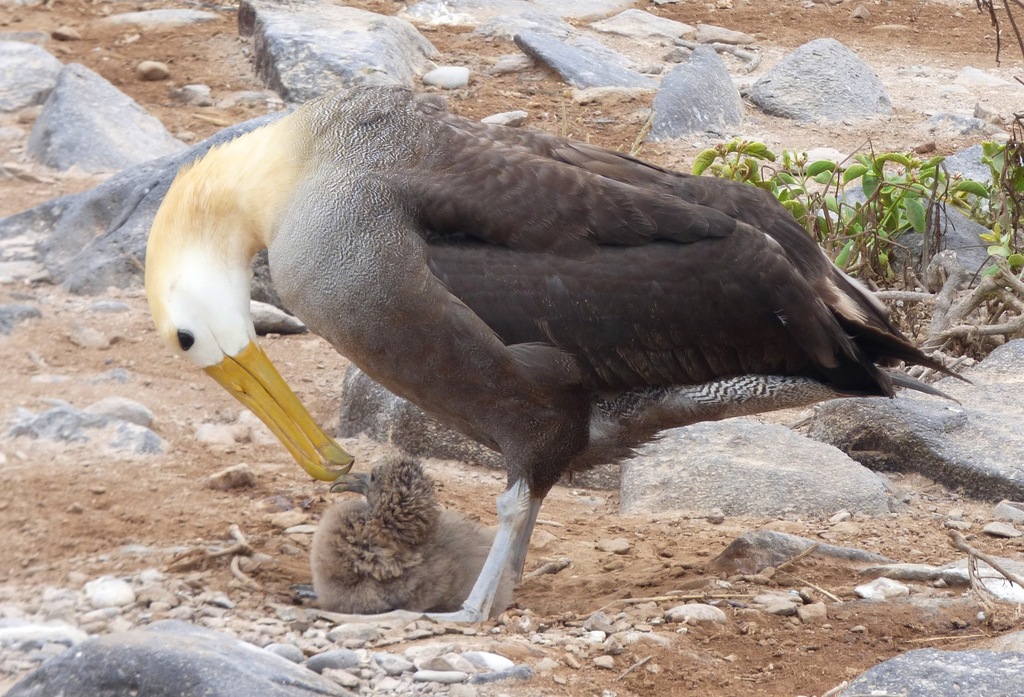
These are medium-sized albatrosses, measuring 80 to 90 cm (31 to 35 in) in length with a wingspan of 220–250 cm (7.2–8.2 ft). They range between 2.7 and 4.0 kg (6.0 and 8.8 lb) in mass, with males averaging significantly heavier than females. They are distinctive for their yellowish-cream neck and head, which contrasts with their mostly brownish bodies. Even more distinctive is the very long, bright yellow bill, which looks disproportionately large in comparison to the relatively small head and long, slender neck. They also have chestnut brown upper parts and underparts, except for the breast, with fine barring, a little coarser on the rump. They have brown upper-wings, back, and tail, along with a whitish breast and underwings. Their axillaries are brown. Finally they have bluish feet. Juveniles are similar to adults except for more white on their head. Chicks have brown fluffy feathers. The lifespan of this species may reach 40 to 45 years.
Range & habitat
The waved albatross breeds primarily on Española Island in the Galápagos archipelago; however, there have been sightings of non-breeders and therefore possible small numbers, around 10 to 20, of breeders on Genovesa Island and Isla de la Plata. During non-breeding season they will shift to the east and southeast to the continental shelf region off the coast of Peru and Ecuador. Sometimes they are seen in Colombia. In January 2026, a waved albatross was spotted off the coast of California near Piedras Blancas Light Station, approximately 3,300 miles from its normal range. There was also a suspected sighting in October 2025 in Northern California. It is unknown why the bird had traveled so far north.
Wikipedia: “Range”
What it does
The primary food sources of the waved albatross are fish, squid, and crustaceans, as well as smaller birds. But they have also been observed to scavenge for other food sources, including the regurgitated food of other birds. When foraging, the waved albatross finds places in the ocean where prey will be near this surface; this is the most effective way for the albatross to get its food. The waved albatrosses will forage 10 to 100 km (6.2–62.1 mi) away from the place where the chicks are nesting to get food for them.
Wikipedia: “Feeding”
In human culture
The waved albatross derives its name from the wave-like pattern of the feathers on adult birds.
Wikipedia: “Etymology”
Listen
Looking for field recordings…
Where it lives
Recorded sightings
—
geo-referenced records in GBIF, from museums, herbaria and field observers.
Drag the globe to turn it. Dots are where records exist, not a range map; darker means more records.
In the stacks
Searching the stacks…
Every page naming Phoebastria irrorata in the Biodiversity Heritage Library →
This page is assembled live from iNaturalist, GBIF, Wikipedia, the Source Library and the Internet Archive. It is not yet part of the hand-edited codex. iNaturalist taxon 4143.