- Animals
- ›Chordates
- ›Vertebrates
- ›Mammals
- ›Therians
- ›Placental Mammals
- ›Ungulates, Carnivorans, and Allies
- ›Even-toed Ungulates and Cetaceans
- ›Cetaceans and Hippopotamuses
- ›Cetaceans
- ›Toothed Whales
- ›Oceanic Dolphins and Porpoises
- ›Porpoises
- ›Neophocaena
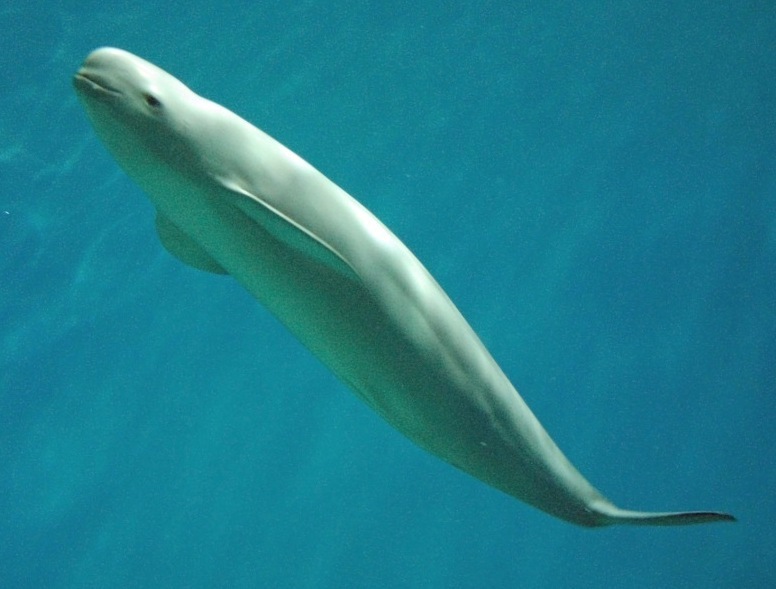
Indo-Pacific Finless Porpoise
Neophocaena phocaenoides
The Indo-Pacific finless porpoise (Neophocaena phocaenoides), or finless porpoise, is one of seven porpoise species. Most of the population has been found around the Korean peninsula in the Yellow and East China Seas, although a freshwater population is found around Jiuduansha near Shanghai at the mouth of China's Yangtze River. Genetic studies indicate that the finless porpoise is the most basal living member of the porpoise family.
From the article Indo-Pacific finless porpoise on Wikipedia (CC BY-SA), quoted section by section
Description
Finless porpoises can grow to as much as 2.27 m (7 ft 5 in) in length, and can weigh up to 72 kg (159 lb), although the majority are smaller. The flippers are moderately large, reaching up to 20% of the total body length. Adults are typically a uniform, light grey colour, although some may have lighter patches of skin around the mouth or darker patches in front of the flippers. Newborn calves of the central and eastern subspecies are mostly black with grey around the dorsal ridge area, becoming fully grey after four to six months. However, newborn calves of the western subspecies are a light creamy grey, and become darker as they age. Adults grow more than 1.55 m (5 ft) in length and up to 30–45 kg (65–100 lb) in weight.
Internal anatomy. The anatomy of finless porpoises has been relatively well studied, compared with that of some other cetacean species. For example, the tubercles along the dorsal ridge are known to contain numerous nerve endings that may possess a sensory function. The auditory system also appears well-developed, with numerous large nerve fibres specialised for rapid communication between the ears and the brain. On the other hand, sight is relatively poor, with a reduced lens and a limited number of fibres in the optic nerve and to the muscles moving the eyes. The skeleton is unusually light, accounting for only 5% of total weight. …
Range & habitat
The Indo-Pacific finless porpoise lives in the coastal waters of Asia, especially around Indonesia, Malaysia, India, and Bangladesh. At the western end, their range includes the length of the western coast of India and continues up into the Persian Gulf. On the eastern edge of their range, they are found throughout the Indonesian archipelago and range north to the Taiwan Strait. Finless porpoises are also one of the species protected at Sundarbans National Park.
Wikipedia: “Distribution”
What it does
Finless porpoises are opportunistic feeders using various kinds of available food items available in their habitat, including fish, crustaceans, and cephalopods. They are reported to eat fish, shrimp and squid off Pakistan. Seasonal changes in their diets have not been studied. They also apparently ingest some plant material when living in estuaries, mangroves, and rivers, including leaves, rice, and eggs deposited on vegetation.
Wikipedia: “Diet”
Listen
Looking for field recordings…
Where it lives
Recorded sightings
—
geo-referenced records in GBIF, from museums, herbaria and field observers.
Drag the globe to turn it. Dots are where records exist, not a range map; darker means more records.
In the stacks
Searching the stacks…
Every page naming Neophocaena phocaenoides in the Biodiversity Heritage Library →
This page is assembled live from iNaturalist, GBIF, Wikipedia, the Source Library and the Internet Archive. It is not yet part of the hand-edited codex. iNaturalist taxon 41450.