- Animals
- ›Chordates
- ›Vertebrates
- ›Ray-finned Fishes
- ›Salmons, Pikes and Mudminnows
- ›Salmons, Trouts, and Whitefishes
- ›Salmons, Trouts, and Whitefishes
- ›Salmons and Trouts
- ›Salvelinus
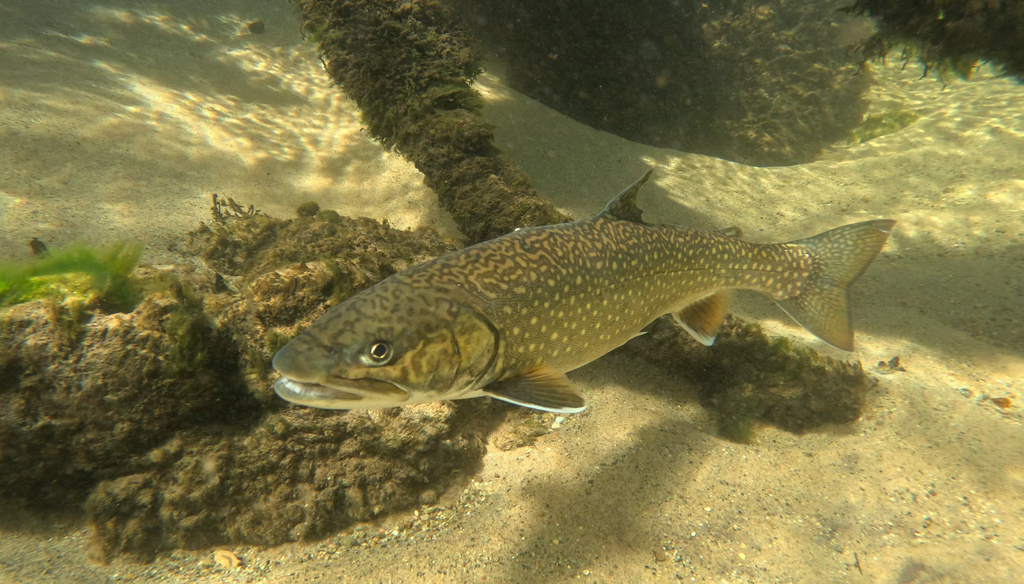
Splake
Salvelinus namaycush × fontinalis
The splake or slake (Salvelinus namaycush × Salvelinus fontinalis) is a hybrid of two fish species resulting from the crossing of a male brook trout (Salvelinus fontinalis) and a female lake trout (Salvelinus namaycush). The name itself is a portmanteau of speckled trout (another name for brook trout) and lake trout, and may have been used to describe such hybrids as early as the 1880s. Hybrids of the male lake trout with the female brook trout (the so-called "brookinaw") have also been produced, but are not as successful.
The intrageneric hybrid is of the genus Salvelinus and, hence, is most properly known as a char or charr. In some locales, the fish is referred to as the wendigo. Although the hybrid is genetically stable and is, theoretically, capable of reproducing, splake reproduction is uncommon, for behavioral reasons, outside the hatchery environment. However, in some instances splake have back-crossed with parent species that inhabit the same waters, and create a self-sustaining population of splake backcrosses. This has been documented in several instances in Wyoming and the Intermountain West, notably Hog Park Reservoir, Wyoming where Splake were accidentally stocked once in the 1980s and the population still exists today through spawning and back-crossing with Brook Trout that are also found in the watershed.. Because splake typically do not reproduce just as other hybrid fish, they are used as a sport fish in many lakes across the US. Fishery managers are able to control populations numbers due to the extremely poor spawning success rate.
From the article Splake on Wikipedia (CC BY-SA), quoted section by section
Description
The fish possesses characteristics of both parent species. Splake in some instances can exhibit higher growth rates than either parent species (under ideal circumstances) and can attain 46 cm (18 in) in length only two years after being planted as fingerlings (i.e., at 2½ years of age). By way of contrast, lacustrine brook trout would approach 25 cm (10 in) in length at a similar age and similarly aged lake trout would be expected to be less than 40 cm (16 in) long. The maximum size is about 9 kg (20 lb), but fish over 4 kg (9 lb) are very rare and are considered trophies. In the Intermountain West, Splake grow much slower and live a very long time, with fish approaching 30 years old recorded in Wyoming. Since Splake are a hybrid, they can inherit more DNA from one parent species vs. the other, and subsequently have behavior, growth, and appearance more like the parent species that they inherit more traits from. This often leads to some fish being more drab, living in deeper water, and living longer lives like a Lake Trout, and in contrast, some fish living more shallow lives, with bright colors and behaving more like Brook Trout. This can also be apparent when looking at external morphology, particularly the caudal fin. Splake are capable of having a forked tail like a Lake Trout, a relatively square tail like a Brook Trout, or an intermediate tail. …
Where it lives
Recorded sightings
—
geo-referenced records in GBIF, from museums, herbaria and field observers.
Drag the globe to turn it. Dots are where records exist, not a range map; darker means more records.
In the stacks
This page is assembled live from iNaturalist, GBIF, Wikipedia, the Source Library and the Internet Archive. It is not yet part of the hand-edited codex. iNaturalist taxon 415468.