- Animals
- ›Chordates
- ›Vertebrates
- ›Mammals
- ›Therians
- ›Placental Mammals
- ›Ungulates, Carnivorans, and Allies
- ›Even-toed Ungulates and Cetaceans
- ›Cetaceans and Hippopotamuses
- ›Cetaceans
- ›Baleen Whales
- ›Rorquals
- ›Balaenoptera
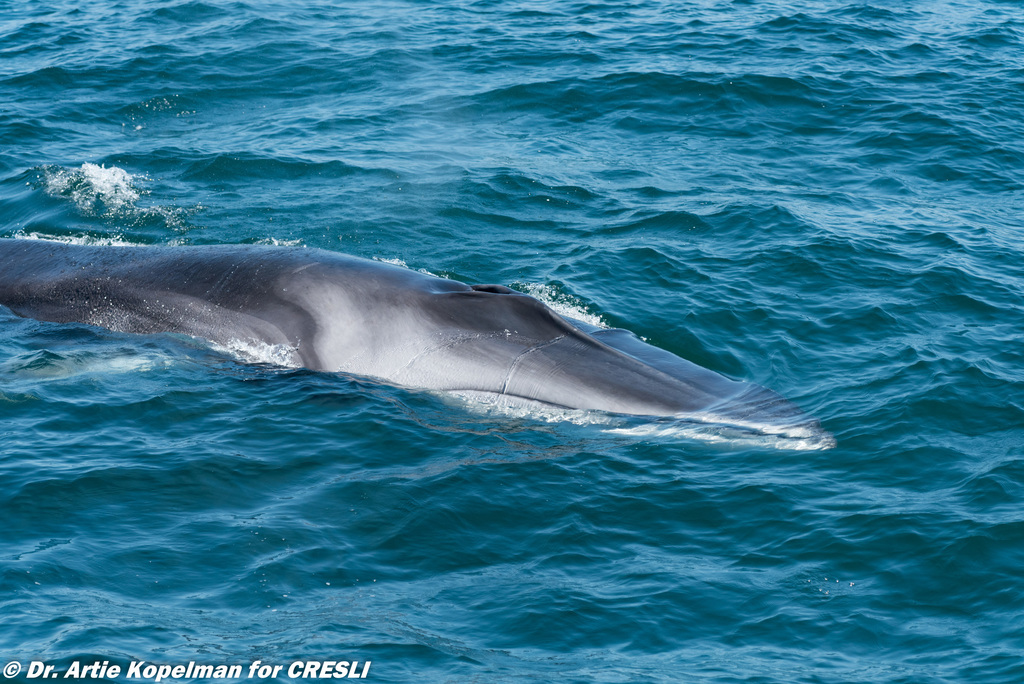
Fin Whale
Balaenoptera physalus
The fin whale (Balaenoptera physalus), also known as the finback whale or common rorqual, is a species of baleen whale and the second-longest cetacean after the blue whale. The biggest individual reportedly measured 26–27.3 m (85–90 ft) in length, with a maximum recorded weight of 65.5 to 120 t (64.5 to 118.1 long tons; 72.2 to 132.3 short tons). The fin whale's body is long, slender, and brownish-gray in color, with a paler underside to appear less conspicuous from below (countershading).
At least two recognized subspecies exist, one in the North Atlantic and one across the Southern Hemisphere. The species is found in all the major oceans, from polar to tropical waters, and is absent only from waters close to the pack ice at the poles and relatively small areas of water away from the open ocean. The highest population density occurs in temperate and cool waters. Its prey mainly consists of smaller schooling fish, small squid, and crustaceans, including copepods and krill. Mating takes place in temperate, low-latitude seas during the winter. Fin whales are often observed in pods of 6–10 animals, with whom they communicate using frequency-modulated sounds, ranging from 16 to 40 hertz.
From the article Fin whale on Wikipedia (CC BY-SA), quoted section by section
Description
The body is relatively slender, with a slim back and a large, hook-shaped dorsal fin measuring 61 cm (24 in), located on the fourth posterior end of the body. It has an elongated ridge on its back and around 260 to 480 baleen plates. It has two blowholes that can squirt 4–6 m (13–20 ft) up in the air. Like most rorquals, the fin whale has grooves between the tip of the lower jaw and the navel. Among whale species, the fin whale is exceeded in size only by the blue whale. Adults usually average 36–45 t (35–44 long tons; 40–50 short tons) in weight. Males have a mean length of 21 m (69 ft), and females average 22 m (72 ft). They are sexually dimorphic, with females generally being longer and heavier than males. The largest specimens can attain lengths of over 26–27 m (85–89 ft) and weights of 65.5–80 t (64.5–78.7 long tons; 72.2–88.2 short tons). The record length was measured at 27.3 m (90 ft). The Discovery Committee reported lengths up to 27 m (88 ft). However, the longest fin whale ever scientifically measured was a 25.9 m (85 ft) female caught south of Antarctica in the Southern Indian Ocean, as verified by Major F. A. Spencer, a whaling inspector aboard the whaling ship Southern Princess (1936–38). The fin whale is estimated to have weighed up to 120 tonnes (130 short tons). …
Wikipedia: “Anatomy”
Range & habitat
Like many large rorquals, the fin whale is a cosmopolitan species. It is found in all the world's major oceans and in waters ranging from the polar to the tropical. It is absent only from waters close to the ice pack at both the north and south extremities and relatively small areas of water away from the large oceans, such as the Red Sea, although they can reach into the Baltic Sea, a marginal sea of such conditions. The highest population density occurs in temperate and cool waters. It is less densely populated in the warmest, equatorial regions. The North Atlantic fin whale has an extensive distribution, occurring from the Gulf of Mexico and Mediterranean Sea, northward to Baffin Bay and Spitsbergen. In general, fin whales are more common north of roughly 30°N latitude, but considerable confusion arises about their occurrence south of 30°N latitude, because of the difficulty in distinguishing fin whales from Bryde's whales. Extensive ship surveys have led researchers to conclude that the summer feeding range of fin whales in the western North Atlantic is mainly between 30ºN and 51°N, from shore seaward to the 1,000 fathoms (6,000 ft; 1,800 m) contour. Summer distribution of fin whales in the North Pacific is the immediate offshore waters from central Baja California to Japan and as far north as the Chukchi Sea, bordering the Arctic Ocean. …
Wikipedia: “Range and habitat”
What it does
The fin whale is a filter feeder, consuming small schooling fish, squid, and crustaceans, including copepods and krill. In the North Pacific, they feed on krill in the genera Euphausia, Thysanoessa, and Nyctiphanes, large copepods in the genus Neocalanus, small schooling fish (such as the genera Engraulis, Mallotus, Clupea, and Theragra), and squid. Based on stomach-content analysis of over 19,500 fin whales caught by the Japanese whaling fleet in the North Pacific from 1952 to 1971, 64.1% contained only krill, 25.5% copepods, 5.0% fish, 3.4% krill and copepods, and 1.7% squid. A 1959 study, which studied the stomach contents of about 7500 fin whales caught in the northern North Pacific and Bering Sea from 1952 to 1958, found that they mainly preyed on euphausiids around the Aleutian Islands and in the Gulf of Alaska and schooling fish in the northern Bering Sea and off Kamchatka. Of the fin whale stomachs sampled off British Columbia between 1963 and 1967, euphausiids dominated the diet for four of the five years (82.3 to 100% of the diet), while copepods only formed a major portion of the diet in 1965 (35.7%). Miscellaneous fish, squid, and octopus played only a very minor part of the diet in two of the five years (3.6 to 4.8%). …
Wikipedia: “Feeding”
In human culture
Mating takes place during the winter, in temperate, low-latitude waters, and the gestation period lasts between 11 and 12 months. The length of the young at birth is 6–6.5 m (20–21 ft). At 6 to 7 months of age, when it is 11–12 m (36–39 ft) in length, a newborn weans from its mother, and the calf accompanies its mother to the summer feeding area. Calves remain with their mothers for about a year. Although reports of up to six foetuses have been made, single births are far more typical. In the Northern Hemisphere, females reach sexual maturity between the ages of 6 and 12, at lengths of 17.7–19 m (58–62 ft), and around 20 m (66 ft) in the Southern Hemisphere. Males reach sexual maturity at 6–10 years. Full physical maturity is attained between 22 and 25 years. Fin whales live, on average, to 75–90 years. The fin whales studied in one 1958 study were estimated to be either 50 years old or 60–67 years old. Three fin whales, killed as part of a commercial hunt in Iceland in 2013 and 2015, were found to be aged 82, 80, and 65. Some studies have recorded individual whales living longer: one, studied near Iceland in 1988, was estimated to be 94 years old; a 1979 study recorded the maximum lifespan as 114 years; and a female specimen, which was found in 2010, measured 17.6 m (58 ft) in length and weighed 30 t (30 long tons; 33 short tons), was estimated to be 135–140 years old. …
Wikipedia: “Life history”
Listen
Looking for field recordings…
Where it lives
Recorded sightings
—
geo-referenced records in GBIF, from museums, herbaria and field observers.
Drag the globe to turn it. Dots are where records exist, not a range map; darker means more records.
In the stacks
Searching the stacks…
Every page naming Balaenoptera physalus in the Biodiversity Heritage Library →
This page is assembled live from iNaturalist, GBIF, Wikipedia, the Source Library and the Internet Archive. It is not yet part of the hand-edited codex. iNaturalist taxon 41562.