- Animals
- ›Chordates
- ›Vertebrates
- ›Mammals
- ›Therians
- ›Placental Mammals
- ›Ungulates, Carnivorans, and Allies
- ›Carnivorans
- ›Civets, Genets, and Oyans
- ›Palm Civets and Binturongs
- ›Arctogalidia
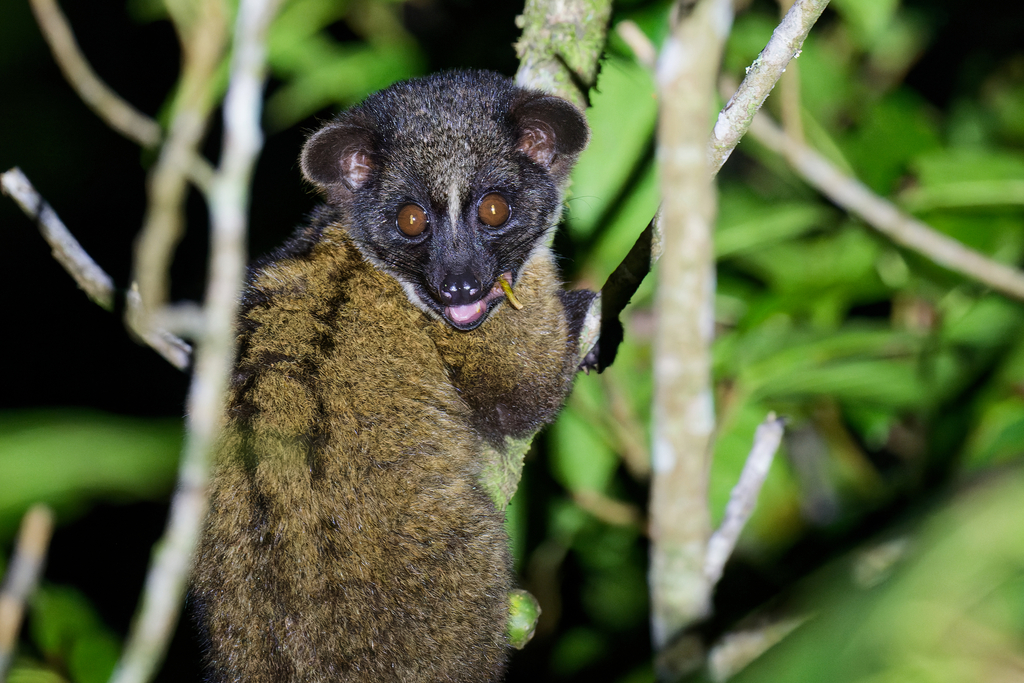
Small-toothed Palm Civet
Arctogalidia trivirgata
The small-toothed palm civet (Arctogalidia trivirgata), also known as the three-striped palm civet, is a viverrid native to dense forests from Northeast India to mainland Southeast Asia and the islands of Borneo, Sumatra and Java.
A monotypic genus, Arctogalidia means 'bear-weasel' (from ancient Greek arkto- 'bear' + galidia 'little weasel'). The specific epithet trivirgata means 'three-striped' in Latin.
From the article Small-toothed palm civet on Wikipedia (CC BY-SA), quoted section by section
Description
The small-toothed palm civet is blackish grey, has black paws and three black longitudinal stripes on the back. The black stripes appear as rows of broken spots, but some individuals also have white tips on the ears, depending on their region of origin. The long tail has a tubular shape, and appears light and fluffy. Its body measures about 53 cm (21 in) with a tail of 58 cm (23 in) and weighs 2.4 kg (5.3 lb). It has short fur that is generally a tawny or buff color while the head is a darker greyish tawny. The coat color is generally lighter at a younger age, and darkens as the individuals matures. Its muzzle is brown with a white streak that extends from the nose to the forehead. Females have the perineal scent gland near the vulva.
What it does
The small-toothed palm civet's diet is varied and omnivorous, and usually consists of insects, small mammals, nesting birds, fruits, frogs and lizards. It is solitary, arboreal and nocturnal. However, small-toothed palm civets have occasionally been spotted feeding together in the treetops as well as falling asleep while making physical contact.
Reproduction. Very little is known about the reproductive behavior of the small-toothed palm civet due to their arboreal and nocturnal lifestyle. It is believed that they follow an aseasonal reproductive schedule, with females having two to three litters per year. Each litter contains 2-3 young civets. The gestation period for small-toothed palm civets is roughly 45 days.
Wikipedia: “Behaviour”
Listen
Looking for field recordings…
Where it lives
Recorded sightings
—
geo-referenced records in GBIF, from museums, herbaria and field observers.
Drag the globe to turn it. Dots are where records exist, not a range map; darker means more records.
In the stacks
Searching the stacks…
Every page naming Arctogalidia trivirgata in the Biodiversity Heritage Library →
This page is assembled live from iNaturalist, GBIF, Wikipedia, the Source Library and the Internet Archive. It is not yet part of the hand-edited codex. iNaturalist taxon 41602.