- Animals
- ›Chordates
- ›Vertebrates
- ›Mammals
- ›Therians
- ›Placental Mammals
- ›Ungulates, Carnivorans, and Allies
- ›Carnivorans
- ›Civets, Genets, and Oyans
- ›Large Terrestrial Civets
- ›Viverra
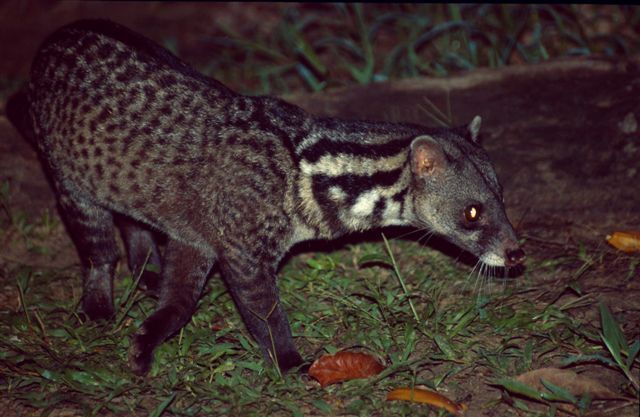
Malay Civet
Viverra tangalunga
The Malay civet (Viverra tangalunga), also known as the Malayan civet and Oriental civet, is a viverrid native to the Malay Peninsula and the islands of Sumatra, Bangka, Borneo, the Rhio-Lingga Archipelago, and the Philippines. It is listed as "Least Concern" by IUCN as it is a relatively widely distributed, appears to be tolerant of degraded habitats, and occurs in a number of protected areas.
From the article Malayan civet on Wikipedia (CC BY-SA), quoted section by section
Range & habitat
The historical range of the Malay civet includes Indonesia, Malaysia, Brunei, the Philippines and Singapore. In Malaysia, it occurs in Borneo, Banggi Island, Langkawi Island, Penang Island and in Peninsular Malaysia. It also occurs in Sumatra. It was introduced to Sulawesi and the Maluku Islands. Museum records indicate that the Malay civet also occurred on the Indonesian islands of Java, Bawal and Telok Pai, and on the Philippine island Leyte. In 2012, an individual was photographed in Singapore. The Malay civet population in the Philippines may have originated in Borneo and colonized Palawan island naturally. It possibly later dispersed to the rest of Philippines through human introduction, because land connection between Philippines islands did not exist during last glacial period. The Malay civet inhabits a wide variety of habitats including forests, secondary habitats, cultivated land and the outskirts of villages.
Wikipedia: “Distribution and habitat”
What it does
Malay civets are solitary, omnivorous, and primarily terrestrial. Densities of Malay civets are higher in unlogged than in a logged forests. Fruit comprises a larger proportion of diet in unlogged forest compared to logged forest. With fruit contributing a larger percentage of the diet in unlogged forests, logging may lead to increased competition by other frugivores such as palm civets which may exploit fruit directly on trees unlike the mainly terrestrial Malay civet. Around the Malaysian Bera Lake Malay civets were found in logged forest. Arboreal, frugivorous civets are little affected by logging, whereas terrestrial, carnivorous or insectivorous species might be negatively impacted by logging.
Wikipedia: “Ecology and behaviour”
Listen
Looking for field recordings…
Where it lives
Recorded sightings
—
geo-referenced records in GBIF, from museums, herbaria and field observers.
Drag the globe to turn it. Dots are where records exist, not a range map; darker means more records.
In the stacks
Searching the stacks…
Every page naming Viverra tangalunga in the Biodiversity Heritage Library →
This page is assembled live from iNaturalist, GBIF, Wikipedia, the Source Library and the Internet Archive. It is not yet part of the hand-edited codex. iNaturalist taxon 41615.