- Animals
- ›Chordates
- ›Vertebrates
- ›Mammals
- ›Therians
- ›Placental Mammals
- ›Ungulates, Carnivorans, and Allies
- ›Carnivorans
- ›Civets, Genets, and Oyans
- ›Large Terrestrial Civets
- ›Viverra
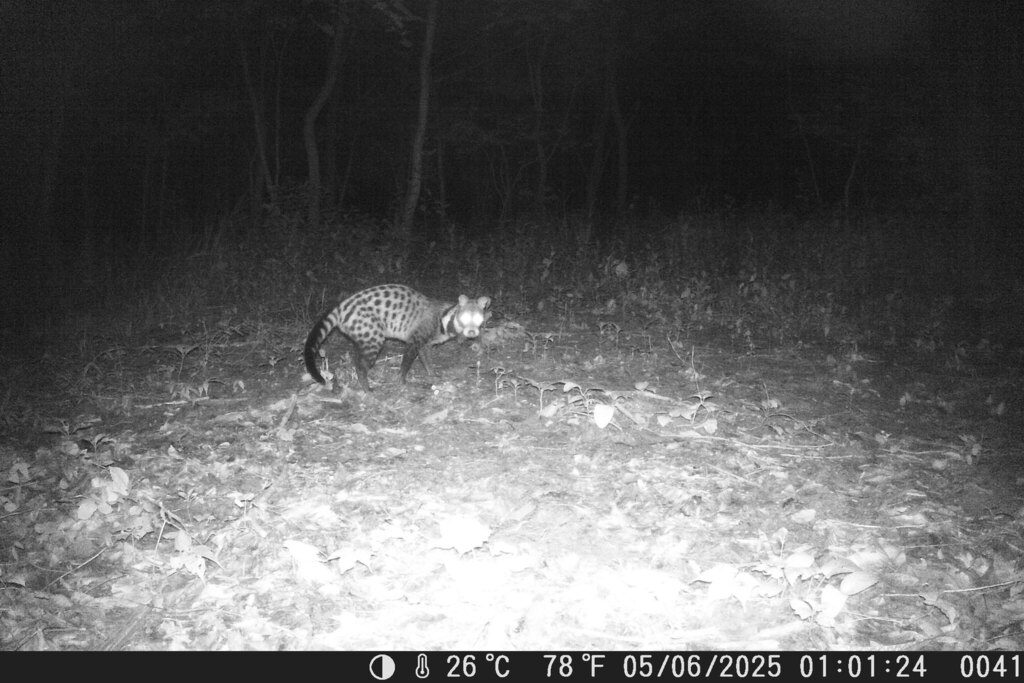
Large-spotted Civet
Viverra megaspila
The large-spotted civet (Viverra megaspila) is a species of viverrid native to Southeast Asia. It is listed as Endangered on the IUCN Red List.
From the article Large-spotted civet on Wikipedia (CC BY-SA), quoted section by section
Description
Pocock described the large-spotted civet as varying in colour from silvery-grey to golden-buff or tawny with a black to brown pattern and large or comparatively small spots, which are separated or sometimes fusing into blotches or into vertical stripes behind the shoulders. White bands on the tail are mostly restricted to the sides and lower surface but very seldom form complete rings. Adults measure 30–30.5 in (76–77 cm) in head and body with a 13–15.5 in (33–39 cm) long tail. Its weight ranges from 6.6–8.4 kg (14.5–18.5 lb).
Wikipedia: “Characteristics”
Range & habitat
The large-spotted civet occurs in Myanmar, Thailand, Malaysia, Cambodia, Laos, Vietnam and southern China. In China, it was last sighted in 1998. It inhabits evergreen, deciduous, and dry dipterocarp forests below elevations of 300 m (980 ft). In Thailand, it occurs in several protected areas as far south as Ranong Province.
Wikipedia: “Distribution and habitat”
In human culture
Pocock considered V. megaspila and V. civettina to be distinct species. Ellerman and Morrison-Scott considered V. civettina a subspecies of V. megaspila.
== References ==
Wikipedia: “Taxonomic history”
Listen
Looking for field recordings…
Where it lives
Recorded sightings
—
geo-referenced records in GBIF, from museums, herbaria and field observers.
Drag the globe to turn it. Dots are where records exist, not a range map; darker means more records.
In the stacks
Searching the stacks…
Every page naming Viverra megaspila in the Biodiversity Heritage Library →
This page is assembled live from iNaturalist, GBIF, Wikipedia, the Source Library and the Internet Archive. It is not yet part of the hand-edited codex. iNaturalist taxon 41616.