- Animals
- ›Chordates
- ›Vertebrates
- ›Mammals
- ›Therians
- ›Placental Mammals
- ›Ungulates, Carnivorans, and Allies
- ›Carnivorans
- ›Civets, Genets, and Oyans
- ›Palm Civets and Binturongs
- ›Paguma
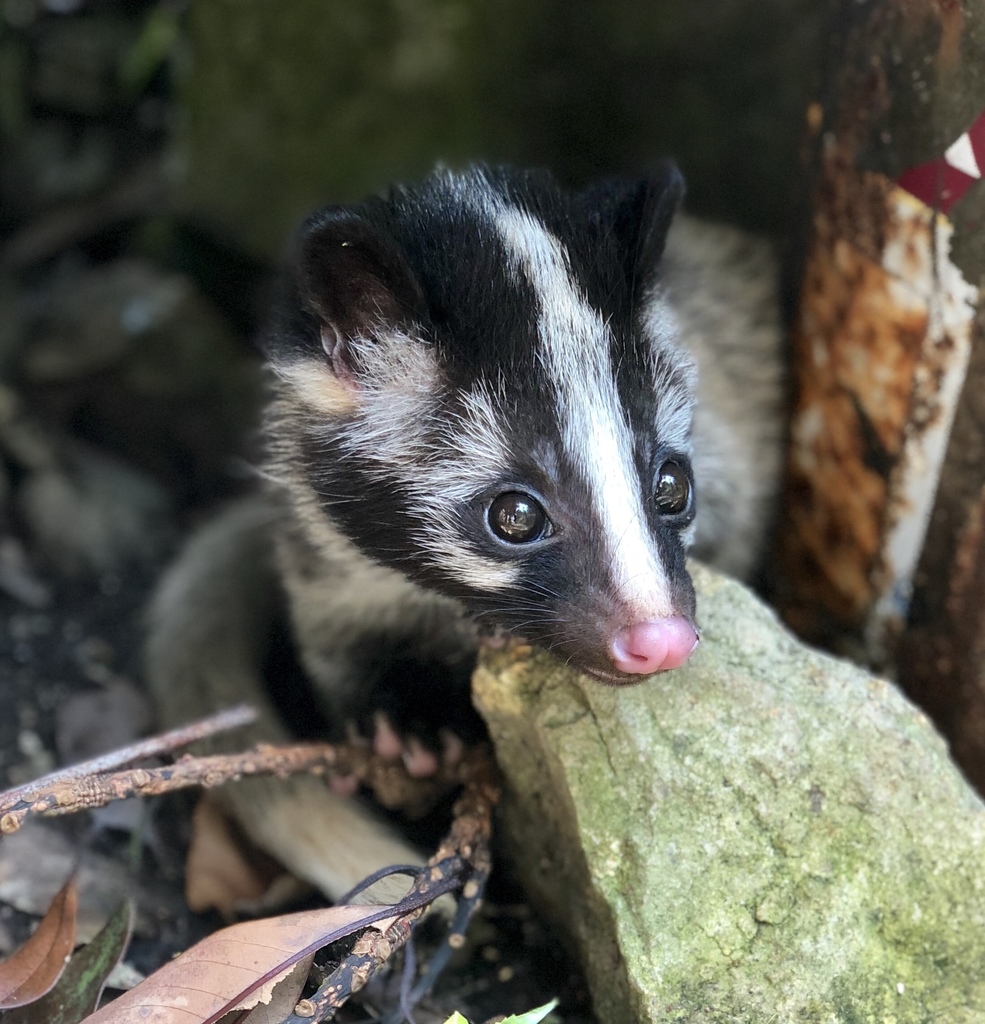
Masked Palm Civet
Paguma larvata
The masked palm civet (Paguma larvata), also called the gem-faced civet or Himalayan palm civet, is a viverrid species native to the Indian subcontinent and Southeast Asia. It has been listed as least concern on the IUCN Red List since 2008 as it occurs in many protected areas, is tolerant to some degree of habitat modification, and widely distributed with presumed large populations that are unlikely to be declining.
The genus Paguma was first named and described by John Edward Gray in 1831. All described forms are regarded as a single species.
From the article Masked palm civet on Wikipedia (CC BY-SA), quoted section by section
Description
The masked palm civet's fur is grayish to ochraceous, black on the head, shoulders and neck, and blackish brown on the tail and feet. It has a white blaze on the forehead; white marks above and below the eyes extend to the ears, forming a half-collar. In morphology the masked palm civet resembles other palm civets, but does not have spots or stripes. Its tail is more than two-thirds the length of head and body. It has two pairs of mammae. The whitish mask extends laterally to the far edges of the cheeks and caudally up the forehead, past the ears, and down the back of the neck before stopping just under the shoulder blades. The eyes are surrounded by white fur that can vary from faint, incomplete outlines to well-defined blotches. The lips, chin, and throat are white. In some, white stripes of fur, comparable to sideburns on humans due to shape and location, curve up from the throat. These curves vary in thickness and have ends that terminate either in small blotches at the ear base or large blotches that surround the base of both darkly furred ears. The species having a large repartition, differences in morphological parameters can be observable in different populations. …
Wikipedia: “Characteristics”
Range & habitat
The masked palm civet is distributed from the northern parts of the Indian subcontinent, especially the Himalayas, ranging eastwards across Bhutan, Bangladesh, Myanmar, Thailand, Peninsular Malaysia, Laos, Cambodia, Vietnam to China, Borneo, Sumatra, Taiwan, and the Andaman and Nicobar islands. It has been recorded in both evergreen and deciduous forest, and in disturbed habitat. It also inhabits fragmented forest habitats, albeit at reduced density. Results of a genetic study indicate that the masked palm civet is not native to Japan, but that it was introduced multiple times over centuries; at least two introductions were from Taiwan.
Wikipedia: “Distribution and habitat”
What it does
The masked palm civet is a nocturnal solitary predator that is occasionally active during the day. It is partly arboreal. When alarmed, the masked palm civet sprays a secretion from its anal gland to deter predators.
Feeding and diet. The masked palm civet is an omnivore feeding on rats and birds as well as on fruit such as figs, mangoes, bananas, and leaves. Scat analysis indicates that they also eat mollusks, arthropods, bark and to a lesser extent snakes and frogs. The composition of the diet varies between seasons and sites.
Reproduction. Masked palm civets are polyestrous and their mating behavior is promiscuous. There are two breeding seasons per year. The female bears up to four young. Masked palm civets are known to reach 15 years of age in captivity. Copulation in masked palm civets can last for more than 30 minutes. Upon completion of copulation, males leave a mating plug in the female's vaginal tract. The young grow to the size of an adult in about three months.
Wikipedia: “Ecology and behaviour”
Listen
Looking for field recordings…
Where it lives
Recorded sightings
—
geo-referenced records in GBIF, from museums, herbaria and field observers.
Drag the globe to turn it. Dots are where records exist, not a range map; darker means more records.
In the stacks
Searching the stacks…
Every page naming Paguma larvata in the Biodiversity Heritage Library →
This page is assembled live from iNaturalist, GBIF, Wikipedia, the Source Library and the Internet Archive. It is not yet part of the hand-edited codex. iNaturalist taxon 41625.