- Animals
- ›Chordates
- ›Vertebrates
- ›Mammals
- ›Therians
- ›Placental Mammals
- ›Ungulates, Carnivorans, and Allies
- ›Carnivorans
- ›Civets, Genets, and Oyans
- ›Large Terrestrial Civets
- ›Civettictis
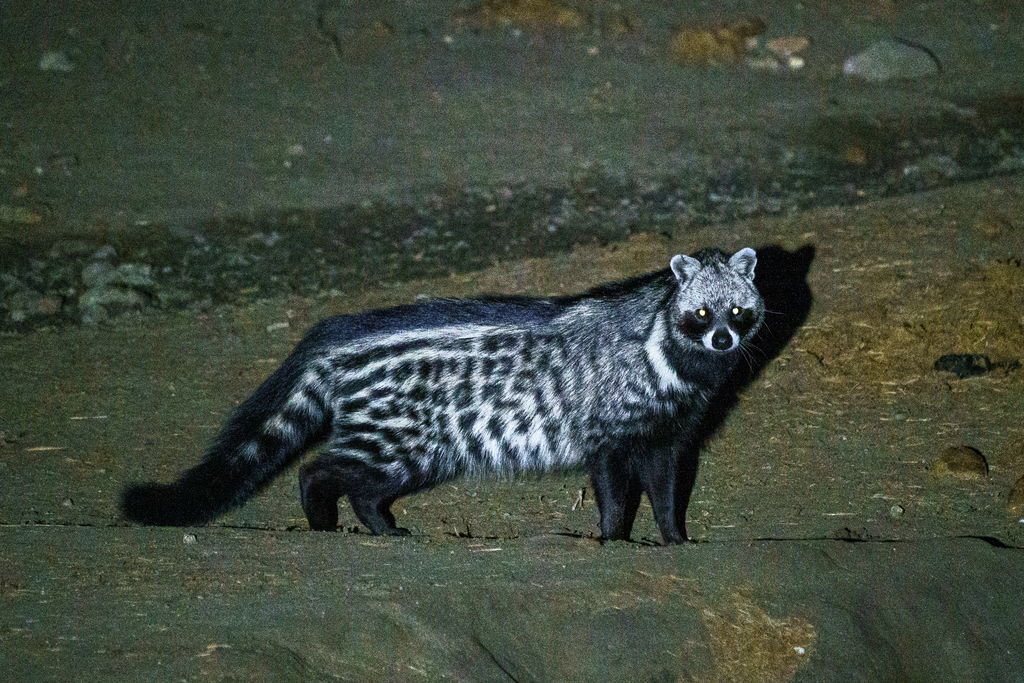
African Civet
Civettictis civetta
The African civet (Civettictis civetta) is a large viverrid native to sub-Saharan Africa, where it is considered common and widely distributed in woodlands and secondary forests. It has been listed as least concern on the IUCN Red List since 2008. In some countries, it is threatened by hunting, and wild-caught individuals are kept for producing civetone for the perfume industry.
The African civet is primarily nocturnal and spends the day sleeping in dense vegetation, but wakes up at sunset. It is a solitary mammal with a unique coloration: the black and white blotches covering its coarse pelage and rings on the tail are an effective cryptic pattern. The black bands surrounding its eyes closely resemble those of the raccoon. Other distinguishing features are its disproportionately large hindquarters and its erectile dorsal crest. It is an omnivorous generalist, preying on small vertebrates, invertebrates, eggs, carrion, and vegetable matter. It is one of the few carnivores capable of eating toxic invertebrates such as termites and millipedes. It detects prey primarily by smell and sound rather than by sight. It is the only living member of the genus Civettictis.
From the article African civet on Wikipedia (CC BY-SA), quoted section by section
Description
The African civet has a coarse and wiry fur that varies in colour from white to creamy yellow to reddish on the back. The stripes, spots, and blotches are deep brown to black. Horizontal lines are prominent on the hind limbs, spots are normally present on its midsection and fade into vertical stripes above the forelimbs. Its muzzle is pointed, ears small and rounded. A black band stretches across its small eyes, and two black bands are around its short broad neck. Following the spine of the animal extending from the neck to the base of the tail is the erectile dorsal crest. The hairs of the erectile crest are longer than those of the rest of the pelage. The sagittal crest of its skull is well-developed providing a large area for attachment of the temporal muscle. The zygomatic arch is robust and provides a large area for attachment of the masseter muscle. This musculature and its strong mandible give it a powerful bite. Its dental formula is 3.1.4.23.1.4.2. Its black paws are compact with hairless soles, five digits per manus in which the first toe is slightly set back from the others. Its long, curved claws are semi-retractile. Its head-and-body length is 67–84 cm (26–33 in), with a 34–47 cm (13–19 in) long tail. The average weight is 11 to 15 kg (24 to 33 lb) within a range of 7 to 20 kg (15 to 44 lb). It is the largest viverrid in Africa. …
Wikipedia: “Characteristics”
Range & habitat
African civets typically sleep during the day in the tall grasses near water sources in central and southern Africa. It often inhabits savannahs, forests, and sometimes near rivers as the tall grasses and thickets present provide them with necessary cover during the day. In Guinea's National Park of Upper Niger, it was recorded during surveys conducted in 1996 to 1997. In Gabon's Moukalaba-Doudou National Park, it was photographed close to forested areas during a survey in 2012. In Batéké Plateau National Park, it was recorded in gallery forest along the Mpassa River during surveys conducted between June 2014 and May 2015. In the Republic of Congo, it was recorded in the Western Congolian forest–savanna mosaic of Odzala-Kokoua National Park during surveys in 2007. In the transboundary Dinder–Alatash (Sudan and Ethiopia) protected area complex it was recorded during surveys between 2015 and 2018. It is also frequently spotted in Ethiopia's northern Degua Tembien massif.
Wikipedia: “Distribution and habitat”
What it does
African civets deposit their feces in large piles called latrines, or specifically "civetries". The latrines are characterized by fruits, seeds, exoskeletons of insect and millipede rings, and occasionally clumps of grass. The role of civet latrines as a mechanism of seed dispersal and forest regeneration is still being researched. Like felids, male African civets scent mark by spraying urine backwards. African civets are typically solitary creatures. They use their perineal gland secretion to mark their territories around their civetries. These markings typically follow common routes and paths and lie within 100 meters of civetries 96.72% of the time. If an African civet feels threatened, it raises its dorsal crest to make itself look larger and thus more formidable and dangerous to attack. This behavior is a predatory defense.
Feeding. Research in southeastern Nigeria revealed that the African civet has an omnivorous diet. …
Wikipedia: “Behaviour and ecology”
In human culture
The generic name Civettictis is a fusion of the French word civette and the Greek word ictis, meaning "weasel". The specific name civetta and the common name "civet" come from the French civette or the Arabic zabād or sinnawr al-zabād ("civet cat").
Local and indigenous names. In Tigrinya: ዝባድ (zibad) In Akan: kankane In Luganda: Ffumbe, Effumbe In Yoruba: Ẹtà, àgútà In Igbo: Edi
Wikipedia: “Etymology”
Listen
Looking for field recordings…
Where it lives
Recorded sightings
—
geo-referenced records in GBIF, from museums, herbaria and field observers.
Drag the globe to turn it. Dots are where records exist, not a range map; darker means more records.
In the stacks
Searching the stacks…
Every page naming Civettictis civetta in the Biodiversity Heritage Library →
This page is assembled live from iNaturalist, GBIF, Wikipedia, the Source Library and the Internet Archive. It is not yet part of the hand-edited codex. iNaturalist taxon 41627.