- Animals
- ›Chordates
- ›Vertebrates
- ›Mammals
- ›Therians
- ›Placental Mammals
- ›Ungulates, Carnivorans, and Allies
- ›Carnivorans
- ›Bears
- ›Typical Bears
- ›Ursus
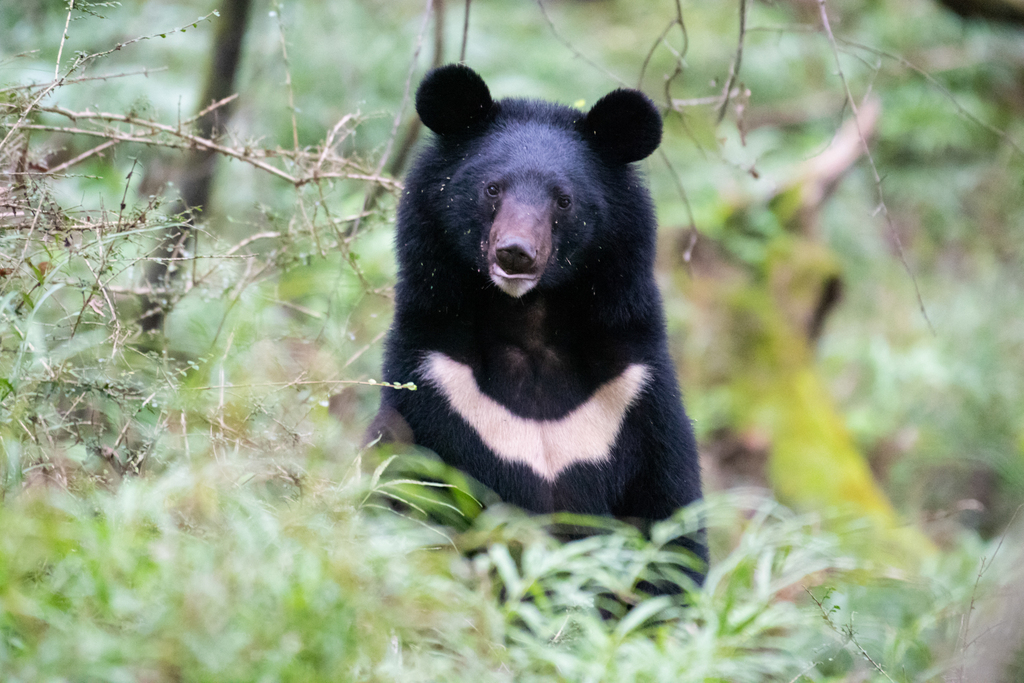
Asian Black Bear
Ursus thibetanus
The Asian black bear (Ursus thibetanus), also known as the Asiatic black bear, moon bear and white-chested bear, is a medium-sized bear species native to Asia that is largely adapted to an arboreal lifestyle. It is distributed from southeastern Iran, Pakistan, India and the Himalayas to mainland Southeast Asia, the Korean Peninsula, Taiwan, China and the Russian Far East to the islands of Honshū and Shikoku in Japan. It is listed as vulnerable on the IUCN Red List, and is threatened by deforestation and poaching for its body parts, which are used in traditional medicine.
From the article Asian black bear on Wikipedia (CC BY-SA), quoted section by section
Description
The Asian black bear has black fur, a light brown muzzle, and a distinct whitish or creamy patch on the chest, which is sometimes V-shaped. Its ears are bell shaped, proportionately longer than those of other bears, and stick out sideways from the head. Its tail is short, around 11 cm (4.3 in) long. Adults measure 70–100 cm (28–39 in) at the shoulder, and 120–190 cm (47–75 in) in length. Adult males weigh 60–200 kg (130–440 lb) with an average weight of about 135 kg (298 lb). Adult females weigh 40–125 kg (88–276 lb), and large ones up to 140 kg (310 lb). The Asian black bear is similar in general build to the brown bear (Ursus arctos), but is lighter and smaller. The lips and nose are larger and more mobile than those of brown bears. The skull of the Asian black bear is relatively small but massive, particularly in the lower jaw. Adult males have skulls measuring 311.7 to 328 mm (12.27 to 12.91 in) in length and 199.5–228 mm (7.85–8.98 in) in width, while female skulls are 291.6–315 mm (11.48–12.40 in) long and 163–173 mm (6.4–6.8 in) wide. …
Wikipedia: “Characteristics”
Range & habitat
During the Middle Pleistocene and early Late Pleistocene, the Asian black bear ranged from the Iberian Peninsula, the Balkans to the Ural Mountains. Today, it occurs very patchily in its former range from southeastern Iran eastward through Afghanistan and Pakistan, across the foothills of the Himalayas in India and Myanmar to mainland Southeast Asia, except Malaysia. Its range in mainland China is patchy in the northeast and south, Hainan, and it is absent in much of east-central China. Other population clusters exist in Taiwan, the southern Russian Far East and in North Korea. Small remnant populations survive in South Korea, and on Honshu and Shikoku islands. It typically inhabits deciduous forests, mixed forests and thornbrush forests. In the summer, it usually inhabits elevations of around 3,500 m (11,480 ft) in the Himalayas but rarely above 3,700 m (12,000 ft). In winter, it descends to elevations below 1,500 m (4,920 ft). In Japan, it also occurs at sea level. There is no definitive estimate as to the number of Asian black bears: Japan posed estimates of 8–14,000 bears living on Honshū, though the reliability of this is now doubted. Although their reliability is unclear, rangewide estimates of 5–6,000 Asian black bears have been presented by Russian biologists. …
Wikipedia: “Distribution and habitat”
What it does
Asian black bears are diurnal, though they become nocturnal near human habitations. They will walk in a procession of largest to smallest. They are good climbers of rocks and trees, and will climb to feed, rest, sun, elude enemies and hibernate. Some older bears may become too heavy to climb. Half of their life is spent in trees and they are one of the largest arboreal mammals. In the Ussuri territory in the Russian Far East, Asian black bears can spend up to 15% of their time in trees. Asian black bears break branches and twigs to place under themselves when feeding on trees, thus causing many trees in their home ranges to have nest-like structures on their tops. Asian black bears will rest for short periods in nests on trees standing fifteen feet or higher. Asian black bears do not hibernate over most of their range. They may hibernate in their colder, northern ranges, though some bears will simply move to lower elevations. Nearly all pregnant sows hibernate. Asian black bears prepare their dens for hibernation in mid-October, and will sleep from November until March. Their dens can either be dug-out hollow trees (60 feet above ground), caves or holes in the ground, hollow logs, or steep, mountainous and sunny slopes. They may also den in abandoned brown bear dens. Asian black bears tend to den at lower elevations and on less steep slopes than brown bears. …
Wikipedia: “Behavior and ecology”
In human culture
In Japanese culture, the Asian black bear is traditionally associated with the mountain spirit (yama no kami) and is characterized variously as 'mountain man' (yamaotoko), 'mountain uncle' (yama no ossan), 'mountain father' (yama no oyaji), a loving mother, and a child. Being a largely solitary creature, the Asian black bear is also viewed as 'lonely person' (sabishigariya). Asian black bears feature very little in lowland Japanese folklore, but are prominent in upland Japan, a fact thought to reflect the bear's greater economic value in upland areas. According to the local folklore in Kituarahara-gun in Niigata, the Asian black bear received its white mark after being given a silk-wrapped amulet by yama no kami, which left the mark after being removed. In Hindu mythology, the Asian black bear Jambavantha (also known as Jambavan or Jamvanta) is believed to have lived from Treta Yuga to Dvapara Yuga. In the epic Ramayana, Jambavantha assists Rama in finding his wife Sita and battle her abductor, Ravana. The Asian black bear in Thailand is called mi khwai (Thai: หมีควาย), meaning 'buffalo bear', not due to its appearance, but a v-shaped patch of fur under its neck similar to that of a buffalo. …
Wikipedia: “In folklore, literature, and popular culture”
Listen
Looking for field recordings…
Where it lives
Recorded sightings
—
geo-referenced records in GBIF, from museums, herbaria and field observers.
Drag the globe to turn it. Dots are where records exist, not a range map; darker means more records.
In the stacks
Searching the stacks…
Every page naming Ursus thibetanus in the Biodiversity Heritage Library →
This page is assembled live from iNaturalist, GBIF, Wikipedia, the Source Library and the Internet Archive. It is not yet part of the hand-edited codex. iNaturalist taxon 41647.