- Animals
- ›Chordates
- ›Vertebrates
- ›Mammals
- ›Therians
- ›Placental Mammals
- ›Ungulates, Carnivorans, and Allies
- ›Carnivorans
- ›Raccoons, Coatis, and Allies
- ›Procyon
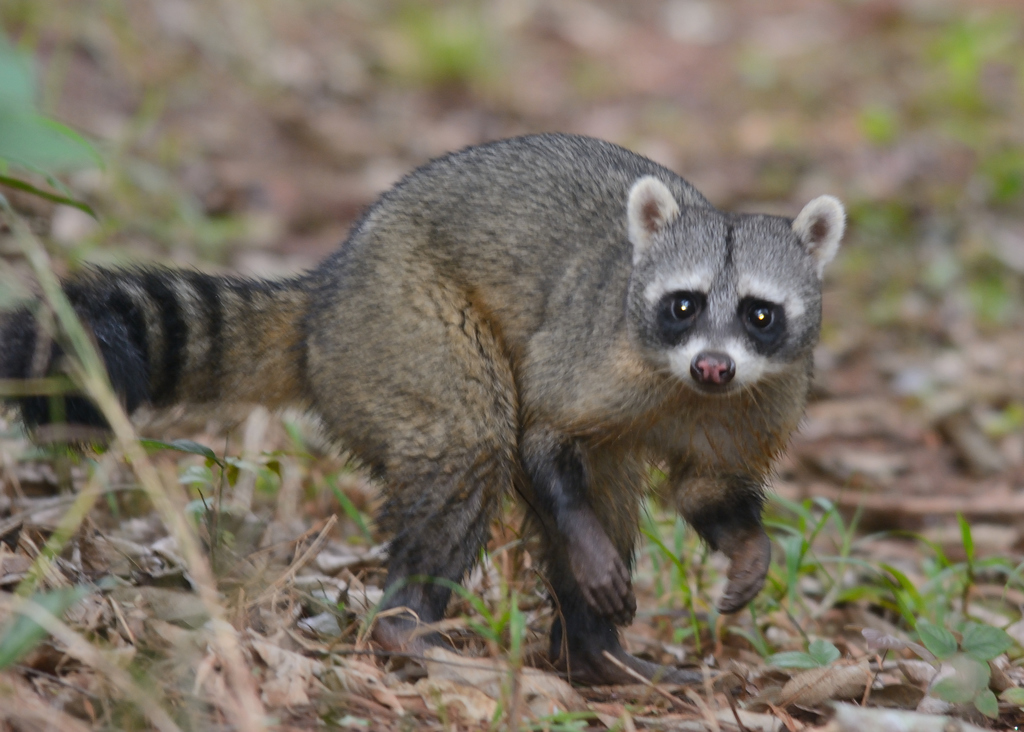
Crab-eating Raccoon
Procyon cancrivorus
The crab-eating raccoon, southern raccoon, or South American raccoon (Procyon cancrivorus) is a species of raccoon native to marshy and jungle areas of Central and South America (including Trinidad and Tobago). It is found from Costa Rica south through most areas of South America east of the Andes down to northern Argentina and Uruguay. Despite its name, this species does not feed exclusively on crabs, and the common raccoon also seeks and eats crabs where they are available. In the Tupi–Guarani languages, it is known as aguará or agoará popé.
From the article Crab-eating raccoon on Wikipedia (CC BY-SA), quoted section by section
Range & habitat
The crab-eating raccoon can be found in South America and parts of Central America. It can be found in Trinidad and Tobago, Costa Rica, Panama, Colombia, Venezuela, Suriname, Guyana, French Guiana, Ecuador, Brazil, Peru, Bolivia, Paraguay, Uruguay, and Argentina.
Wikipedia: “Distribution”
What it does
The crab-eating raccoon eats crabs, lobsters, crayfish, other crustaceans, and shellfish, such as oysters and clams. It is an omnivore and its diet also includes, for example, small amphibians, fish, insects, small turtles, turtle eggs, fruits, nuts, and vegetables. It resembles its northern cousin, the common raccoon, in having a bushy ringed tail and "bandit mask" of fur around its eyes. Unlike the common raccoon, the hair on the nape of the neck points towards the head, rather than backward. The crab-eating raccoon also appears to be more adapted to an arboreal lifestyle than the common raccoon, with sharper, narrower claws. It also is better adapted for a diet of hard-shelled food, with most of the cheek teeth being larger than those of the common raccoon, with broader, rounded cusps. Although the crab-eating raccoon can appear smaller and more streamlined than the common raccoon due to its much shorter fur and more gracile build, the crab-eating raccoon is of similar dimensions to the northern species. Therefore, Allen's rule does not apply to the genus. Head and body length is 41 to 80 cm (16 to 31 in), tail length is 20 to 56 cm (8 to 22 in) and height at the shoulder is about 23 cm (9 in). Weights can range from 2 to 12 kg (4 to 26 lb), though are mostly between 5 and 7 kg (11 and 15 lb). Males are usually larger than the females. …
Wikipedia: “Diet and anatomy”
Listen
Looking for field recordings…
Where it lives
Recorded sightings
—
geo-referenced records in GBIF, from museums, herbaria and field observers.
Drag the globe to turn it. Dots are where records exist, not a range map; darker means more records.
In the stacks
Searching the stacks…
Every page naming Procyon cancrivorus in the Biodiversity Heritage Library →
This page is assembled live from iNaturalist, GBIF, Wikipedia, the Source Library and the Internet Archive. It is not yet part of the hand-edited codex. iNaturalist taxon 41667.