- Animals
- ›Chordates
- ›Vertebrates
- ›Mammals
- ›Therians
- ›Placental Mammals
- ›Ungulates, Carnivorans, and Allies
- ›Carnivorans
- ›Raccoons, Coatis, and Allies
- ›Potos
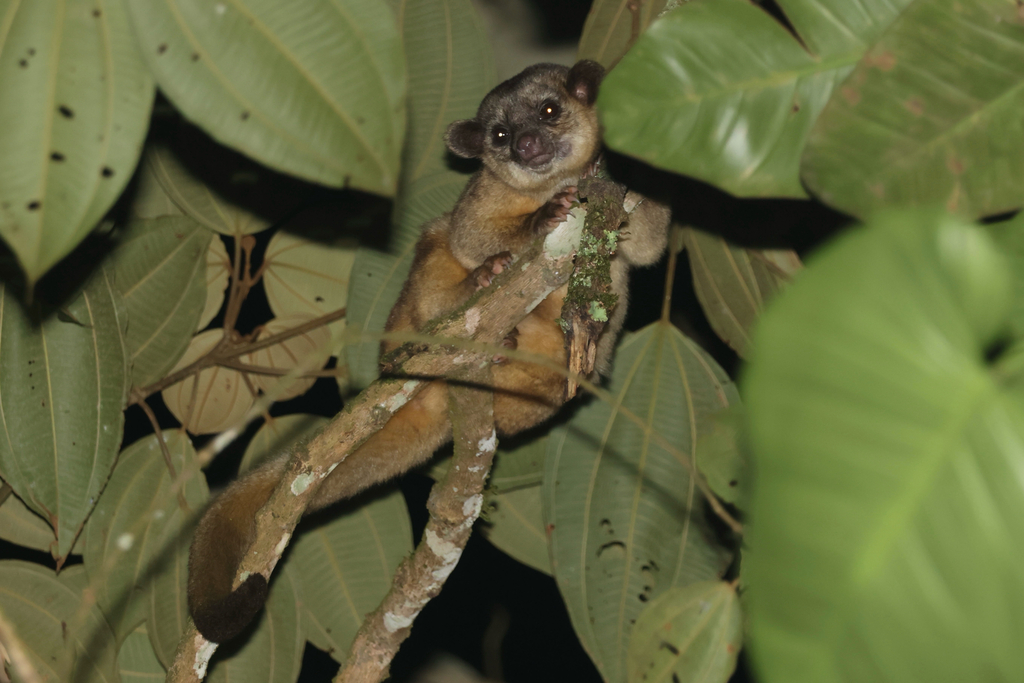
Kinkajou
Potos flavus
The kinkajou (/ˈkɪŋkədʒuː/ KING-kə-joo; Potos flavus) is a mammal of the family Procyonidae, a relative to olingos, coatis, raccoons, and the ringtail and cacomistle. It is the only member of the genus Potos and is also known as the honey bear (a name shared with several unrelated species). Though kinkajous are arboreal, they are not closely related to any other tree-dwelling mammal group (primates, mustelids, etc.).
Native to tropical rainforests of Mexico, Central and South America, this mostly frugivorous mammal is seldom seen by people because of its strict nocturnal habits. However, it is hunted for the pet trade, its skin (to make wallets and horse saddles), and its meat. The species has been included in Appendix III of CITES by Honduras, which means that exports from Honduras require an export permit, and exports from other countries require a certificate of origin or of re-export. They may live up to 40 years in captivity.
From the article Kinkajou on Wikipedia (CC BY-SA), quoted section by section
Range & habitat
Kinkajous range from east and south of the Sierra Madre in Mexico, throughout Central America to Bolivia east of the Andes and the Atlantic Forest of southeastern Brazil. Their altitudinal range is from sea level to 2,500 m (8,200 ft). They are found in closed-canopy tropical forests, including lowland rainforest, montane forest, dry forest, gallery forest, and secondary forest. Deforestation is thus a potential threat to the species.
Wikipedia: “Range and habitat”
What it does
Although the kinkajou is classified in the order Carnivora and has sharp teeth, its omnivorous diet consists mainly of fruit, particularly figs. Some 90% of their diet consists of (primarily ripe) fruit. To eat softer fruits, they hold it with their forepaws, then scoop out the succulent pulp with their tongue. They may play an important role in seed dispersal. Leaves, flowers, nectar, and various herbs make up much of the other 10% of their diet. They sometimes eat insects, particularly ants. They may occasionally eat bird eggs and small vertebrates. Their frugivorous habits are convergent with those of diurnal spider monkeys, with the two species filling similar ecological roles where they overlap, but at different times of the day. The kinkajou's slender 5-inch (13 cm) extrudable tongue helps the animal to obtain fruit and to lick nectar from flowers, so it may act as a pollinator. (Nectar is also sometimes obtained by eating entire flowers.) Although captive specimens avidly eat honey (hence the name "honey bear"), honey in the diet of wild kinkajous is not well reported. While they are usually solitary when foraging, they occasionally forage in large groups, and sometimes associate with olingos (which are also nocturnal arboreal frugivores). The larger kinkajous are dominant and will drive olingos away when food is scarce. …
Wikipedia: “Feeding”
In human culture
The common name kinkajou derives from French quincajou, based on the Algonquian name for the wolverine. It is similar to the Ojibwe word gwiingwaʼaage, perhaps from a Proto-Algonquian *kwi·nkwaʔa·ke. Its other names in English include honey bear, night ape, and night walker. Throughout its range, several regional names are used; for instance, the Dutch names nachtaap, rolbeer, and rolstaartbeer are used in Suriname. Local names in Portuguese and Spanish include jupará, yapará, huasa, cuchi cuchi, leoncillo, marta, and perro de monte; many of these come from indigenous languages such as Old Tupi.
Wikipedia: “Etymology”
Listen
Looking for field recordings…
Where it lives
Recorded sightings
—
geo-referenced records in GBIF, from museums, herbaria and field observers.
Drag the globe to turn it. Dots are where records exist, not a range map; darker means more records.
In the stacks
Searching the stacks…
Every page naming Potos flavus in the Biodiversity Heritage Library →
This page is assembled live from iNaturalist, GBIF, Wikipedia, the Source Library and the Internet Archive. It is not yet part of the hand-edited codex. iNaturalist taxon 41678.