- Animals
- ›Flatworms
- ›Rhabditophora
- ›Neodermata
- ›tapeworms
- ›Eucestoda
- ›Cyclophyllidea
- ›Bird and Rodent Tapeworms
- ›Hymenolepis
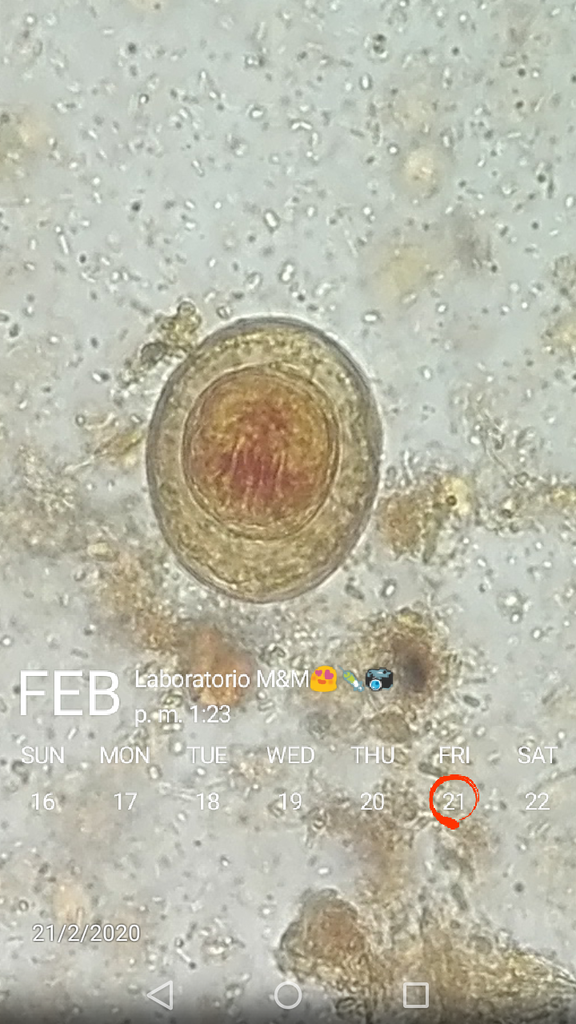
Dwarf Tapeworm
Hymenolepis nana
The dwarf tapeworm (Hymenolepis nana, also known as Rodentolepis nana, Vampirolepis nana, Hymenolepis fraterna, and Taenia nana) is a cosmopolitan species though most common in temperate zones, and is one of the most common cestodes (a type of intestinal worm or helminth) infecting humans, especially children.
From the article Hymenolepis nana on Wikipedia (CC BY-SA), quoted section by section
Description
As its name implies (Ancient Greek: νᾶνος, nānos – dwarf), it is a small species, seldom exceeding 40 mm long and 1 mm wide. The scolex bears a retractable rostellum armed with a single circle of 20 to 30 hooks. The scolex also has four suckers, or a tetrad. The neck is long and slender, and the segments are wider than long. Genital pores are unilateral, and each mature segment contains three testes. After apolysis, gravid segments disintegrate, releasing eggs, which measure 30 to 47 μm in diameter. The oncosphere is covered with a thin, hyaline, outer membrane and an inner, thick membrane with polar thickenings that bear several filaments. The heavy embryophores that give taeniid eggs their characteristic striated appearance are lacking in this and the other families of tapeworms infecting humans. The rostellum remains invaginated in the apex of the organ. Rostellar hooklets are shaped like tuning forks. The neck is long and slender, the region of growth. The strobila starts with short, narrow proglottids, followed with mature ones.
Wikipedia: “Morphology”
What it does
Infection is acquired most commonly from eggs in the feces of another infected individual, which are transferred in food, by contamination. Eggs hatch in the duodenum, releasing oncospheres, which penetrate the mucosa and come to lie in lymph channels of the villi. An oncosphere develops into a cysticercoid which has a tail and a well-formed scolex. It is made of longitudinal fibers and is spade-shaped with the rest of the worm still inside the cyst. In five to six days, cysticercoids emerge into the lumen of the small intestine, where they attach and mature. The direct life cycle is doubtless a recent modification of the ancestral two-host life cycle found in other species of hymenolepidids, because cysticercoids of H. nana can still develop normally within larval fleas and beetles. One reason for facultative nature of the life cycle is that H. nana cysticercoids can develop at higher temperatures than can those of the other hymenolepidids. Direct contaminative infection by eggs is probably the most common route in human cases, but accidental ingestion of an infected grain beetle or flea cannot be ruled out. The direct infectiousness of the eggs frees the parasite from its former dependence upon an insect intermediate host, making rapid infection and person-to-person spread possible. …
Wikipedia: “Life cycle”
In human culture
In 1887, Grassi demonstrated that transmission from rat to rat did not require an intermediate host. Later, in 1921, Saeki demonstrated a direct cycle of transmission of H. nana in humans, transmission without an intermediate host. In addition to the direct cycle, Nicholl and Minchin demonstrated that fleas can serve as intermediate hosts between humans.
Wikipedia: “History”
Where it lives
Recorded sightings
—
geo-referenced records in GBIF, from museums, herbaria and field observers.
Drag the globe to turn it. Dots are where records exist, not a range map; darker means more records.
In the stacks
Searching the stacks…
Every page naming Hymenolepis nana in the Biodiversity Heritage Library →
This page is assembled live from iNaturalist, GBIF, Wikipedia, the Source Library and the Internet Archive. It is not yet part of the hand-edited codex. iNaturalist taxon 417443.