- Animals
- ›Flatworms
- ›Rhabditophora
- ›Neodermata
- ›tapeworms
- ›Eucestoda
- ›Cyclophyllidea
- ›Bird and Rodent Tapeworms
- ›Hymenolepis
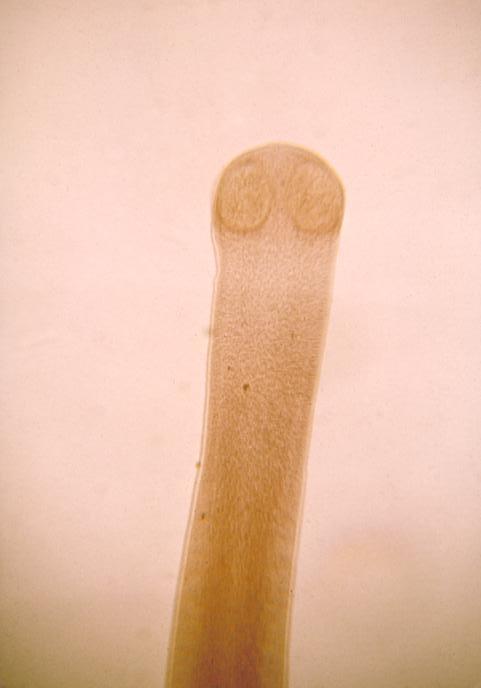
Rat Tapeworm
Hymenolepis diminuta
Hymenolepis diminuta, also known as rat tapeworm, is a species of Hymenolepis tapeworm that causes hymenolepiasis. It has slightly bigger eggs and proglottids than H. nana and infects mammals using insects as intermediate hosts. The adult structure is 20 to 60 cm long and the mature proglottid is similar to that of H. nana, except it is larger.
Hymenolepis diminuta is prevalent worldwide, but only a few hundred human cases have been reported. Few cases have ever been reported in Australia, United States, Spain, and Italy. In countries such as Malaysia, Thailand, Jamaica, Indonesia, the prevalence is higher.
From the article Hymenolepis diminuta on Wikipedia (CC BY-SA), quoted section by section
What it does
The cycle begins as arthropods ingest the eggs. Arthropods are then able to act as the intermediate host. When ingested, the eggs develop into cysticercoids. As shown in the CDC life cycle, oncospheres hatch and then penetrate the intestinal wall. Rodents can become infected when they eat arthropods. Humans, especially children, can ingest the arthropods as well and therefore become infected via the same mechanism. Rodents, especially rats, are definitive hosts and natural reservoirs of H. diminuta. It induces apoptosis in the intenstine's epithelial tissue. The intermediate hosts are the coprophilic arthropods (fleas, lepidoptera, and coleoptera). As the definitive host (rats) eats an infected arthropod, cysticercoids present in the body cavity transform into the adult worm. The resulting eggs are then passed through the stool. In recent findings, beetle-to-beetle transmission of H. diminuta can be seen via the feces. Additionally, more infections occur due to this mechanism of egg dispersal.
Wikipedia: “Life cycle”
Where it lives
Recorded sightings
—
geo-referenced records in GBIF, from museums, herbaria and field observers.
Drag the globe to turn it. Dots are where records exist, not a range map; darker means more records.
In the stacks
Searching the stacks…
Every page naming Hymenolepis diminuta in the Biodiversity Heritage Library →
This page is assembled live from iNaturalist, GBIF, Wikipedia, the Source Library and the Internet Archive. It is not yet part of the hand-edited codex. iNaturalist taxon 417446.