- Animals
- ›Chordates
- ›Vertebrates
- ›Mammals
- ›Therians
- ›Placental Mammals
- ›Ungulates, Carnivorans, and Allies
- ›Carnivorans
- ›Mustelids
- ›Otters
- ›Lontra
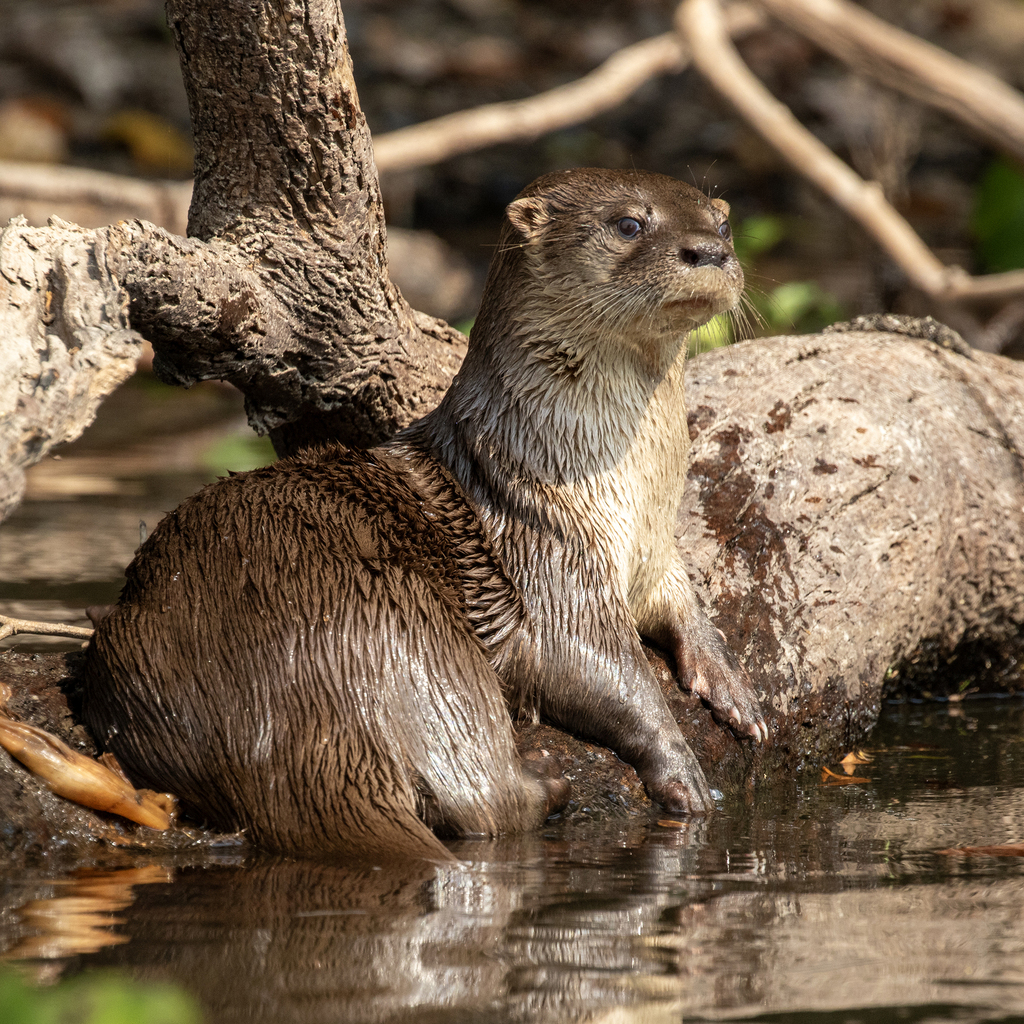
Central Neotropical River Otter
Lontra longicaudis
The neotropical otter or neotropical river otter (Lontra longicaudis) is a near-threatened (per the IUCN) otter species found in freshwater systems from Mexico and Central America through mainland South America, as well as the island of Trinidad. It is physically similar to the northern (L. canadensis) and southern river otter (L. provocax), which occur directly north and south of this species' range, respectively. Its head-to-body length can range from 36–66 centimetres (14–26 in), plus a tail of 37–84 centimetres (15–33 in). Body weight ranges from 5–15 kilograms (11–33 lb).
The neotropical otter is found in many different riverine habitats and riparian zones, including those in tropical and temperate deciduous to evergreen forests, savannas, llanos (of Colombia and Venezuela) and the pantanal (in Bolivia, Brazil and Paraguay). It prefers to live in clear, fast-flowing rivers and streams, preferably away from competition with the more boisterous giant otter (Pteronura brasiliensis). Unlike other otters (including the aforementioned giant species), which live in large and cohesive socio-familial units, the neotropical otter is a relatively solitary animal, feeding mostly on fish and crustaceans.
From the article Neotropical otter on Wikipedia (CC BY-SA), quoted section by section
Description
The Neotropical otter is covered in a short, dark grayish-brown pelage. Fur color is lighter around the muzzle and throat. They possess a long wide tail, with short stout legs and fully webbed toes. Sexually dimorphic, the males are about 25% larger than the females. Its head-and-body length can range from 36–66 centimetres (14–26 in), plus a tail of 37–84 centimetres (15–33 in). Body mass of the otter generally ranges from 5 to 15 kilograms (11–33 pounds). Neotropical otters will communicate with nearby otters via scent marking. Communication may also occur via whistles, hums, and screeches. The dental formula seldom varies from that of Eurasian otters (Lutra lutra), except in the few cases of otters that have dental anomalies. Females and males have the same formula. The dental formula (for half the skull) is as follows:
Upper: 3 incisors, 1 canine, 4 premolars and 1 molar Lower: 3 incisors, 1 canine, 3 premolars and 2 molars
Range & habitat
The Neotropical otter has the widest distribution of all the Lontra species. Their habitat can range from northwest Mexico to central Argentina. They prefer clear, fast-flowing rivers, and are rarely known to settle in sluggish, silt-laden lowland waters or boggy areas. While mostly occurring at 300–1,500 m (980–4,900 ft) above sea level, they have been found settled at 3,000 m (9,800 ft). They require dense riparian vegetation and abundant den sites but, other than that, the Neotropical otter is very versatile and tolerant to environmental change. The otters prefer den sites that are solid, high, dry, and in proximity to deep water. The Neotropical otter is the greatest generalist of all otter species. In addition to rivers and streams, they can settle in and exploit some rather formidable habitats, such as wastewater treatment plants, rice paddies, sugar cane plantations, estuaries, deltas, drainage ditches, and sometimes swamps. They can inhabit cold, glacial lakes and streams in the Andes of Ecuador and Colombia. Neotropical otters will also venture to the seashore and beaches (maintaining an almost "brackish" lifestyle), hunting marine creatures and playing in the highly saline water.
Wikipedia: “Distribution and habitat”
What it does
The Neotropical otter's diet consists mostly of fish and crustaceans making up 67% and 28%, respectively, of its total diet. The otter will also occasionally feed on mollusks and small mammals, as well as birds, large insects and fruits. In areas where fish and crustaceans are scarce, aquatic insects, such as dobsonfly larvae, can become its main prey. This otter is known to occasionally attack fishnets for a source of prey, hindering fishing productivity. Otters living near marine habitats can have a much higher proportion of crustaceans in their diets. Seasonality also greatly affect otters' food choice. During the dry season, when less fish and crustaceans are available, one study found a higher proportion of frogs in otters' diet. Though, during this time, anurans and reptiles still made up a very small percentage of the total diet. This might also be due to the fact that certain frogs mate during the dry season, so the frogs are easier prey. All in all, the distribution of available food species in a particular area roughly correlates to the percentage of each species found in otters' diet.
Wikipedia: “Diet”
Listen
Looking for field recordings…
Where it lives
Recorded sightings
—
geo-referenced records in GBIF, from museums, herbaria and field observers.
Drag the globe to turn it. Dots are where records exist, not a range map; darker means more records.
In the stacks
Searching the stacks…
Every page naming Lontra longicaudis in the Biodiversity Heritage Library →
This page is assembled live from iNaturalist, GBIF, Wikipedia, the Source Library and the Internet Archive. It is not yet part of the hand-edited codex. iNaturalist taxon 41778.