- Animals
- ›Chordates
- ›Vertebrates
- ›Mammals
- ›Therians
- ›Placental Mammals
- ›Ungulates, Carnivorans, and Allies
- ›Carnivorans
- ›Mustelids
- ›Wolverines, Martens, and Tayras
- ›Martes
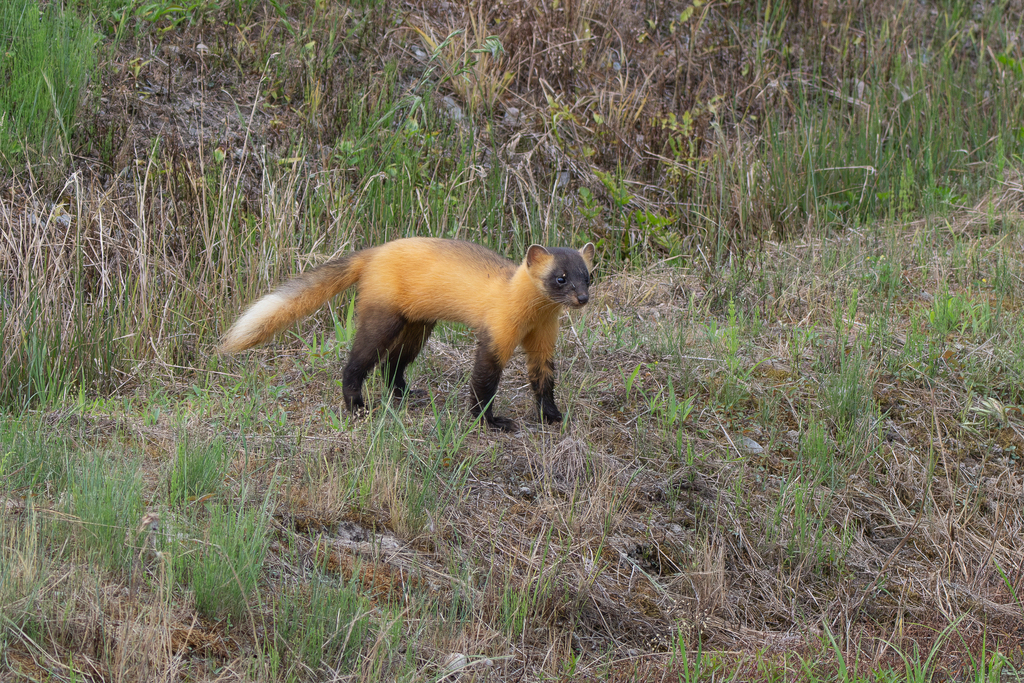
Japanese Marten
Martes melampus
The Japanese marten (Martes melampus) is a marten species endemic to Japan. It is native to the forested regions of Honshu, Kyushu, Shikoku, and Tsushima, Japan. It is agile, territorial, and is important in seed dispersal in northern Japan's shrublands. Its coat varies depending on the region from yellow to brown. It is least concerned in conservations status despite habitat loss from logging and forest fragmentation. Conservation efforts include legal protection and habitat restoration.
In Japanese folklore it is associated with shapeshifting and omens.
From the article Japanese marten on Wikipedia (CC BY-SA), quoted section by section
Description
It is 0.5 m (1.6 ft) in length typically, not including a 20 cm (8 in) long tail, and between 1 and 1.5 kg (2.2 and 3.3 lb) in weight. Males are generally larger than females. The pelage varies in color from dark brown to dull yellow with a cream-colored throat. Honshu and Kyushu martens have yellow fur coats, while Tsushima and Shikoku martens have brown fur coats.
Range & habitat
The Japanese marten prefers low-disturbed deciduous broad-leave forests and mixed forests due to the presence of fruit-bearing trees and vegetation for food and shelter. In the winter, the Japanese marten tends to go to the forests where it can get the most prey. In the summer, its habitat and diet become much more generalized, allowing it to live in a much more varied environment. The Japanese marten can be found throughout regions in Japan with forests such as Honshu, Kyushu, Shikoku, and Tsushima Islands. Different populations in different regions have certain genetic traits making them unique from one another.
Wikipedia: “Habitat”
What it does
Both males and females are territorial; the size of each individual's territory depends on food availability. The Japanese marten is omnivorous, preferring meat from fish, frogs, and small birds and mammals, but consuming insects, fruit, and seeds when necessary. Its diet varies based on season and the environment, adapting to available food sources. In warmer months such as the spring and summer, it eats mammals (rodents and arthropods) and birds. Fruit is eaten all year, although the type of fruit depends on what is readily available. They feed off of existing carcasses in short increments of time to avoid competition with larger species such as bears. Some large animals are beneficial to martens, as they open up carcasses making food more accessible to them. It has a very good sense of smell to aid in food location.
Wikipedia: “Diet and behavior”
Listen
Looking for field recordings…
Where it lives
Recorded sightings
—
geo-referenced records in GBIF, from museums, herbaria and field observers.
Drag the globe to turn it. Dots are where records exist, not a range map; darker means more records.
In the stacks
Searching the stacks…
Every page naming Martes melampus in the Biodiversity Heritage Library →
This page is assembled live from iNaturalist, GBIF, Wikipedia, the Source Library and the Internet Archive. It is not yet part of the hand-edited codex. iNaturalist taxon 41794.