- Animals
- ›Chordates
- ›Vertebrates
- ›Ray-finned Fishes
- ›Spiny-rayed fishes
- ›Freshwater Sunfishes, Grunters, and Allies
- ›Freshwater Sunfishes and relatives
- ›Oriental Perches
- ›Coreoperca
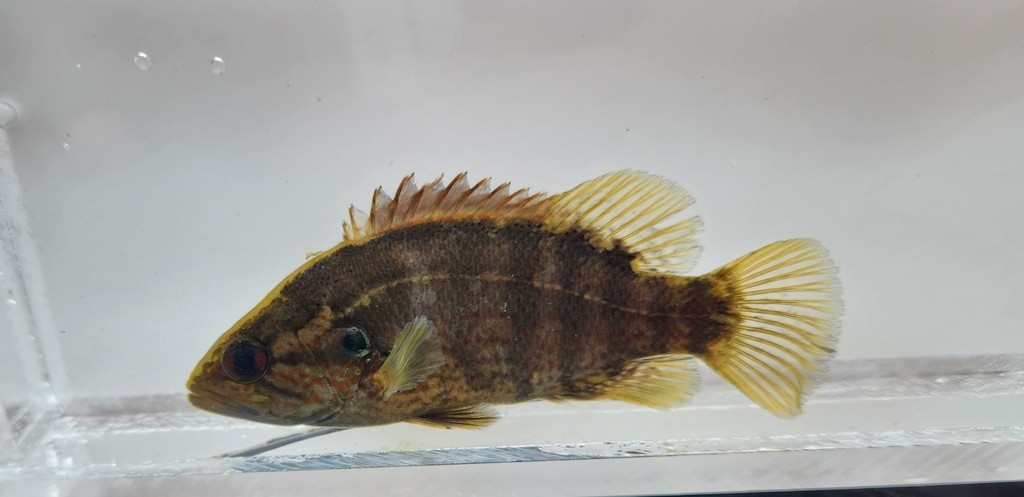
Japanese Perch
Coreoperca kawamebari
Coreoperca kawamebari, commonly known as the Japanese perch, redfin perch, Japanese river perch, Eye-spot perch or in Anglophone parts of Japan, simply the perch, is a predatory species of the freshwater perch native to Japan and southern Korea. They are sometimes kept as pets. The Japanese perch (Coreoperca kawamebari) are a member of the perch family but with the predatory feeding behaviour of the black bass (Micropterus) and bluegill (Lepomis macrochirus).
From the article Coreoperca kawamebari on Wikipedia (CC BY-SA), quoted section by section
Description
Japanese perch are greenish with red pelvic, anal and caudal fins. They have five to eight dark vertical bars on their sides. The Japanese perch can reach up to 15 cm (5.9 in) in length. They can live for up to 7 years.
What it does
The Japanese perch is a predatory species. Juveniles feed on zooplankton, bottom invertebrate fauna, other fish fry, scuds, small shrimp and insects, while adults feed on both invertebrates and smaller fish, mainly Japanese rice fish, Japanese minnows (Nipponocypris temminckii, Rhynchocypris spp., Gnathopogon elongatus), Japanese smelt (Hypomesus nipponensis) fry, small crayfish and tadpoles. Japanese perch start eating other fish when they reach a size of around 6 cm (2.4 in).
Wikipedia: “Diet”
Where it lives
Recorded sightings
—
geo-referenced records in GBIF, from museums, herbaria and field observers.
Drag the globe to turn it. Dots are where records exist, not a range map; darker means more records.
In the stacks
Searching the stacks…
Every page naming Coreoperca kawamebari in the Biodiversity Heritage Library →
This page is assembled live from iNaturalist, GBIF, Wikipedia, the Source Library and the Internet Archive. It is not yet part of the hand-edited codex. iNaturalist taxon 418104.