- Animals
- ›Chordates
- ›Vertebrates
- ›Mammals
- ›Therians
- ›Placental Mammals
- ›Ungulates, Carnivorans, and Allies
- ›Carnivorans
- ›Mustelids
- ›Weasels
- ›Mustela
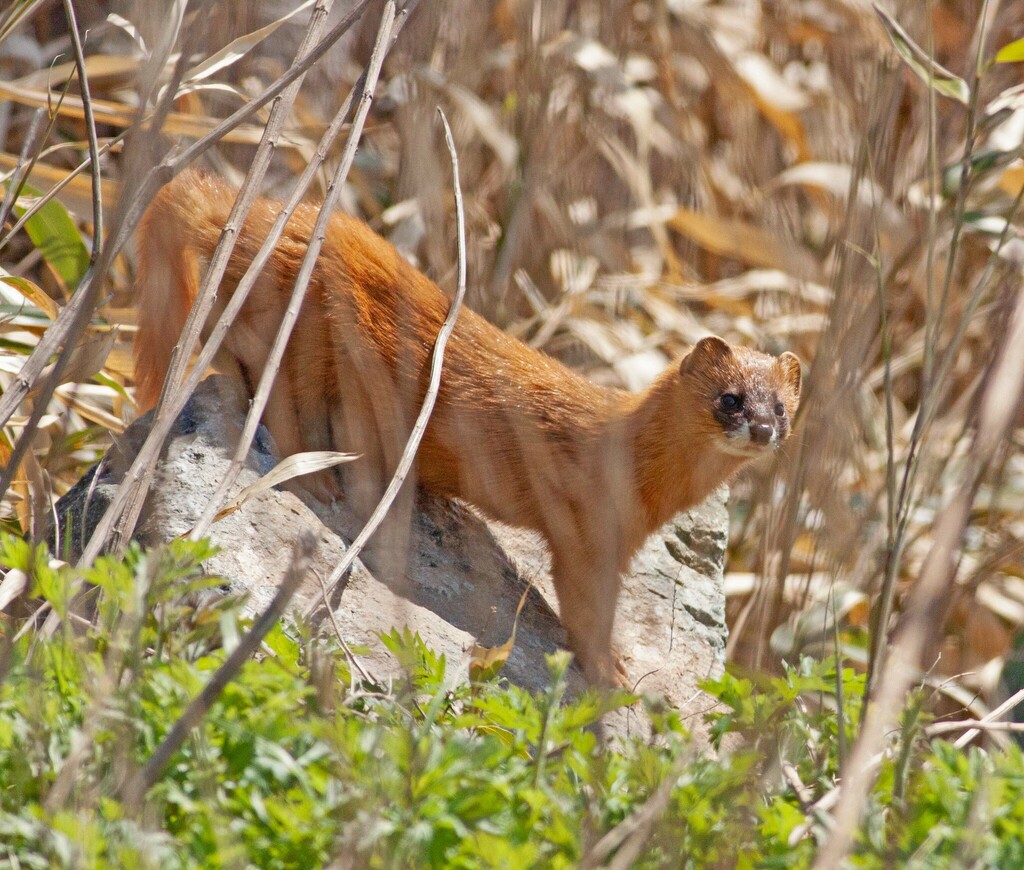
Siberian Weasel
Mustela sibirica
The Siberian weasel or kolonok (Mustela sibirica) is a medium-sized weasel native to Asia, where it is widely distributed and inhabits various forest habitats and open areas. It is therefore listed as least concern on the IUCN Red List.
From the article Siberian weasel on Wikipedia (CC BY-SA), quoted section by section
Description
The Siberian weasel has a long, stretched out body with relatively short legs. Its head is elongated, narrow and relatively small, and its short ears are broad at the base. Its tail is half the length of its body. Its winter fur is very dense, soft and fluffy, with guard hairs reaching 3–4 cm (1.2–1.6 in) in length. The underfur is dense and loose fitting. Siberian weasels are monotone in colour, being bright reddish-ocherous or straw-red, though orange or peach tones are sometimes noticeable on the skin. These tones are especially bright on the back, while the flanks and underbelly are paler. A dark, coffee-brown mask is present on the face. Their tails are more brightly coloured than the back, and are fluffier than those of other members of the genus. The lips and chin are white or slightly ochreous. The front of the muzzle is darker than the remaining parts of the head. Its skull is in several respects intermediate in form between that of the stoat and the mink; it is longer and larger than that of the stoat, but is somewhat more flattened than the mink's. Adult males are 28–39 cm (11–15 in) long, while females reach 25–30.5 cm (9.8–12.0 in). The tail in males reaches 15.5–21 cm (6.1–8.3 in) in length, while that of females reaches 13.3–16.4 cm (5.2–6.5 in). Males weigh 650–820 g (23–29 oz), while females weigh 360–430 g (13–15 oz). …
Range & habitat
The Siberian weasels ranges from the Himalayas in Pakistan, India, Nepal and Bhutan to northern Myanmar, northern Thailand, Laos, Taiwan, China, and Korea. In Russia, it occurs in the Kirov Province, Tataria, from the western Urals through Siberia to the Russian Far East. It has been introduced to Honshu, Shikoku and Kyushu islands.
Wikipedia: “Distribution and habitat”
What it does
In terms of prey selection, Siberian weasels are midway between small, rodent-eating mustelids such as polecats and the more polyphagous martens. They rarely eat reptiles, invertebrates and plants, preferring instead to prey on rodents of small to moderate size. Water voles are their most frequent prey in their western range, while voles and mice are eaten in their eastern range. Moderate sized rodents targeted by Siberian weasels in the east include Daurian and Alpine pikas, and Siberian zokors. In local areas, chipmunks, muskrats, red squirrels and jerboas are eaten. Fish may be eaten in some areas during certain seasons. In Ussuriland, they scavenge extensively on the kills of wolves and yellow-throated martens during the winter. Elsewhere, small birds are an important food item. Reptiles and amphibians are typically eaten at the periphery of the Siberian weasel's range. Plant foods known to be eaten by Siberian weasels include pine nuts and Actinidia fruits. They typically eat about 100–120 grams (3.5–4.2 oz) of food daily, and cache excess food. In urban areas in China, Siberian weasels prey extensively on rats. They are capable of killing and dragging the largest fowls. Siberian weasels are active hunters and chase prey through snow, logs, water and people's houses.
Wikipedia: “Diet”
In human culture
In Chinese folklore, the Siberian weasel is viewed as a wandering spirit (shen) that can steal and replace people's souls. Although Siberian weasels are overall useful for limiting rodent populations, they are nonetheless damaging to poultry and muskrat farms. They frequently enter the roosts of domesticated fowl and pigeons, sometimes killing more than they can eat. Siberian weasels are valuable furbearers, being significantly harvested in Siberia and the Far East. Their fur is used both in its natural state and for imitating the fur of more valuable species. A couple of alternative names for the fur were Tartar sable and fire marten. Siberian weasel fur is also used to make the so-called kolinsky sable-hair brush. In China, their orange fur is largely used to create ink brushes for calligraphers. The name of the brush is thus 狼毫筆, lit. 'wolf hairs brush', as a reduction from 黃鼠狼 + 毫 + 筆, lit. "yellow rat wolf" "hairs" "brush". Their hairs are appreciated because they are harder than goat hair (羊毫). They are hunted by shooting with dogs or through the use of box traps. They are extremely aggressive when caught in traps, emitting piercing shrieks and letting loose a pungent secretion which reportedly takes days to wash away.
Wikipedia: “Cultural significance”
Listen
Looking for field recordings…
Where it lives
Recorded sightings
—
geo-referenced records in GBIF, from museums, herbaria and field observers.
Drag the globe to turn it. Dots are where records exist, not a range map; darker means more records.
In the stacks
Searching the stacks…
Every page naming Mustela sibirica in the Biodiversity Heritage Library →
This page is assembled live from iNaturalist, GBIF, Wikipedia, the Source Library and the Internet Archive. It is not yet part of the hand-edited codex. iNaturalist taxon 41813.