- Animals
- ›Chordates
- ›Vertebrates
- ›Mammals
- ›Therians
- ›Placental Mammals
- ›Ungulates, Carnivorans, and Allies
- ›Carnivorans
- ›Mustelids
- ›Zorillas, Grisons, and Allies
- ›Vormela
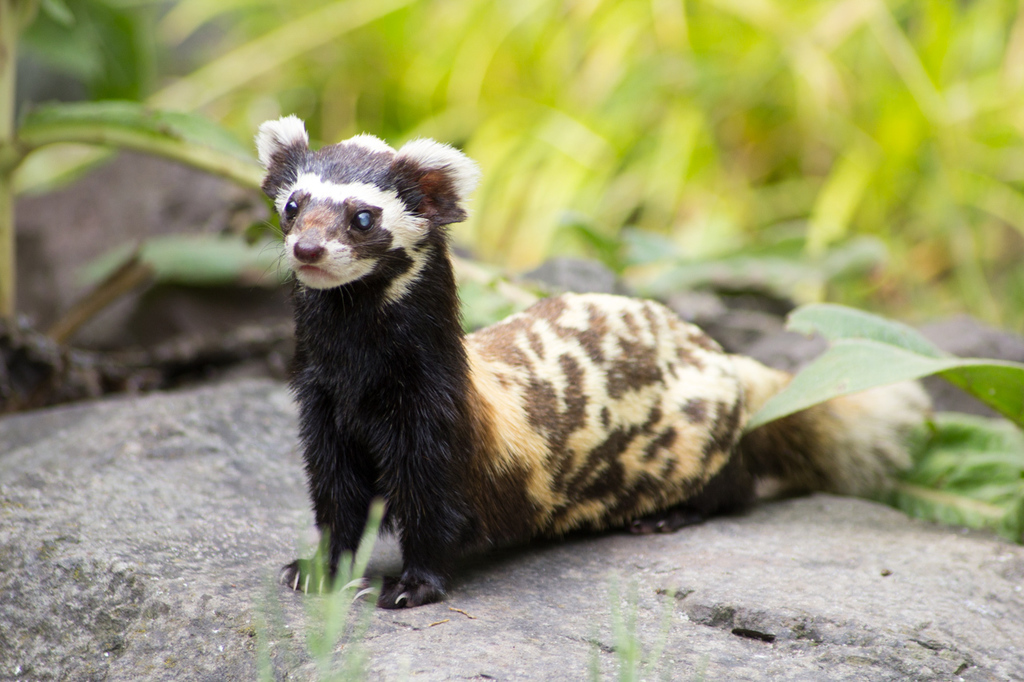
Marbled Polecat
Vormela peregusna
The marbled polecat (Vormela peregusna) is a small mammal belonging to the monotypic genus Vormela within the Mustelinae subfamily. Vormela is from the German word Würmlein, which means "little worm". The term peregusna comes from perehuznya, which is Ukrainian for polecat. Marbled polecats are generally found in the drier areas and grasslands of southeastern Europe to western China. Like other members of Mustelinae, it can emit a strong-smelling secretion from anal sacs under the tail when...
From the article Marbled polecat on Wikipedia (CC BY-SA), quoted section by section
Description
Ranging in length from 29–35 cm (head and body), the marbled polecat has a short muzzle and very large, noticeable ears. The limbs are short and claws are long and strong. While the tail is long, with long hair, the overall pelage is short. Black and white mark the face, with a black stripe across the eyes and white markings around the mouth. Dorsally, the pelage is yellow and heavily mottled with irregular reddish or brown spots. The tail is dark brown with a yellowish band in the midregion. The ventral region and limbs are a dark brown. Females weigh from 295 to 600 g (10.4 to 21.2 oz) and males from 320 to 715 g (11.3 to 25.2 oz).
Range & habitat
The marbled polecat is distributed from Southeast Europe including the Balkans to the Caucasus, the Levant and Central Asia into north-western Pakistan, southern Mongolia and northern China. In 1998, a marbled polecat was recorded on the Sinai Peninsula, Egypt. It inhabits open desert, semidesert, and semiarid rocky areas in upland valleys and low hill ranges, steppe country, and arid subtropical scrub forest. It avoids montane regions. Marbled polecats have been sighted in cultivated areas such as melon patches and vegetable fields.
Wikipedia: “Distribution and habitat”
What it does
The marbled polecat is most active during the morning and evening. Its eyesight is weak, and it relies on its well-developed sense of smell. Vocalization is limited and consists of shrill alarm cries, grunts and a submissive long shriek. It is solitary and moves extensively through a home range of 0.5–0.6 km2 (0.19–0.23 sq mi). It generally stays in a shelter once. When encountering each other, they are usually aggressive. When alarmed, a marbled polecat raises up on its legs while arching its back and curling its tail over its back, with the long tail hair erect. It may also raise its head, bare its teeth, and give shrill, short hisses. If threatened, it can expel a foul-smelling secretion from enlarged anal glands under its tail. To excavate burrows, the marbled polecat digs out earth with its forelegs while anchoring itself with its chin and hind legs. It uses its teeth to pull out obstacles such as roots. Burrows of large ground squirrels or similar rodents such as the great gerbil (Rhombomys opimus) and Libyan jird (Meriones libycus) are used by marbled polecats for resting and breeding. They may also dig their own dens or live in underground irrigation tunnels.[1] In the winter, marbled polecats line their dens with grass.
Reproduction. Marbled polecats mate from March to early June. Their mating calls are most often heard as low, rumbling sounds in a slow rhythm. …
Wikipedia: “Behaviour and ecology”
Listen
Looking for field recordings…
Where it lives
Recorded sightings
—
geo-referenced records in GBIF, from museums, herbaria and field observers.
Drag the globe to turn it. Dots are where records exist, not a range map; darker means more records.
In the stacks
Searching the stacks…
Every page naming Vormela peregusna in the Biodiversity Heritage Library →
This page is assembled live from iNaturalist, GBIF, Wikipedia, the Source Library and the Internet Archive. It is not yet part of the hand-edited codex. iNaturalist taxon 41829.