- Animals
- ›Chordates
- ›Vertebrates
- ›Mammals
- ›Therians
- ›Placental Mammals
- ›Ungulates, Carnivorans, and Allies
- ›Carnivorans
- ›Skunks and Stink-badgers
- ›True Skunks
- ›Mephitis
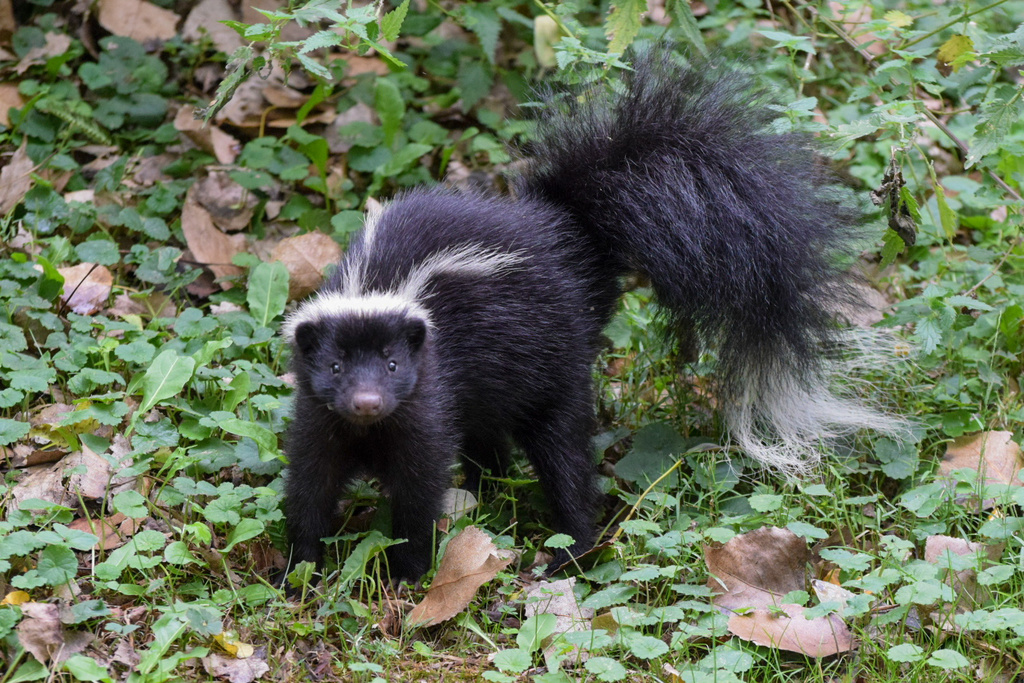
Striped Skunk
Mephitis mephitis
The striped skunk (Mephitis mephitis) is a skunk of the genus Mephitis that occurs across much of North America, including southern Canada, the United States, and northern Mexico. It is currently listed as least concern by the IUCN on account of its wide range and ability to adapt to human-modified environments.
Striped skunks are polygamous omnivores with few natural predators, save for birds of prey. Striped skunks are mostly nocturnal. Like all skunks, they possess highly developed musk-filled scent glands to ward off predators. They have a long history of association with humans, having been trapped and captively bred for their fur and kept as pets. The striped skunk is one of the most recognizable of North America's animals, and is a popular figure in cartoons and children's books.
From the article Striped skunk on Wikipedia (CC BY-SA), quoted section by section
Description
The striped skunk is a stoutly-built, short-limbed animal with a small, conical head and a long, heavily furred tail. Adult males are 10% larger than females, with both sexes measuring between 52–77 centimetres (20–30 in) in total body length and usually weighing 1.8–4.5 kg (4.0–9.9 lb), though some may weigh 5.5 kg (12 lb). The feet are plantigrade with bare soles, and are not as broad or flat as those of hog-nosed skunks. The forefeet are armed with five long, curved claws adapted for digging, while those on the hind feet are shorter and straighter.
The color patterns of the fur vary greatly, but generally consist of a black base with a white stripe extending from the head which divides along the shoulders, continuing along the flanks to the rump and tail. Some specimens have a white patch on the chest, while others bear white stripes on the outer surface of the front limbs. Brown or cream-colored mutations occasionally occur. Like all skunks, the striped skunk possesses two highly developed scent glands, one on each side of the anus, containing about 15 millilitres (0.53 imp fl oz; 0.51 US fl oz) of musk each, which provides a chemical defense against predation. This oily, yellow-colored musk consists of a mixture of powerfully odorous thiols (sulfur analogues of alcohols, in older sources called "mercaptans"), which can be sprayed at a distance of several meters. …
Range & habitat
The striped skunk inhabits a wide variety of habitats, particularly mixed woodlands, brushy corners and open fields interspersed with wooded ravines and rocky outcrops. Some populations, particularly in northwestern Illinois, prefer cultivated areas over uncultivated ones.
Wikipedia: “Habitat”
What it does
The striped skunk is polygamous, and normally breeds once a year, though yearling females who have failed to mate may enter a second estrous cycle a month after the first. The mating season usually occurs between mid-February to mid-April, though it is delayed at higher latitudes. Prior to copulating, the males' testicles swell during the January–February period, with maximum size being attained in March. Males during this period will cover much ground in their search for females, sometimes covering 4 km (2.5 mi) per night. When a male locates a female, he will approach her from the rear and lick her genitals, then bite her on the nape before copulating. A single male may have a harem of several females, which he mates with and defends against other males for a period of about 35 days. Once the mating period has finished, the impregnated females confine themselves to their dens, while the males attempt to rebuild their fat reserves.
The gestation period lasts around 59–77 days, with kits being born at about mid-May to early June. Litters generally consist of 2–12 kits, with the average being five or six, though a litter of 18 is known from Pennsylvania. Kits are born blind and sparsely furred, weighing 25–40 grams. The eyes open after around three weeks, and they are weaned after 42–56 days. …
Wikipedia: “Reproduction and development”
At the table
The striped skunk was regularly eaten by trappers and indigenous peoples, provided the animal was not too old or had not sprayed before being killed. American zoologist Clinton Hart Merriam described skunk meat as white, tender, sweet and more delicate than chicken. The meat was prized by Chinese immigrants, who also bought skunk gall bladders for medicinal purposes. The fat was once reputed to make an excellent lubricant. The musk was once used as a folk remedy for asthma, despite its very strong odor.
Wikipedia: “Other uses”
In human culture
The striped skunk is commonly featured in the myths and oral traditions of Native Americans. Some stories try to explain its striped pattern or how it got its smell. Skunks fill various roles in legends and may be featured as heroes, villains, tricksters, or monsters. For the Muscogee people, the skunk represented family loyalty and defense of loved ones. The Winnebago people used the skunk to symbolize vanity, being beautiful on the outside but ugly on the inside. The striped skunk was once called the "emblem of America" by Ernest Thompson Seton. It has been prevalent in modern popular culture, being the subject of various jazz and funk songs like Cab Calloway's "Skunk Song" and the Brecker Brothers' "Some Skunk Funk". The skunk connection in these genres may be due to the term "funk" being a term for strong odor. The novelty song "Dead Skunk" by Loudon Wainwright III was popular in the early 1970s. Skunks are also popular characters in children's stories, comics and cartoons, most notably the Warner Bros. character Pepé Le Pew and the Disney character Flower from the 1942 animated film Bambi, their musky odor making them a source of fear and ostracization.
Wikipedia: “In culture”
Listen
Looking for field recordings…
Where it lives
Recorded sightings
—
geo-referenced records in GBIF, from museums, herbaria and field observers.
Drag the globe to turn it. Dots are where records exist, not a range map; darker means more records.
In the old herbals & bestiaries

The natural history of Carolina, Florida, and the Bahama Islands : containing two hundred a...
Catesby, Mark, bioloog, kunstenaar · 1743 · p.195

The Natural History of Carolina Florida and Bahama Islands Vol. 2
Mark Catesby · 1743 · p.193

Mark Catesby — Piscium, serpentum, insectorum (pt. 1) (1750)
Mark Catesby · 1750 · p.195
In the stacks
Searching the stacks…
Every page naming Mephitis mephitis in the Biodiversity Heritage Library →
This page is assembled live from iNaturalist, GBIF, Wikipedia, the Source Library and the Internet Archive. It is not yet part of the hand-edited codex. iNaturalist taxon 41880.