- Animals
- ›Chordates
- ›Vertebrates
- ›Mammals
- ›Therians
- ›Placental Mammals
- ›Ungulates, Carnivorans, and Allies
- ›Carnivorans
- ›Mongooses
- ›Solitary Mongooses
- ›Cynictis
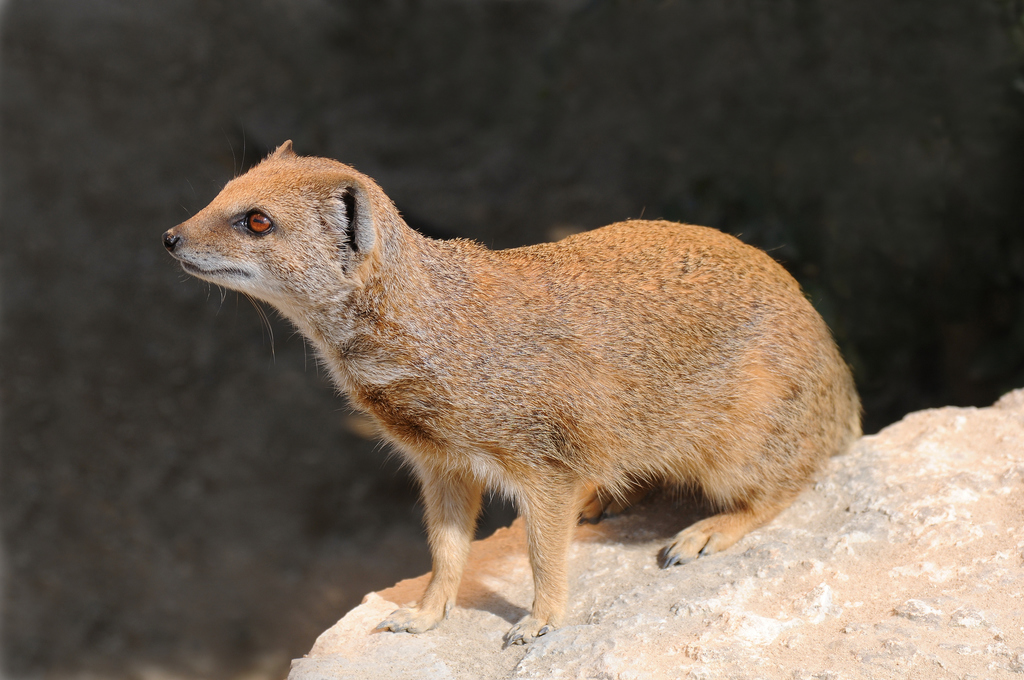
Yellow Mongoose
Cynictis penicillata
The yellow mongoose (Cynictis penicillata), sometimes referred to as the red meerkat, is a member of the mongoose family. It averages about 0.45 kg (1 lb) in weight and about 510 mm (20 in) in length. It lives in open country, semi-desert scrubland and grasslands in Angola, Botswana, South Africa, Namibia, and Zimbabwe. It is the only species in the genus Cynictis.
From the article Yellow mongoose on Wikipedia (CC BY-SA), quoted section by section
Description
In general, the yellow mongoose has lighter highlights on the underbelly and chin, a bushy tail, and a complete lack of sexual dimorphism. Southern yellow mongooses are larger, have yellow or reddish fur, longer fur, and a longer tail with a characteristic white tip. Northern subspecies tend towards smaller size, grey colouration, a grey or darker grey tip to the tail, and shorter hair more appropriate to the hotter climate.
Wikipedia: “Characteristics”
What it does
The yellow mongoose is primarily diurnal, though nocturnal activity has been observed. Living in colonies of up to 20 individuals in a permanent burrow complex, the yellow mongoose will often co-exist with Cape ground squirrels or suricates and share maintenance of the warren, adding new tunnels and burrows as necessary. The tunnel system has many entrances, nearby which the yellow mongoose makes its latrines. The yellow mongoose is a carnivore, feeding mostly on beetles, termites, grasshoppers, crickets, caterpillars, and ants, but also on rodents, small birds, reptiles, amphibians, carrion, eggs, grass, and seeds. In urban environments in South Africa, it also forages among human food garbage.
Social structure. The social structure of the yellow mongoose is hierarchical, based around a central breeding pair and their most recent offspring. There are also subadults, the elderly, or adult relatives of the central pair. Male ranges tend to overlap, while females from other dens have contiguous non-overlapping ranges. Every day, the alpha male will mark members of his group with anal gland secretions, and his boundaries with facial and anal secretions, as well as urine. The alpha male also rubs his back against raised objects, leaving behind hair as a visual marker of territory. Other members of the group mark their dens with cheek secretions. …
Wikipedia: “Behaviour and ecology”
Listen
Looking for field recordings…
Where it lives
Recorded sightings
—
geo-referenced records in GBIF, from museums, herbaria and field observers.
Drag the globe to turn it. Dots are where records exist, not a range map; darker means more records.
In the stacks
Searching the stacks…
Every page naming Cynictis penicillata in the Biodiversity Heritage Library →
This page is assembled live from iNaturalist, GBIF, Wikipedia, the Source Library and the Internet Archive. It is not yet part of the hand-edited codex. iNaturalist taxon 41911.