- Animals
- ›Chordates
- ›Vertebrates
- ›Mammals
- ›Therians
- ›Placental Mammals
- ›Ungulates, Carnivorans, and Allies
- ›Carnivorans
- ›Mongooses
- ›Social Mongooses
- ›Crossarchus
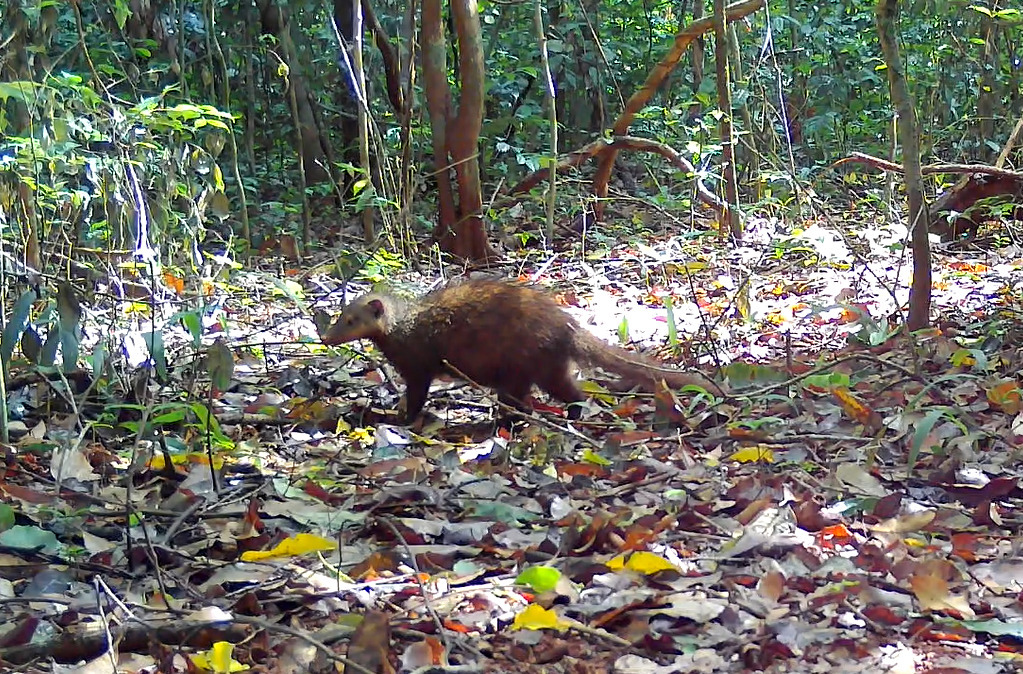
Alexander's Kusimanse
Crossarchus alexandri
Alexander's kusimanse (Crossarchus alexandri) is a mongoose species native to Central African rainforests. The species was first described in 1907 by Oldfield Thomas and R. C. Wroughton based on specimens collected by Boyd Alexander, and named after Alexander himself. It is largely restricted to northern Democratic republic of Congo, and western Uganda. It is classified as Least Concern on the IUCN Red List.
From the article Alexander's kusimanse on Wikipedia (CC BY-SA), quoted section by section
Description
Alexander's kusimanse is a small mongoose with short legs. It measures about 375–437 mm (14.8–17.2 in) in body length, and has a 243–318 mm (9.6–12.5 in) long tail. It has brownish black hairy fur with tinges of gray. The head consists of a long snout with pale buff colored lips, and small brownish ears. The hind part of the body is covered with long guard hairs, which are darker at the base and white colored at the tips. The short legs are darker in color, and consist of long, sharp claws. The tail is similar in color to the body, and covered with tufts of hair. The females have three pairs of nipples.
Range & habitat
Alexander's kusimanse is restricted to northern Democratic republic of Congo, and western Uganda, and parts of Republic of Congo and Central African Republic. Though it is subject to habitat loss, it is classified as Least Concern on the IUCN Red List.
Wikipedia: “Distribution and habitat”
What it does
Alexander's kusimanse is a social species and forages in groups of up to 20 individuals. The animals often mark trees with secretions from their anal glands. They sleep in hollow tree trunks, and dead logs in small groups. This group behavior helps the kusimanses to protect against predators. Any alarm by a single animal results in the group heading for safety. It feeds on grubs, small animals and fruits. It produces a litter of two to four younglings.
Wikipedia: “Behaviour”
Listen
Looking for field recordings…
Where it lives
Recorded sightings
—
geo-referenced records in GBIF, from museums, herbaria and field observers.
Drag the globe to turn it. Dots are where records exist, not a range map; darker means more records.
In the stacks
Searching the stacks…
Every page naming Crossarchus alexandri in the Biodiversity Heritage Library →
This page is assembled live from iNaturalist, GBIF, Wikipedia, the Source Library and the Internet Archive. It is not yet part of the hand-edited codex. iNaturalist taxon 41915.