On eBird ↗
Sooty Albatross
Live sightings near you, the range map, bar charts of when it is seen, and Macaulay Library photos and recordings.
Sooty Albatross
Phoebetria fusca
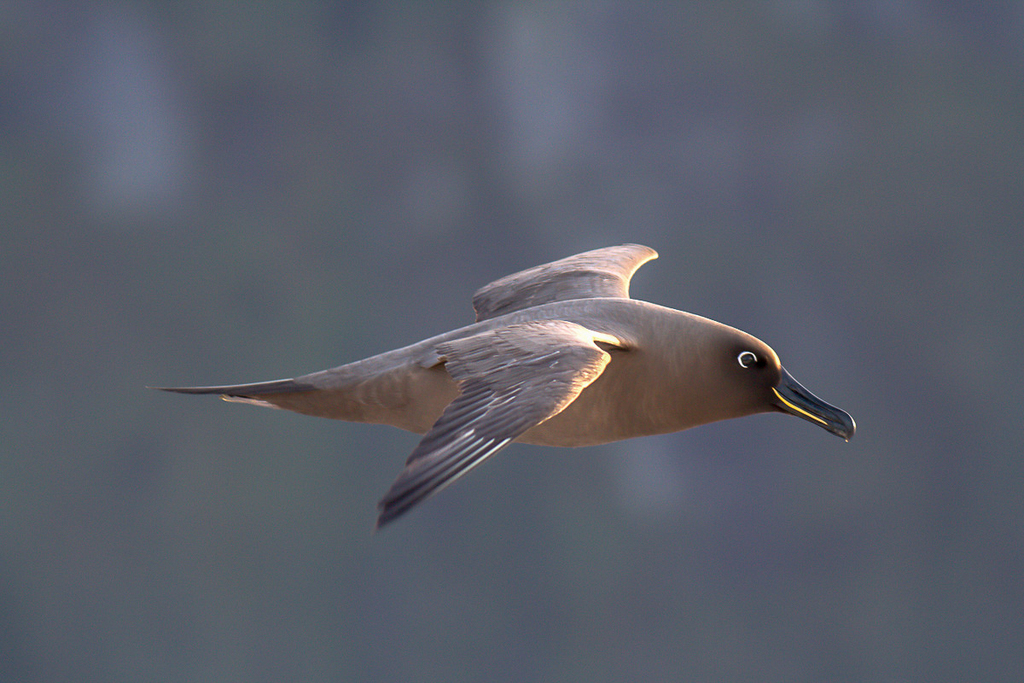
The sooty albatross (Phoebetria fusca), also known to sailors as the Quaker, is a species of marine bird belonging to the albatross family Diomedeidae. It is a medium-sized albatross that sports a sooty-brown or sooty-black color. It can be found in the southern Atlantic Ocean, the southern Indian Ocean, and the Southern Ocean. This bird scavenges for squid, fish, and carrion. Like other albatrosses, these birds mate for life and return to the same breeding spots every season. A single pair will mate every other year on a variety of islands in the southern Atlantic Ocean and the southern Indian Ocean islands. This bird is an endangered species and conservation efforts are taking place.
From the article Sooty albatross on Wikipedia (CC BY-SA), quoted section by section
Description
The sooty albatross is a medium-sized albatross, measuring about 85 cm (33 in) from head to tail, with a 2 m (6.6 ft) wingspan. Average adult body mass is about 2.5 kg (5.5 lbs), with males weighing more than females. Plumage ranges from a sooty-brown to a sooty-black color depending on the individual, but the head and sometimes tail are typically darker than the rest of the body. Around almost the entire eye, excluding the inner corner, a white ring is present. On the lower jaw, a yellow to orange line is present on the beak, which is otherwise a uniform glossy black. Juvenile or immature sooty albatrosses look nearly identical after losing their down feathers.
Range & habitat
The sooty albatross can be found in the South Atlantic Ocean, the southern Indian Ocean, and the Southern Ocean between Australia and South America, although they have not been recorded in the South Pacific Ocean between Australia and South America. Its northern and southern limits are approximately 20°S and 65°S, respectively, and an eastern and western limit of approximately 160°E and 75°W. This albatross nests on islands in the southern Atlantic Ocean (Gough Island and the Tristan da Cunha group) and the southern Indian Ocean (Prince Edward Island, Marion Island, the Crozet Islands, Amsterdam Island, and the Kerguelen Islands). In general, the sooty albatross can be found foraging over deep ocean. Non-breeding adults do not often venture out of their native oceans but have a broader foraging range, while breeding adults forage closer to their breeding sites, within 600 km (370 mi), and juvenile birds tend to be confined to subtropical waters.
Wikipedia: “Distribution and habitat”
What it does
The sooty albatross is a marine bird that spends more of its non-breeding life over the ocean. When breeding, it will return to land and continue to breed there for life. Below is a closer look into the feeding and reproductive habits of the sooty albatross. Sooty albatrosses build their nests on ledges of coastal and inland cliffs. They typically breed in groups of 5-60 nests but can live in solidarity. They return to their breeding grounds in mid-July to early September, making them biennial breeders. Sooty Albatross colonies can be marked by their distinctive sky calls, which are loud and repeating pee-oo’s. This bird species is also distinctive in its synchronized flight patterns, in which they switch flight patterns and angles during active flight so that the birds may fly in unison. The Sooty Albatross displays complex social and mating behaviors that are described as the 15 signs. This guide records Albatross behaviors, including brief first encounters, prolonged encounters, and bonding behaviors that occur throughout several months when the Sooty Albatrosses are courting. Sooty Albatrosses are shy in their interactions, typically feeding in solitude at sea, but have been seen associating with yellow-nosed mollymawks and whales. This bird species forages during the daytime, with peak feeding activity being 3 hours before dusk.
Feeding. …
Wikipedia: “Behavior and ecology”
Listen
Looking for field recordings…
Where it lives
Recorded sightings
—
geo-referenced records in GBIF, from museums, herbaria and field observers.
Drag the globe to turn it. Dots are where records exist, not a range map; darker means more records.
In the stacks
Searching the stacks…
Every page naming Phoebetria fusca in the Biodiversity Heritage Library →
This page is assembled live from iNaturalist, GBIF, Wikipedia, the Source Library and the Internet Archive. It is not yet part of the hand-edited codex. iNaturalist taxon 4192.