On eBird ↗
Antarctic Petrel
Live sightings near you, the range map, bar charts of when it is seen, and Macaulay Library photos and recordings.
Antarctic Petrel
Thalassoica antarctica
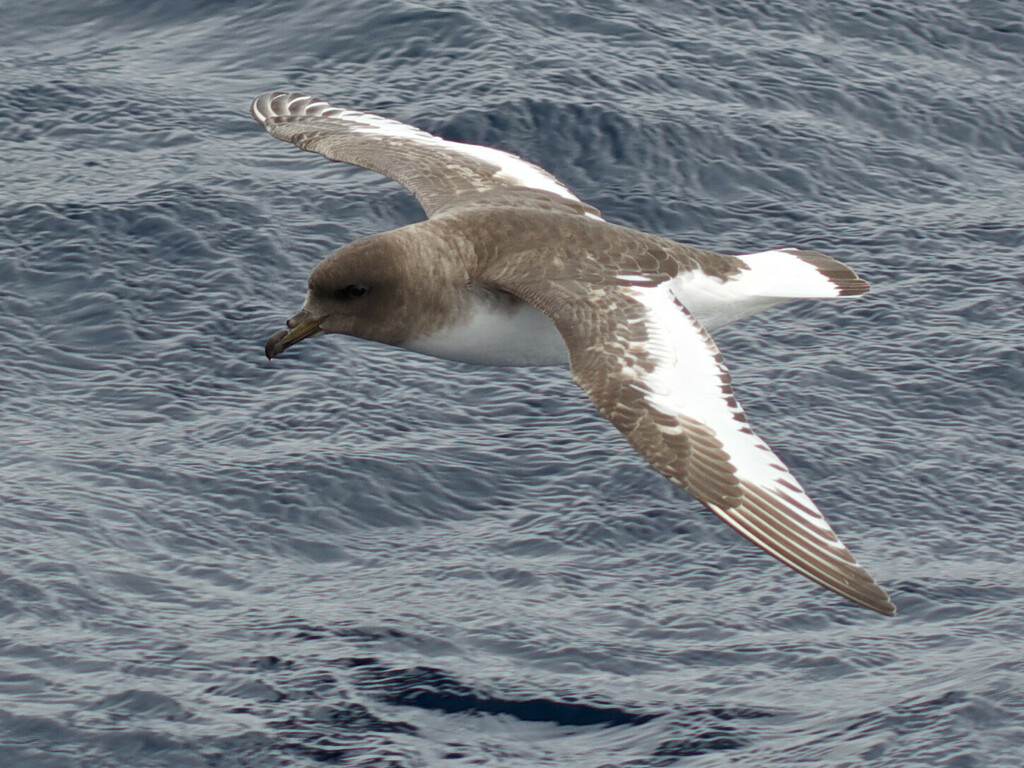
The Antarctic petrel (Thalassoica antarctica) is a boldly marked dark brown and white petrel, found in Antarctica, most commonly in the Ross and Weddell Seas. They eat Antarctic krill, fish, and small squid. They feed while swimming but can dive from both the surface and the air.
From the article Antarctic petrel on Wikipedia (CC BY-SA), quoted section by section
Description
The adult Antarctic petrel has a brown head, sides, throat, and back. The bill is dark brown and the feet are grey. The underparts are white and their tail and secondaries on the wings are white with brown tips. These are medium-sized relative to other petrels with a wingspan of 100–110 cm (39–43 in), a length of 40–45 cm (16–18 in), and an average weight of 675 g (23.8 oz).
Range & habitat
The Antarctic petrel, as its name implies, lives and breeds in the Southern Ocean, and on the Antarctic islands. They nest on snow-free cliffs and rock faces, on the coast or on offshore islands. However, they have been found up to 250 km inland. Another common roosting spot is icebergs. Breeding colonies during the October–November breeding period, can be as large as 200,000 pairs. However, the largest single colony ever observed, Mühlig-Hofmann Mountains, was estimated to be about one million Antartic petrels, presumably including non-breeders and chicks. They occasionally migrate to Australia or New Zealand in late winter. This tends to occur when they are caught in a bad storm.
Wikipedia: “Distribution and habitat”
What it does
The petrel's diet is mainly krill, squid and small fish. Food is usually seized when the bird is on the surface but they also plunge-dive to obtain food, diving up to a depth of 1.5 m (4 ft 11 in).
Wikipedia: “Food and feeding”
Listen
Looking for field recordings…
Where it lives
Recorded sightings
—
geo-referenced records in GBIF, from museums, herbaria and field observers.
Drag the globe to turn it. Dots are where records exist, not a range map; darker means more records.
In the stacks
Searching the stacks…
Every page naming Thalassoica antarctica in the Biodiversity Heritage Library →
This page is assembled live from iNaturalist, GBIF, Wikipedia, the Source Library and the Internet Archive. It is not yet part of the hand-edited codex. iNaturalist taxon 4202.