- Animals
- ›Chordates
- ›Vertebrates
- ›Mammals
- ›Therians
- ›Placental Mammals
- ›Ungulates, Carnivorans, and Allies
- ›Carnivorans
- ›Canids
- ›Vulpes
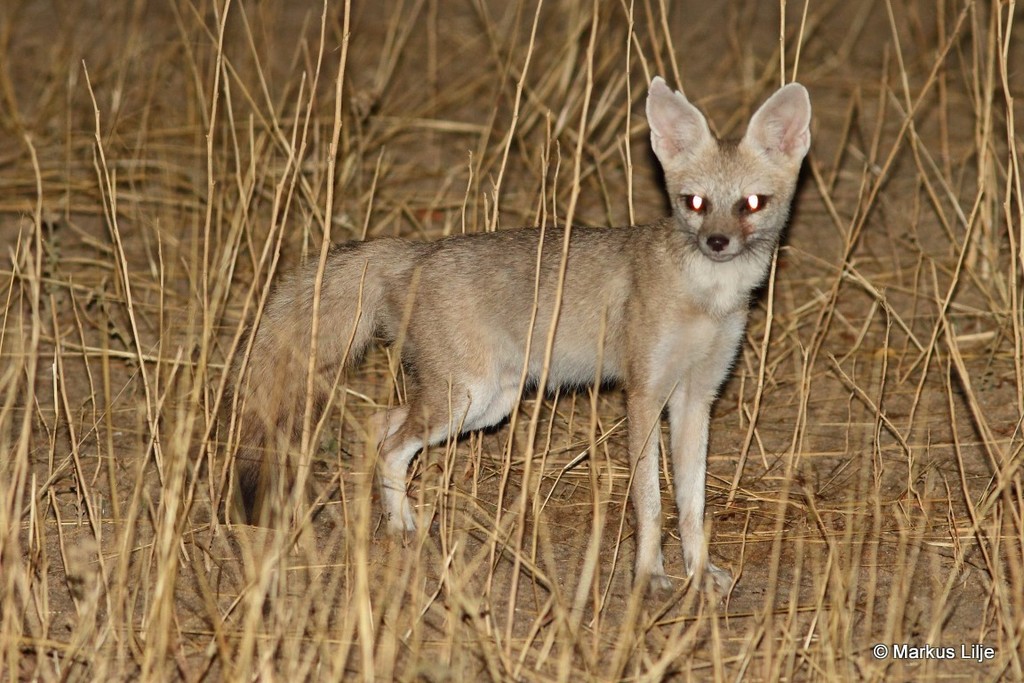
Pale Fox
Vulpes pallida
The pale fox (Vulpes pallida) is a species of fox found in the band of African Sahel from Senegal in the west to Sudan in the east. It is one of the least studied of all canid species, in part due to its remote habitat and its sandy coat that blends in well with the desert-like terrain. The pale fox is distinguished by its light-colored fur and oversized ears, which enable it to excel in camouflage and survival in harsh environments.
Individuals of the species serve as key predators and scavengers. Despite being lesser known, the pale fox is considered a significant indicator of an ecosystem's health and a focal point for conservation interests.
From the article Pale fox on Wikipedia (CC BY-SA), quoted section by section
Description
The pale fox is a small fox, with a long body and relatively short legs and a narrow muzzle. The fur is quite thin, with a pale sandy color that turns white towards the abdomen. The back is often speckled with a blackish or a rufous coloration, with a darker mid-dorsal line. The flanks are paler than the dorsal pelage, blending into buffy-white underparts, and the legs are rufous. It has a pale face, an elongated muzzle with relatively long whiskers, and a dark ring surrounding the eye. Its sandy-colored fur offers effective camouflage within the desert landscape, blending seamlessly with the dunes and rocky terrain. Its tail is long and bushy, with a reddish-brown color with a prominent black tip and a dark patch above the tail gland. The skull is small with a relatively short maxillary region and small sharp canine teeth. One of the most prominent features of the species, its ears, are large, and triangular compared to other foxes but such a shape is typical of a desert inhabiting canid. The ears of the pale fox play a crucial role, both in thermoregulation, by releasing heat in their typically warm habitats, and in increasing their hearing acuity to detect prey and predators. Head and body length is 38 to 55 cm (15 to 22 in), tail length is 23 to 29 cm (9.1 to 11.4 in), and weight 2.0 to 3.6 kg (4.4 to 7.9 lb).
Range & habitat
Pale fox is distributed in the semi-arid Sahelian region of Africa bordering the Sahara Desert, from Mauritania and Senegal via Nigeria, Cameroon and Chad to the Red Sea. The southern border of its range extends to the savanna zones of northern Guinea. It is also present in Benin, Burkina Faso, Eritrea, Ethiopia, Gambia, Mali, Niger, South Sudan and Sudan. The habitat is sandy or stony arid terrain, and the pale fox is able to relocate southwards and northwards in relation to the periodic droughts that affect these regions.
Wikipedia: “Distribution and habitat”
What it does
The pale fox, similar to other species, exhibits unique reproductive behaviors influenced by its desert environment and the challenges this poses for its young. These foxes are monogamous, often forming pair bonds with mates that can last for several breeding seasons. Typically, they breed during the cooler months, a timing that corresponds with seasonal variations in various factors, one of which being food availability. Once mating has concluded, the female pale fox often excavates a burrow or occupies existing underground dens to birth her pups. The gestation period usually spans 50 to 60 days, and litter sizes for pale foxes typically vary from three to six pups. While larger litters are uncommon, they have been observed. Newborn pups are inherently blind and deaf immediately following birth, thus making them completely dependent on their mother. Their average life span is no more than 10 years.
Wikipedia: “Reproduction”
Listen
Looking for field recordings…
Where it lives
Recorded sightings
—
geo-referenced records in GBIF, from museums, herbaria and field observers.
Drag the globe to turn it. Dots are where records exist, not a range map; darker means more records.
In the stacks
Searching the stacks…
Every page naming Vulpes pallida in the Biodiversity Heritage Library →
This page is assembled live from iNaturalist, GBIF, Wikipedia, the Source Library and the Internet Archive. It is not yet part of the hand-edited codex. iNaturalist taxon 42064.