- Animals
- ›Chordates
- ›Vertebrates
- ›Mammals
- ›Therians
- ›Placental Mammals
- ›Ungulates, Carnivorans, and Allies
- ›Even-toed Ungulates and Cetaceans
- ›Ruminants
- ›Chevrotains
- ›Tragulus
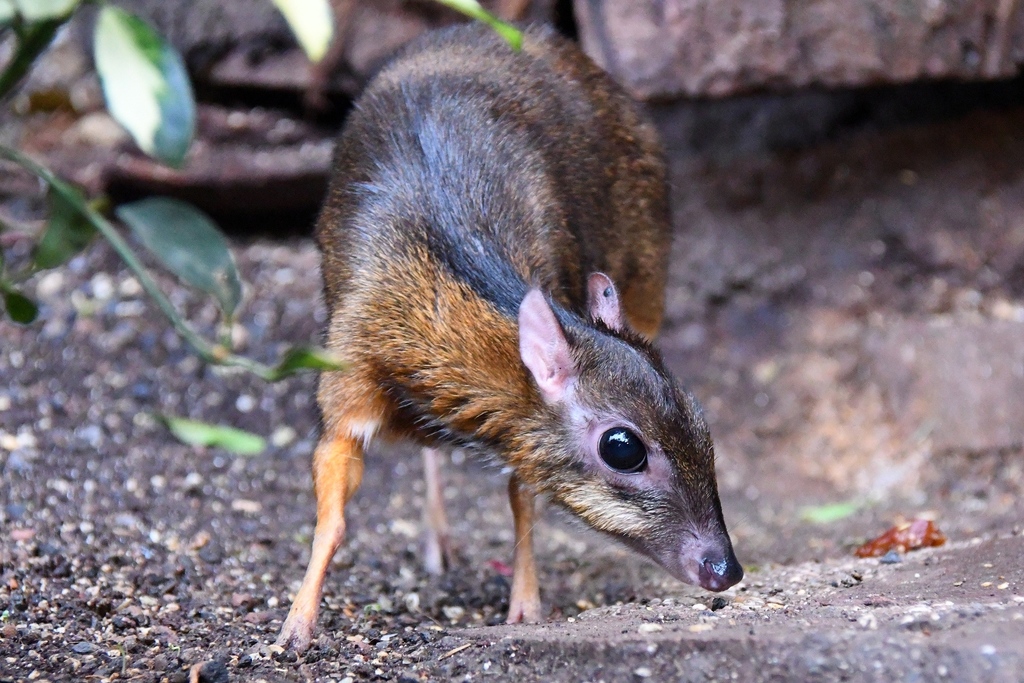
Javan Chevrotain
Tragulus javanicus
The Java mouse-deer (Tragulus javanicus) is a species of even-toed ungulate in the family Tragulidae. When it reaches maturity it is about the size of a rabbit, making it the smallest living ungulate. It is found in forests in Java and perhaps Bali, although sightings there have not been verified.
This mouse-deer is depicted in Indonesian folklore as Sang Kancil.
From the article Java mouse-deer on Wikipedia (CC BY-SA), quoted section by section
Description
Mouse-deer possess triangular-shaped heads, arched backs, and rounded bodies with elevated rear ends. The thin, short legs which support the mouse-deer are about the diameter of an average pencil. Unlike the antlered true deer, or horned bovids, but akin to Moschus musk deer, male Java mouse-deer have elongated, tusk-like upper canines which protrude downward from the upper jaw along the sides of their mouth. Males use these "tusks" to defend themselves and their mates against rivals. Females can be distinguished from males because they lack these prominent canines, and they are slightly smaller than the males. Java mouse-deer can be further distinguished by their lack of upper incisors, similar to bovids. The coat coloration of the Java mouse-deer is reddish-brown with a white underside, and pale white spots or vertical markings are also present on the animal's neck. With an average length of 45 cm (18 in) and an average height of 30 cm (12 in), the Java mouse-deer is the smallest extant (living) ungulate or hoofed mammal, as well as the smallest extant even-toed ungulate. The weight of the Java mouse-deer ranges from 1 to 2 kilograms (2.2 to 4.4 lb), with males being heavier than females. It has an average tail length of about 5 cm (2.0 in). …
Range & habitat
Tragulus javanicus is usually considered to be endemic to Java, Indonesia. There have been unverified reports of sightings on Bali. The Java mouse-deer prefers higher elevations and tropical forest regions of Java, although it does appear at lower elevations between 400–700 metres (1,300–2,300 ft) above sea level. During the day, Java mouse-deer can be seen roaming in crown-gap areas with dense undergrowth of creeping bamboo, through which they make tunnels through the thick vegetation which lead to resting places and feeding areas. At night, the Java mouse-deer moves to higher and drier ridge areas. It has been argued that Java mouse-deer are an "edge" species, favoring areas of dense vegetation along riverbanks. Additionally, Java mouse-deer have been found to be more prevalent in logged areas than in the more mature forests, and their densities tended to decrease proportionately as the logged forests matured.
Wikipedia: “Habitat”
What it does
Java mouse-deer are primarily herbivores, although in captivity they have been observed to eat insects as well as foliage. Their diet consists primarily of that which they find on the ground in the dense vegetation they inhabit, and they prefer the plants of the faster-growing gap species over the closed forest understory species, likely due to the increased richness of secondary protective compounds which the gap species provide. They are often classified as folivores, eating primarily leaves, shrubs, shoots, buds, and fungi, in addition to fruits which have fallen from trees. The fruits which Java mouse-deer commonly consume range from 1–5 grams (0.035–0.176 oz), while the seeds range from 0.01–0.5 g (0.00035–0.01764 oz). Because of the small size of the Java mouse-deer, they are vulnerable to dogs, crocodiles, wild cats such as panthers, birds of prey, and snakes.
Wikipedia: “Ecology”
In human culture
Historically, the mouse-deer has featured prominently in Malay and Indonesian folklore, where it is considered a wise creature. This character, Sang Kancil (pronounced "Kahn-cheel"), is a diminutive but wise mouse-deer; despite being tiny in comparison to other animals, his cunning and intelligence allows him to prevail over his larger opponents.
Wikipedia: “Indonesian folklore”
Listen
Looking for field recordings…
Where it lives
Recorded sightings
—
geo-referenced records in GBIF, from museums, herbaria and field observers.
Drag the globe to turn it. Dots are where records exist, not a range map; darker means more records.
In the stacks
Searching the stacks…
Every page naming Tragulus javanicus in the Biodiversity Heritage Library →
This page is assembled live from iNaturalist, GBIF, Wikipedia, the Source Library and the Internet Archive. It is not yet part of the hand-edited codex. iNaturalist taxon 42110.