- Animals
- ›Chordates
- ›Vertebrates
- ›Mammals
- ›Therians
- ›Placental Mammals
- ›Ungulates, Carnivorans, and Allies
- ›Even-toed Ungulates and Cetaceans
- ›Suids and Peccaries
- ›Peccaries
- ›Catagonus
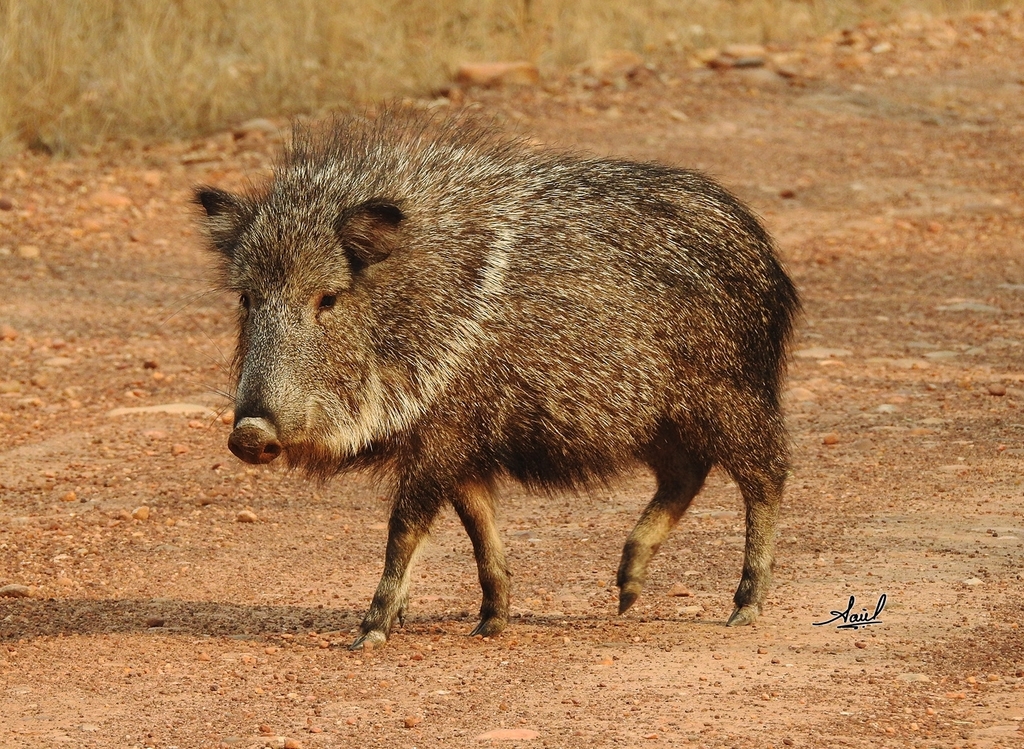
Chacoan Peccary
Catagonus wagneri
The Chacoan peccary or tagua (Catagonus wagneri) is the last extant species of the genus Catagonus; it is a peccary found in the Gran Chaco of Paraguay, Bolivia, and Argentina. Approximately 3,000 remain in the world. It is believed to be the closest living relative to the extinct genus Platygonus.
From the article Chacoan peccary on Wikipedia (CC BY-SA), quoted section by section
Range & habitat
The Chacoan peccary is confined to hot, dry areas. Dominated by low-lying succulents and thorny bushes, the Gran Chaco is about 140,000 km2 (54,000 sq mi). A few scattered giant trees are found, but the majority of the vegetation is thorny scrub vegetation. The Chacoan peccary has developed adaptations such as well-developed sinuses to combat dry, dusty conditions. Their feet are also small, which allows maneuverability among spiny plants.
Wikipedia: “Habitat”
What it does
Young are generally born between September and December, but litters have been found almost year-round. Births have been linked to periods of food abundance and rainfall. The average number of embryos has been recorded as approximately 2.72. Females may leave the herd to give birth and then return afterwards. Newborns are precocial, able to run a few hours after birth. The pelage of the young resembles that of the adults. There is no sexual dimorphism.
Wikipedia: “Reproduction”
At the table
The arid habitat of the Gran Chaco region provides very tough vegetation for the Chacoan peccary. These peccaries feed on various species of cacti, such as Cleistocactus baumannii and Opuntia discolor. It uses its tough snout to roll the cacti on the ground, rubbing the spines off. It may pull off the spines with its teeth and spit them out. The kidneys are specialized to break down acids from the cacti. The two-chambered stomachs are also well suited to digest tough foods. Occasionally grazing on bromeliad roots, it also eats acacia pods and fallen cactus flowers. This species of peccary seeks out salt licks formed from ant mounds and construction projects (road building and land clearings). The Chacoan peccary gains essential minerals like calcium, magnesium, and chlorine from the salt licks.
Wikipedia: “Food habits”
In human culture
The Chacoan peccary was first described in 1930 based on fossils and was originally thought to be an extinct species. In 1971, the animal was discovered to still be extant in the Argentine province of Salta. The species was well-known to the local people, but it took a while for Western scientists to acknowledge its existence. Because it was originally described as extinct before its rediscovery, it is an example of a Lazarus taxon.
Wikipedia: “History”
Listen
Looking for field recordings…
Where it lives
Recorded sightings
—
geo-referenced records in GBIF, from museums, herbaria and field observers.
Drag the globe to turn it. Dots are where records exist, not a range map; darker means more records.
In the stacks
Searching the stacks…
Every page naming Catagonus wagneri in the Biodiversity Heritage Library →
This page is assembled live from iNaturalist, GBIF, Wikipedia, the Source Library and the Internet Archive. It is not yet part of the hand-edited codex. iNaturalist taxon 42117.