- Animals
- ›Chordates
- ›Vertebrates
- ›Mammals
- ›Therians
- ›Placental Mammals
- ›Ungulates, Carnivorans, and Allies
- ›Even-toed Ungulates and Cetaceans
- ›Suids and Peccaries
- ›Suids
- ›Suines
- ›Warthogs
- ›Phacochoerus
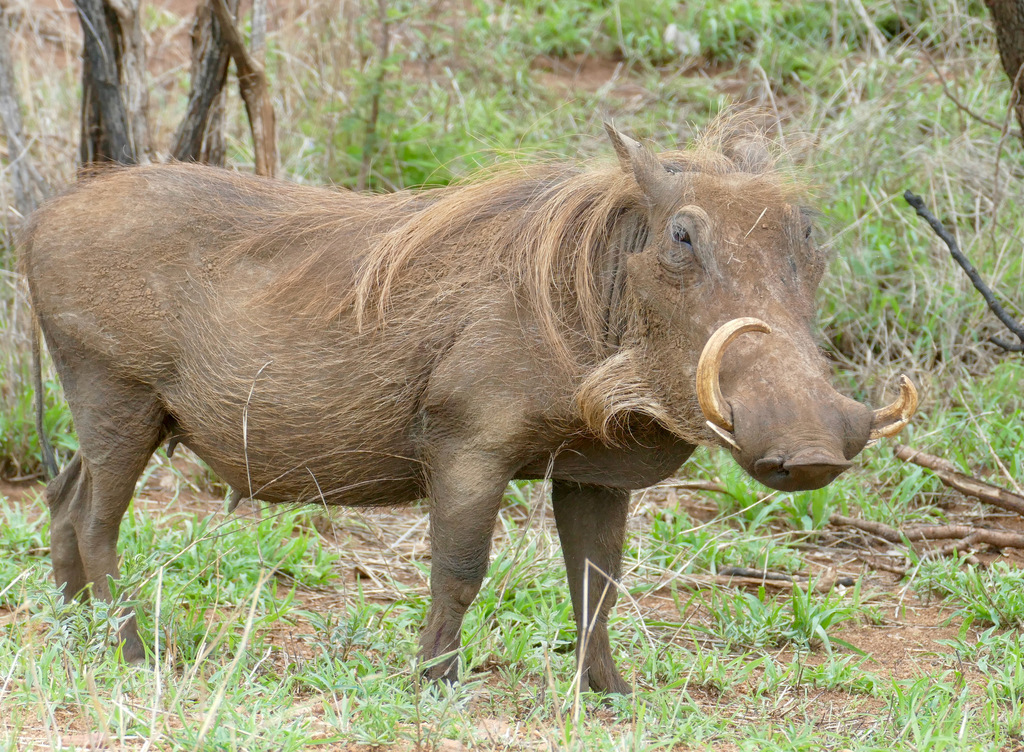
Common Warthog
Phacochoerus africanus
The common warthog (Phacochoerus africanus) is a wild member of the pig family (Suidae) found in grassland, savanna, and woodland in sub-Saharan Africa. In the past, it was commonly treated as a subspecies of P. aethiopicus, but today that scientific name is restricted to the desert warthog of northern Kenya, Somalia, and eastern Ethiopia.
From the article Common warthog on Wikipedia (CC BY-SA), quoted section by section
Description
The common warthog is a medium-sized species, with a head-and-body length ranging from 0.9 to 1.5 m (2 ft 11 in to 4 ft 11 in), and shoulder height from 63.5 to 85 cm (25.0 to 33.5 in). Females, at 45 to 75 kg (99 to 165 lb), are smaller and lighter than males, at 60 to 150 kg (130 to 330 lb). A warthog is identifiable by the two pairs of tusks protruding from the mouth and curving upwards. The lower pair, which is far shorter than the upper pair, becomes razor-sharp by rubbing against the upper pair every time the mouth is opened and closed. The upper canine teeth can grow to 25.5 cm (10.0 in) long and have a wide elliptical cross section, being about 4.5 cm (1.8 in) deep and 2.5 cm (0.98 in) wide. A tusk will curve 90° or more from the root, and will not lie flat on a table, as it curves somewhat backwards as it grows. The tusks are not used for digging, but are used for combat with other hogs and in defense against predators – the lower set can inflict severe wounds. Common warthog ivory is taken from the constantly growing canine teeth. The tusks, particularly the upper set, work in much the same way as elephant tusks with all designs scaled down. Tusks are carved predominantly for the tourist trade in eastern and southern Africa. The head of the common warthog is large, with a mane down the spine to the middle of the back. Sparse hair covers the body. …
What it does
The common warthog is the only pig species that has adapted to grazing and savanna habitats. Its diet is omnivorous, composed of grasses, roots, berries and other fruits, bark, fungi, dung, insects, eggs and carrion. The diet is seasonably variable, depending on availability of different food items. During the wet seasons, warthogs graze on short perennial grasses. During the dry seasons, they subsist on bulbs, rhizomes, and nutritious roots. Warthogs are powerful diggers, using both their snouts and feet. When feeding, they often bend their front feet backwards and move around on the wrists. Calloused pads that protect the wrists during such movement form early in the development of the fetus. Although they can dig their own burrows, they often occupy abandoned burrows of aardvarks and other animals. The common warthog commonly reverses into burrows, with its head facing the opening and ready to burst out if necessary. Common warthogs will wallow in mud to cope with high temperatures and huddle together to cope with low temperatures. Although capable of fighting (males fight each other during mating season), the common warthog's primary defense is to flee by means of fast sprinting. When threatened, warthogs can run at speeds of up to 48 km/h (30 mph), they will run with their tails sticking up and will enter their dens rear first with tusks facing out. …
Wikipedia: “Ecology”
Listen
Looking for field recordings…
Where it lives
Recorded sightings
—
geo-referenced records in GBIF, from museums, herbaria and field observers.
Drag the globe to turn it. Dots are where records exist, not a range map; darker means more records.
In the stacks
Searching the stacks…
Every page naming Phacochoerus africanus in the Biodiversity Heritage Library →
This page is assembled live from iNaturalist, GBIF, Wikipedia, the Source Library and the Internet Archive. It is not yet part of the hand-edited codex. iNaturalist taxon 42122.