- Animals
- ›Chordates
- ›Vertebrates
- ›Mammals
- ›Therians
- ›Placental Mammals
- ›Ungulates, Carnivorans, and Allies
- ›Even-toed Ungulates and Cetaceans
- ›Suids and Peccaries
- ›Suids
- ›Suines
- ›Typical Pigs
- ›Sus
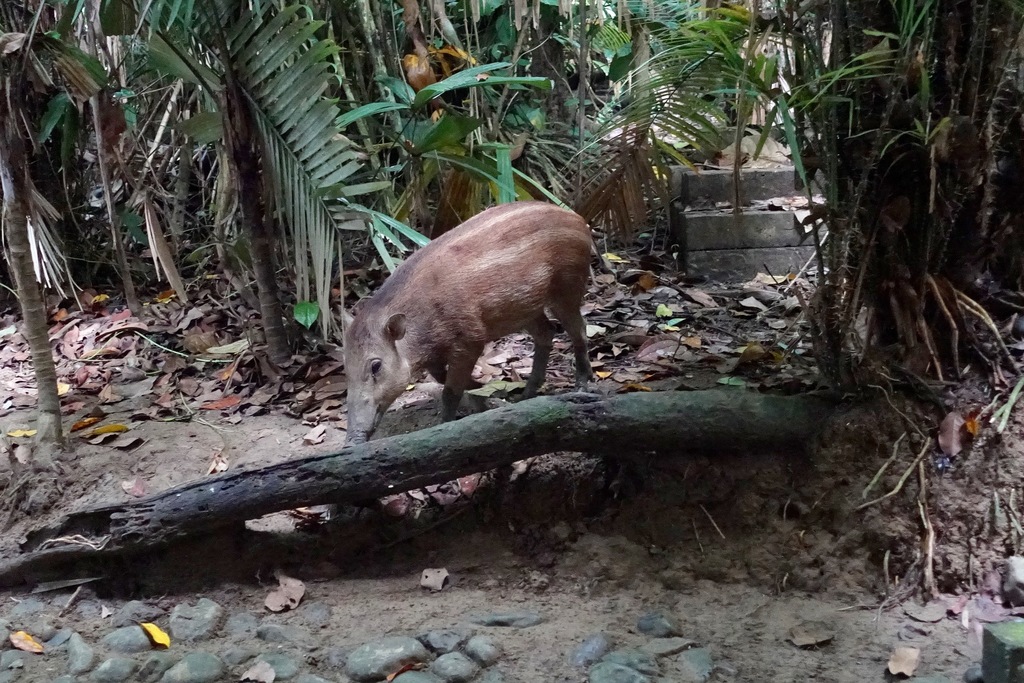
Sulawesi Warty Pig
Sus celebensis
The Celebes warty pig (Sus celebensis), also called Sulawesi warty pig or Sulawesi pig, is a species in the pig genus (Sus) that lives on Sulawesi in Indonesia. It survives in most habitats and can live in altitudes of up to 2,500 m (8,000 ft). It has been domesticated and introduced to a number of other islands in Indonesia.
From the article Celebes warty pig on Wikipedia (CC BY-SA), quoted section by section
Description
The Celebes warty pig is a medium-sized pig, and quite variable in size and appearance. Although a number of subspecies have been recognised, it is now regarded as a monotypic taxon. It is the only pig species that has been domesticated apart from the wild boar; being semi-domesticated may have had an influence on the variability of its appearance. This pig has a head-and-body length of between 80 and 130 cm (30 and 50 in) and a long tail, with males generally being larger than females. The back is rounded and the legs short. The colour is greyish-black, sometimes tinged with red or yellow on the flanks. There are three pairs of facial warts and a fringe of pale bristles on the snout and more bristles on the cheeks. The crown and nape are topped by a short crest of dark bristles, while a dark mid-dorsal stripe extends from the crest towards the tufted tail. Young pigs have longitudinal stripes, but these fade as the piglets grow.
Range & habitat
The Celebes warty pig occurs in Sulawesi, being plentiful in central, eastern and south-eastern parts of the island but uncommon in the northeastern and southern parts. It also occurs naturally on the nearby smaller islands of Buton, Muna, Kabeana, Peleng, Lembeh and the Togian Islands. Besides this, it has been domesticated and introduced to various other islands, has hybridised with Sus scrofa, and has become feral in some places, giving rise to a number of different pig populations. It inhabits various habitat types including rainforest, swamp, cultivated land and grassland, at altitudes up to 2,500 m (8,000 ft).
Wikipedia: “Distribution and habitat”
What it does
This pig tends to move around in small groups of up to nine individuals, led by a dominant male and including several females and their offspring. Foraging takes place mainly in the early morning and the evening; the diet consists mainly of roots, shoots, leaves and fallen fruit, but also includes carrion, invertebrates and small vertebrates. Breeding takes place throughout the year. Gestation periods are probably between four and five months, and litter sizes can be up to eight, but in one study, averaged about two. Young may be eaten by reticulated pythons or saltwater crocodiles.
Wikipedia: “Ecology”
Listen
Looking for field recordings…
Where it lives
Recorded sightings
—
geo-referenced records in GBIF, from museums, herbaria and field observers.
Drag the globe to turn it. Dots are where records exist, not a range map; darker means more records.
In the stacks
Searching the stacks…
Every page naming Sus celebensis in the Biodiversity Heritage Library →
This page is assembled live from iNaturalist, GBIF, Wikipedia, the Source Library and the Internet Archive. It is not yet part of the hand-edited codex. iNaturalist taxon 42128.