- Animals
- ›Chordates
- ›Vertebrates
- ›Mammals
- ›Therians
- ›Placental Mammals
- ›Ungulates, Carnivorans, and Allies
- ›Even-toed Ungulates and Cetaceans
- ›Ruminants
- ›Deer
- ›Plesiometacarpal Deer
- ›Typical Old World Deer
- ›Axis
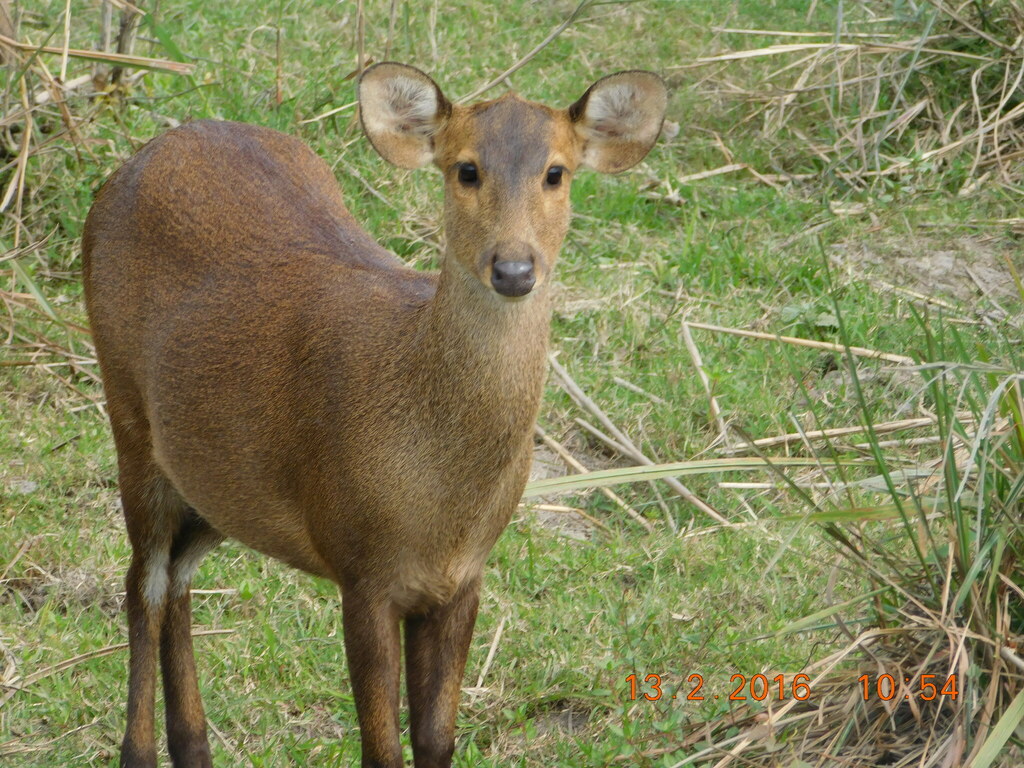
Indochinese Hog Deer
Axis porcinus
The Indian hog deer (Axis porcinus), or Indochinese hog deer, is a small cervid native to the region of the Indian subcontinent and Indo-Gangetic Plain. Introduced populations are established in Australia, as well as the United States and Sri Lanka.
Its name derives from the hog-like manner in which it runs through forests (with its head hung low), to ease ducking under obstacles instead of leaping over them, like most other deer.
From the article Indian hog deer on Wikipedia (CC BY-SA), quoted section by section
Description
A mature hog deer stag stands about 70 centimetres (28 in) at the shoulder, and weighs approximately 50 kilograms (110 lb); hinds are much smaller, standing about 61 centimetres (24 in) and weighing around 30 kilograms (66 lb). They are very solidly built, with a long body and relatively short legs; the line of the back slopes upward from the shoulders to a high rump. The ears are rounded; older animals tend to become light coloured in the face and neck. The Indian hog deer's coat is quite thick, and generally a uniform dark-brown in winter, except for the underparts of the body and legs, which are lighter in colour. During late spring, the change to a summer coat of rich reddish-brown commences, although this may vary between individuals. Many hog deer show a dark dorsal stripe extending from the head down the back of the neck, and along the spine. In summer, there is usually a uniform row of light-coloured spots along either side of the dorsal stripe from the shoulders to the rump. The tail is fairly short and brown, but tipped with white. The underside of the tail is white, and the deer can fan the white hairs out in a distinctive alarm display.
The antlers of a mature hog deer stag are typically three tined, having a brow tine and a solid main beam terminating in inner and outer top tines. However, antlers with more points are not uncommon.
Range & habitat
The Indian hog deer occurs in the Indus River valley in Pakistan, in northern India, Nepal, southern Bhutan, Bangladesh, Myanmar China's Yunnan Province. It has been reintroduced to Thailand but is locally extinct in Laos and Vietnam. A small, isolated population lives in Cambodia's Prek Prasab Wildlife Sanctuary.
Wikipedia: “Distribution and habitat”
What it does
The tiger, leopard and clouded leopard are known predators of the Indian hog deer. Other known predators include the Burmese python and dhole.
Wikipedia: “Behaviour and ecology”
Listen
Looking for field recordings…
Where it lives
Recorded sightings
—
geo-referenced records in GBIF, from museums, herbaria and field observers.
Drag the globe to turn it. Dots are where records exist, not a range map; darker means more records.
In the stacks
Searching the stacks…
Every page naming Axis porcinus in the Biodiversity Heritage Library →
This page is assembled live from iNaturalist, GBIF, Wikipedia, the Source Library and the Internet Archive. It is not yet part of the hand-edited codex. iNaturalist taxon 42165.