- Animals
- ›Chordates
- ›Vertebrates
- ›Mammals
- ›Therians
- ›Placental Mammals
- ›Ungulates, Carnivorans, and Allies
- ›Even-toed Ungulates and Cetaceans
- ›Ruminants
- ›Deer
- ›Plesiometacarpal Deer
- ›Typical Old World Deer
- ›Axis
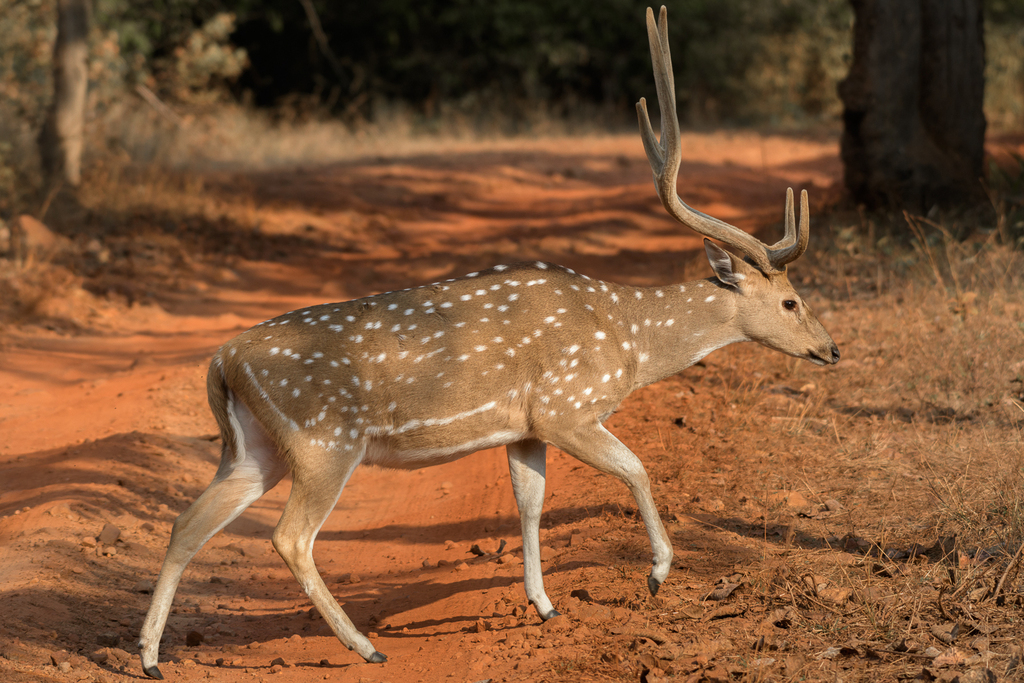
Chital
Axis axis
The chital (Axis axis; ), also called spotted deer and axis deer, is a deer species native to the Indian subcontinent. It was first described by Johann Christian Polycarp Erxleben in 1777. A moderate-sized deer, male chital reach 90 cm (35 in) and females 70 cm (28 in) at the shoulder. While males weigh 70–90 kg (150–200 lb), females weigh around 40–60 kg (88–132 lb). It is sexually dimorphic; males are larger than females, and antlers are present only on males. The upper parts are golden to rufous, completely covered in white spots. The abdomen, rump, throat, insides of legs, ears, and tail are all white. The antlers, three-pronged, are nearly 1 m (3 ft 3 in) long.
From the article Chital on Wikipedia (CC BY-SA), quoted section by section
Description
The chital is a moderately sized deer. Males reach up to 90–100 cm (35–39 in) and females 65–75 cm (26–30 in) at the shoulder; the head-and-body length is around 1.7 m (5 ft 7 in). While immature males weigh 30–75 kg (66–165 lb), the lighter females weigh 25–45 kg (55–99 lb). Mature stags can weigh up to 98–110 kg (216–243 lb). The tail, 20 cm (7.9 in) long, is marked by a dark stripe that stretches along its length. The species is sexually dimorphic; males are larger than females, and antlers are present only on males.The dorsal (upper) parts are golden to rufous, completely covered in white spots. The abdomen, rump, throat, insides of legs, ears, and tail are all white. A conspicuous black stripe runs along the spine (back bone). The chital has well-developed preorbital glands (near the eyes) with stiff hairs. It also has well-developed metatarsal glands and pedal glands located in its hind legs. The preorbital glands, larger in males than in females, are frequently opened in response to certain stimuli.
Each of the antlers has three lines on it. The brow tine (the first division in the antler) is roughly perpendicular to the beam (the central stalk of the antler). The antlers, three-pronged, are nearly 1 m (3 ft 3 in) long. Antlers, as in most other cervids, are shed annually. …
Range & habitat
The chital ranges over 8–30°N in India, Nepal, Bhutan, Bangladesh and Sri Lanka. The western limit of its range is eastern Rajasthan and Gujarat; its northern limit is the Terai and northern West Bengal, Sikkim to western Assam and forested valleys in Bhutan below an elevation of 1,100 m (3,600 ft). It also occurs in the Sundarbans and some eco parks around the Bay of Bengal, but is locally extinct in central and north-eastern Bangladesh. The Andaman and Nicobar Islands and Sri Lanka are the southern limits of its distribution. It inhabits deciduous and semi-evergreen forests and open grasslands throughout the Indian peninsula.
Indonesia. After the British invasion of Java, Stanford Raffles moved into the Buitenzorg Palace and brought chitals from Nepal to graze the lawns. The chital population there is continuously being kept and has increased to the number of hundreds. Some chitals from the palace has also been further introduced to zoos, nature reserves, and private collections across Indonesia to alleviate overpopulation.
Australia. The chital was the first species of deer introduced into Australia in the early 1800s. While some of the stock originated from Sri Lanka, the Indian race likely is also represented.
United States. In the 1860s, chital were introduced to the island of Molokai, Hawaii, as a gift from Hong Kong to King Kamehameha V. …
Wikipedia: “Distribution and habitat”
What it does
Chital are active throughout the day. In the summer, time is spent in rest under shade, and the sun's glare is avoided if the temperature reaches 80 °F (27 °C); activity peaks as dusk approaches. As days grow cooler, foraging begins before sunrise and peaks by early morning. Activity slows down during midday, when the animals rest or loiter about slowly. Foraging recommences by late afternoon and continues till midnight. They fall asleep a few hours before sunrise, typically in the forest which is cooler than the glades. These deer typically move in a single file on specific tracks, with a distance of two to three times their width between them, when on a journey, typically in search of food and water sources. In Gir National Park, chital travel the most in summer of all seasons. When cautiously inspecting its vicinity, the chital stands motionless and listens with rapt attention, facing the potential danger, if any. This stance may be adopted by nearby individuals, as well. As an antipredator measure, chital flee in groups (unlike the hog deer that disperse on alarm); sprints are often followed by hiding in dense undergrowth. The running chital has its tail raised, exposing the white underparts. The chital can leap and clear fences as high as 1.5 m (4 ft 11 in) but prefers to dive under them. …
Wikipedia: “Behaviour and ecology”
In human culture
The vernacular name "chital" (pronounced ) comes from cītal (Hindi: चीतल), derived from the Sanskrit word citrala (चित्रल), meaning "variegated" or "spotted". The name of the cheetah has a similar origin. Variations of "chital" include "cheetal" and "cheetul". Other common names for the chital are Indian spotted deer (or simply the spotted deer) and axis deer.
Wikipedia: “Etymology”
Listen
Looking for field recordings…
Where it lives
Recorded sightings
—
geo-referenced records in GBIF, from museums, herbaria and field observers.
Drag the globe to turn it. Dots are where records exist, not a range map; darker means more records.
In the stacks
Searching the stacks…
Every page naming Axis axis in the Biodiversity Heritage Library →
This page is assembled live from iNaturalist, GBIF, Wikipedia, the Source Library and the Internet Archive. It is not yet part of the hand-edited codex. iNaturalist taxon 42166.