- Animals
- ›Chordates
- ›Vertebrates
- ›Mammals
- ›Therians
- ›Placental Mammals
- ›Ungulates, Carnivorans, and Allies
- ›Even-toed Ungulates and Cetaceans
- ›Ruminants
- ›Deer
- ›New World Deer
- ›True New World Deer and Caribou
- ›Pudu
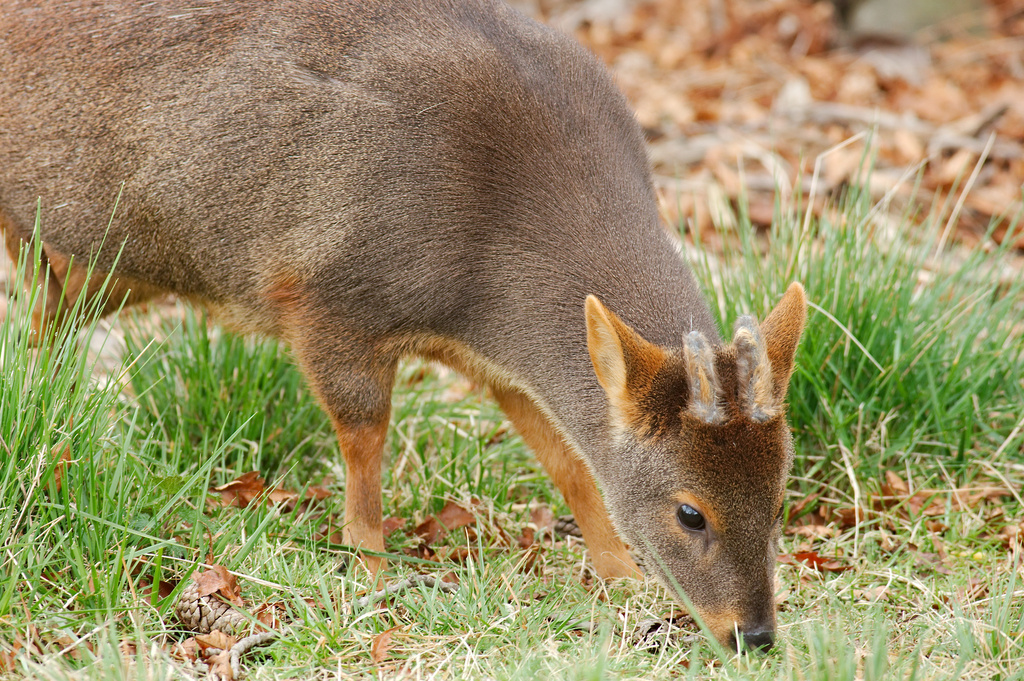
Southern Pudú
Pudu puda
The pudús (Mapudungun püdü or püdu, Spanish: pudú, Spanish pronunciation: ) are two species of South American deer from the genus Pudu, and are the world's smallest deer. The name is a loanword from Mapudungun, the language of the indigenous Mapuche people of central Chile and south-western Argentina. The two species of pudús are the northern pudú (Pudu mephistophiles) from Venezuela, Colombia, Ecuador, and Peru, and the southern pudú (Pudu puda; sometimes incorrectly modified to Pudu pudu)...
From the article Southern pudu on Wikipedia (CC BY-SA), quoted section by section
Description
The southern pudu is characterized by being the third smallest deer in the world. It is slightly larger than its sister species, the northern pudu and Pudella carlae, being 35 to 45 cm (14 to 18 in) tall at the shoulder and weighs 6.4 to 13.4 kg (14 to 30 lb). The antlers of the southern pudu grow to be 5.3 to 9 cm (2.1 to 3.5 in) long and tend to curve back, somewhat like a mountain goat. Its coat is a dark chestnut-brown, and tends to tuft in the front, covering the antlers.
Range & habitat
The southern pudu lives in forests, including both mature and disturbed forests, typically with a dense understory, but it does nevertheless prefer open spaces with rich vegetation for feeding. It is found at lower elevations than its sister species, from sea level to 1,700 m (5,600 ft) elevation. In the Chilean Coast Range the pudu is found in primary and secondary broadleaf evergreen and alerce (Fitzroya cupressoides) forests, and sometimes in Eucalyptus plantations. In the southern Andes of Chile and Argentina it is associated with thickets of bamboo (Chusquea spp.) and Nothofagus dombeyi forests. Foraging by southern pudu is thought to be detrimental for the regeneration of burned forests of Pilgerodendron uviferum.
Wikipedia: “Range and habitat”
Listen
Looking for field recordings…
Where it lives
Recorded sightings
—
geo-referenced records in GBIF, from museums, herbaria and field observers.
Drag the globe to turn it. Dots are where records exist, not a range map; darker means more records.
In the stacks
Searching the stacks…
Every page naming Pudu puda in the Biodiversity Heritage Library →
This page is assembled live from iNaturalist, GBIF, Wikipedia, the Source Library and the Internet Archive. It is not yet part of the hand-edited codex. iNaturalist taxon 42169.