- Animals
- ›Chordates
- ›Vertebrates
- ›Mammals
- ›Therians
- ›Placental Mammals
- ›Ungulates, Carnivorans, and Allies
- ›Even-toed Ungulates and Cetaceans
- ›Ruminants
- ›Deer
- ›New World Deer
- ›Roe and Water Deer
- ›Capreolus
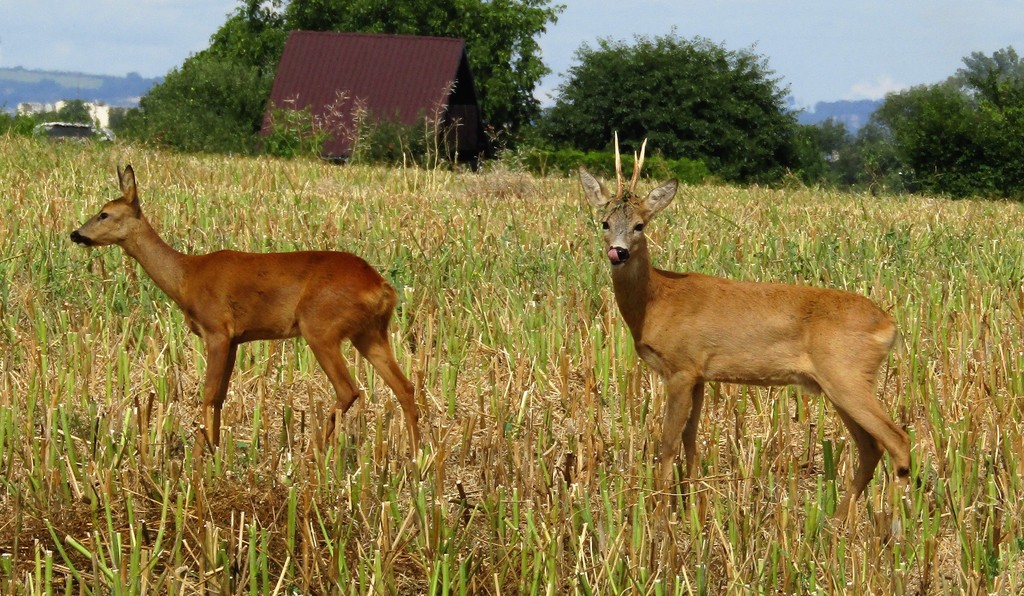
Western Roe Deer
Capreolus capreolus
The European roe deer (Capreolus capreolus), also known as the western roe deer, chevreuil, or simply roe deer or roe, is a Eurasian species of deer. The male of the species is sometimes referred to as a roebuck. The roe deer is relatively small, reddish and grey-brown, and well-adapted to cold environments. The species is widespread in Europe, from the Mediterranean to Scandinavia and from Britain to the Caucasus and east to northern Iran and Iraq....
From the article Roe deer on Wikipedia (CC BY-SA), quoted section by section
Description
The roe deer is a relatively small deer, with a body length of 95–135 cm (3 ft 1 in – 4 ft 5 in) throughout its range, and a shoulder height of 63–67 cm (2 ft 1 in – 2 ft 2 in), and an average weight of 20–25 kg (45–55 lb). In healthy populations, where population density is restricted by hunting or predators, bucks are slightly larger than does. Under other conditions, males can be similar in size to females, or slightly smaller, with weights ranging from 15–35 kg (35–75 lb). Bucks in good conditions develop antlers up to 20–25 cm (8–10 in) long with two or three, rarely even four, points. When the male's antlers begin to regrow, they are covered in a thin layer of velvet-like fur which they shed later on after the hair's blood supply is lost. Males may speed up the process by rubbing their antlers on trees, so that their antlers are hard and stiff for the duels during the mating season. Unlike most cervids, roe deer begin regrowing antlers almost immediately after they are shed. In rare cases, some bucks possess only a single antler branch, the result of a genetic defect.
Range & habitat
The roe deer is found in most areas of Europe, with the exception of northernmost Scandinavia, Iceland, Ireland, and the islands of the Mediterranean Sea. In the Mediterranean region, it is largely confined to mountainous areas, and is absent or rare at low altitudes. There is an early Neolithic fossil record from Jordan.
Belgium. In Flanders the roe deer was mostly confined to the hilly regions in the east, but like in neighbouring countries the population has expanded in recent times. A theory is that the expansion of maize cultivation, which are higher than traditional crops and afford more shelter, has aided their expansion to the west.
Britain. In England and Wales, roe deer have experienced a substantial expansion in their range in the latter half of the 20th century and continuing into the 21st century. This increase in population also appears to be affecting woodland ecosystems. At the start of the 20th century, they were almost extirpated in Southern England, but since then have hugely expanded their range, mostly due to restrictions and decrease in hunting, increases in forests and reductions in arable farming, changes in agriculture (more winter cereal crops), a massive reduction in extensive livestock husbandry, and a general warming climate over the past 200 years. Furthermore, there are no longer any large predators in Britain. …
Wikipedia: “Distribution”
What it does
In order to mitigate risk, roe deer remain within refuge habitats (such as forests) during the day. They are likelier to venture into more open habitats at night and during crepuscular periods when there is less ambient activity. It scrapes leaf litter off the ground to make a 'bed'. When alarmed it will bark a sound much like a dog and flash out its white rump patch. Rump patches differ between the sexes, with the white rump patches heart-shaped on females and kidney-shaped on males. Males may also bark or make a low grunting noise. Does (the females) make a high-pitched "pheep" whine to attract males during the rut (breeding season) in July and August. Initially the female goes looking for a mate and commonly lures the buck back into her territory before mating. The roe deer is territorial, and while the territories of a male and a female might overlap, other roe deer of the same sex are excluded unless they are the doe's offspring of that year.
Wikipedia: “Behaviour”
At the table
The roe deer is a game animal of great economic value in Europe, providing large amounts of meat and generating substantial revenues from in sport hunting activity. In 1998, some 2,500,000 roe deer were shot in western Europe. In Germany during the 1990s, 700,000 were taken per year. As this is insufficient to slow its population growth, the roe deer continues to increase in number. It is the main source of venison in Europe. The meat, like most game meat, is darker in colour than that of most farm-raised deer.
Wikipedia: “Uses”
In human culture
The English roe is from the Old English rā or rāha, from Proto-Germanic *raihô, cognate with Old Norse rá, Old Saxon rēho, Middle Dutch and Dutch ree, Old High German rēh, rēho, rēia, German Reh. It is perhaps ultimately derived from a PIE root *rei-, meaning "streaked, spotted or striped". The word is attested on the 5th-century Caistor-by-Norwich astragalus – a roe deer talus bone, written in Elder Futhark as ᚱᚨᛇᚺᚨᚾ, transliterated as raïhan. In the English language, this deer was originally simply called a 'roe', but over time the word 'roe' has become a qualifier, and it is now usually called 'roe deer'. The Koiné Greek name πύγαργος, transliterated pygargos, mentioned in the Septuagint and the works of various writers such as Hesychius, Herodotus and later Pliny, was originally thought to refer to this species (in many European translations of the Bible), although it is now more often believed to refer to the addax. It is derived from the words pyge (buttocks) and argo (white). The taxonomic name Capreolus is derived from capra or caprea, meaning 'billy goat', with the diminutive suffix -olus. The meaning of this word in Latin is not entirely clear: it may have meant 'ibex' or 'chamois'. The roe was also known as capraginus or capruginus in Latin.
Wikipedia: “Etymology”
Listen
Looking for field recordings…
Where it lives
Recorded sightings
—
geo-referenced records in GBIF, from museums, herbaria and field observers.
Drag the globe to turn it. Dots are where records exist, not a range map; darker means more records.
In the stacks
Searching the stacks…
Every page naming Capreolus capreolus in the Biodiversity Heritage Library →
This page is assembled live from iNaturalist, GBIF, Wikipedia, the Source Library and the Internet Archive. It is not yet part of the hand-edited codex. iNaturalist taxon 42184.