- Animals
- ›Chordates
- ›Vertebrates
- ›Mammals
- ›Therians
- ›Placental Mammals
- ›Ungulates, Carnivorans, and Allies
- ›Even-toed Ungulates and Cetaceans
- ›Tylopodans
- ›Camelids
- ›Camelines
- ›New World Camelids
- ›Lama
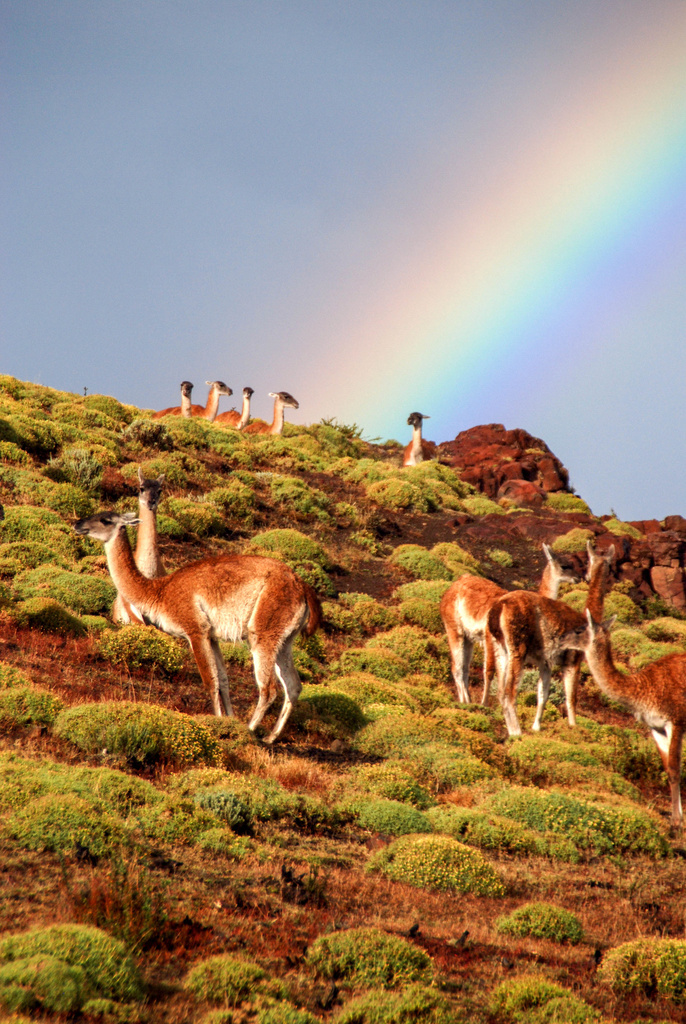
Guanaco
Lama guanicoe
The guanaco (Lama guanicoe), a camelid native to South America, stands between 1.0 and 1.2 m (3 ft 3 in and 3 ft 11 in) at the shoulder and weighs 90 to 140 kg (200 to 310 lb). Its color varies very little (unlike the domestic llama), ranging from a light brown to dark cinnamon and shading to white underneath. Guanacos have grey faces and small, straight ears.
From the article Guanaco on Wikipedia (CC BY-SA), quoted section by section
Description
Guanacos stand between 1.0 and 1.3 m (3 ft 3 in and 4 ft 3 in) at the shoulder, body length of 2.1 to 2.2 m (6 ft 11 in to 7 ft 3 in), and weigh 90 to 140 kg (200 to 310 lb). Their color varies very little (unlike the domestic llama), ranging from a light brown to dark cinnamon and shading to white underneath. Guanacos have grey faces and small, straight ears. The lifespan of a guanaco can be as long as 28 years. Guanacos are one of the largest terrestrial mammals native to South America today. Other terrestrial mammalian megafauna weighing as much or more than the guanaco include the tapirs, the marsh deer, the white-tailed deer, the spectacled bear, and the jaguar. Guanacos have thick skin on their necks, a trait also found in their domestic counterparts, the llama, and their relatives, the wild vicuña and domesticated alpaca. This protects their necks from predator attacks. Bolivians use the neck skin of these animals to make shoes, flattening and pounding the skin to be used for the soles. In Chile, hunting is allowed only in Tierra del Fuego, where the only population not classified as endangered in the country resides. Between 2007 and 2012, 13,200 guanacos were legally hunted in Tierra del Fuego.
Diet. Like camels, guanacos are herbivores, grazing on grasses, shrubs, herbs, lichens, fungi, cacti, and flowers. …
Wikipedia: “Characteristics”
Range & habitat
Guanacos inhabit the steppes, scrublands and mountainous regions of South America. They are found in the altiplano of Peru, Bolivia and Chile, and in Patagonia, with a small population in Paraguay. In Argentina they are more numerous in Patagonian regions, as well as in places such as Isla Grande de Tierra del Fuego. In these areas, they have more robust populations, since grazing competition from livestock is limited. Guanaco respond to forage availability, occupying zones with low to intermediate food availability in the breeding season and those with the highest availability in the non-breeding season. Estimates, as of 2016, place their numbers around 1.5 to 2 million animals: 1,225,000–1,890,000 in Argentina, 270,000–299,000 in Chile, 3,000 in Peru, 150–200 in Bolivia and 20–100 in Paraguay. This is only 3–7% of the guanaco population before the arrival of the Spanish conquistadors in South America. A small population introduced by John Hamilton exists on Staats Island in the Falkland Islands (Malvinas), with a population of around 400 as of 2003. In Torres del Paine National Park, the numbers of guanacos increased from 175 in 1975 to 3,000 in 1993. Guanacos live in herds composed of females, their young, and a dominant male. Bachelor males form separate herds. …
Wikipedia: “Population and distribution”
What it does
The guanaco is a diurnal animal. It lives in small herds consisting of one male and several females with their young. When the male detects danger, he warns the group by bleating. The guanaco can run up to 64 km/h (40 mph; 18 m/s). This speed is important for the survival of guanacos because they cannot easily hide in the open grasslands of the Altiplano. Natural predators of the guanaco include pumas and the culpeo or Andean fox. Fox predation was unknown until 2007 when predators began to be observed in the Karukinka Reserve in Tierra del Fuego. Scientists attribute this to the unfavourable climatic conditions on the island, which are causing food to become scarce, weakening the animals. The absence of pumas on Tierra del Fuego is also believed to be a factor that allows the fox to occupy their ecological niche. Finally, it is believed that this behaviour is not new, as the fox is nocturnal, which makes any predation challenging to observe. Faced with the threat of the fox, guanacos resort to cooperative strategies to protect their young with a shield formation, a circle around the vulnerable. If they are successful, they chase the fox away, which would be impossible with a puma. When threatened, the guanaco alerts the rest of the herd with a high-pitched bleating sound, which sounds similar to a short, sharp laugh. The male usually runs behind the herd to defend them. …
Wikipedia: “Ecology”
In human culture
The guanaco gets its name from the Quechua word wanaku. Young guanacos are called chulengos or "guanaquitos".
Wikipedia: “Etymology”
Listen
Looking for field recordings…
Where it lives
Recorded sightings
—
geo-referenced records in GBIF, from museums, herbaria and field observers.
Drag the globe to turn it. Dots are where records exist, not a range map; darker means more records.
In the stacks
Searching the stacks…
Every page naming Lama guanicoe in the Biodiversity Heritage Library →
This page is assembled live from iNaturalist, GBIF, Wikipedia, the Source Library and the Internet Archive. It is not yet part of the hand-edited codex. iNaturalist taxon 42240.