- Animals
- ›Chordates
- ›Vertebrates
- ›Mammals
- ›Therians
- ›Placental Mammals
- ›Ungulates, Carnivorans, and Allies
- ›Even-toed Ungulates and Cetaceans
- ›Ruminants
- ›Bovids
- ›Antelopes, Goats, and Sheep
- ›Typical Antelopes
- ›Gazella
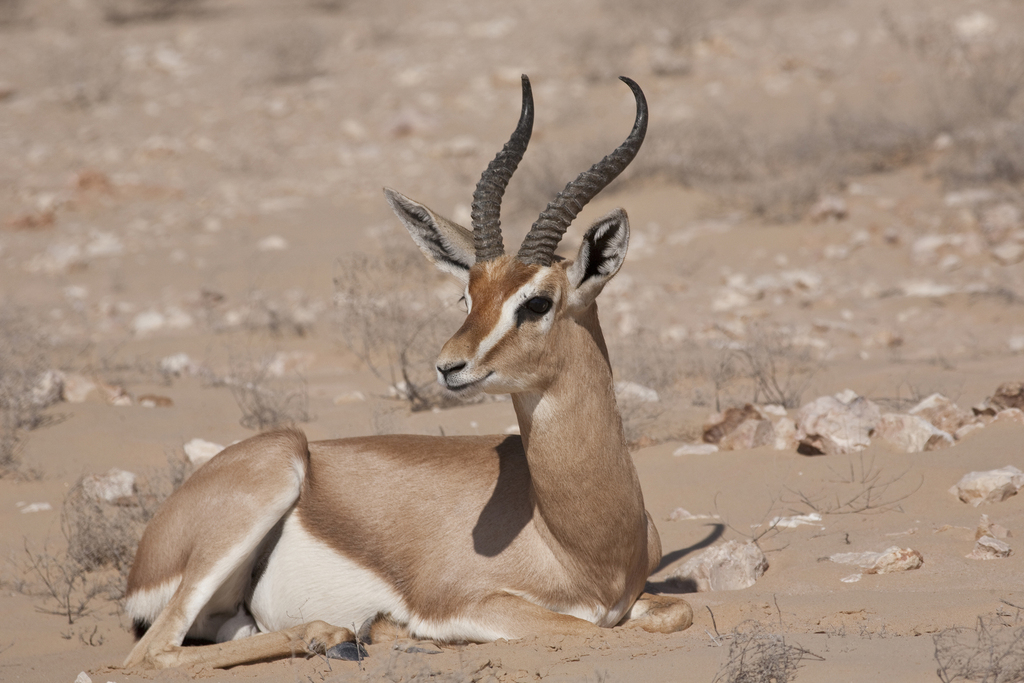
Arabian Gazelle
Gazella arabica
The Arabian gazelle (Gazella arabica) is a species of gazelle known from the Arabian Peninsula. Until recently, it was only known from a single lectotype specimen mistakenly thought to have been collected on the Farasan Islands in the Red Sea in 1825. A 2013 genetic study of the lectotype specimen revealed that skull and skin do not stem from the same individual but belong to two distinct lineages of the mountain gazelle (Gazella gazella), necessitating restriction...
From the article Arabian gazelle on Wikipedia (CC BY-SA), quoted section by section
What it does
The Arabian gazelle lives in grassland, shrubland, and desert habitat types. They predominantly feed on the leaves, flowers, and fruits of acacia trees (Genus Vachellia) and other trees and shrubs. Arabian gazelles are selective browsers, preferring woody plants over grasses. They predominantly feed on all fours, but may rear up on their hind legs to access higher food. They share their habitat with many other herbivores, including Dorcas gazelles (Gazella dorcas), mountain gazelles (Gazella gazella), Nubian ibex (Capra nubiana), Asiatic wild ass (Equus hemionus), and Arabian oryx (Oryx leucoryx). Their main predators are Arabian wolves (Canis lupus arabs). Arabian gazelles are crepuscular, most active in the early morning and evening when temperatures are cooler. In the heat of midday, they rest to chew their cud. They have been found with antibodies to the parasite toxoplasmosis (Toxoplasma gondii). They contract gastrointestinal diseases including clostridiosis and salmonellosis, as well as chronic renal fibrosis.
Wikipedia: “Ecology”
Listen
Looking for field recordings…
Where it lives
Recorded sightings
—
geo-referenced records in GBIF, from museums, herbaria and field observers.
Drag the globe to turn it. Dots are where records exist, not a range map; darker means more records.
In the stacks
Searching the stacks…
Every page naming Gazella arabica in the Biodiversity Heritage Library →
This page is assembled live from iNaturalist, GBIF, Wikipedia, the Source Library and the Internet Archive. It is not yet part of the hand-edited codex. iNaturalist taxon 42255.